
We read your photo as:
Biodegradable wastes are substances that will decay quickly. Which list contains only non-biodegradable wastes?
Biology
ScanSolve AI Answer
Answer
Step-by-step solution
4 stepsUnderstand the definition of biodegradable and non-biodegradable wastes.
The question states that "Biodegradable wastes are substances that will decay quickly." Therefore, non-biodegradable wastes are substances that do not decay quickly or take a very long time to decay.
Evaluate each option to identify items that are non-biodegradable.
- Biodegradable items include organic matter like food scraps, leaves, betel nut husks, coconut husks, and betel nut spittle, as these are natural materials that decompose relatively quickly.
- Non-biodegradable items include man-made materials like plastic, tins, metal scraps, and bottles (typically glass or plastic).
Check each list to find the one containing only non-biodegradable wastes.
- A. Plastic, tins, metal scraps: All three items (plastic, metal tins, metal scraps) are non-biodegradable.
- B. Food scraps, plastics, betel nut husks: Food scraps and betel nut husks are biodegradable. Plastics are non-biodegradable. This list is incorrect.
- C. Betel nut spittle, bottles, plastics: Betel nut spittle is biodegradable. Bottles and plastics are non-biodegradable. This list is incorrect.
- D. Leaves, betel nut husks, coconut husks: All three items (leaves, betel nut husks, coconut husks) are biodegradable. This list is incorrect.
Conclude the correct option.
Option A is the only list that contains exclusively non-biodegradable wastes.
The final answer is
Was this helpful?
Try one yourself
A new problem that tests the same skill.
Still stuck on this one?
Ask a follow-up, and the answer starts from this question.
Got a different question?Ask your own question
More Biology Questions
QFor Item 2, part a), classify the following materials as biodegradable or non-biodegradable…QWhich substance will not be returned to the ecosystem and recycled?QList three (3) types of synthetic biodegradable plastics and one (1) microorganism capable of their…QWhat are the correct classifications and disposal methods for various types of medical waste…QList 5 examples of living things and 5 examples of non-living things.
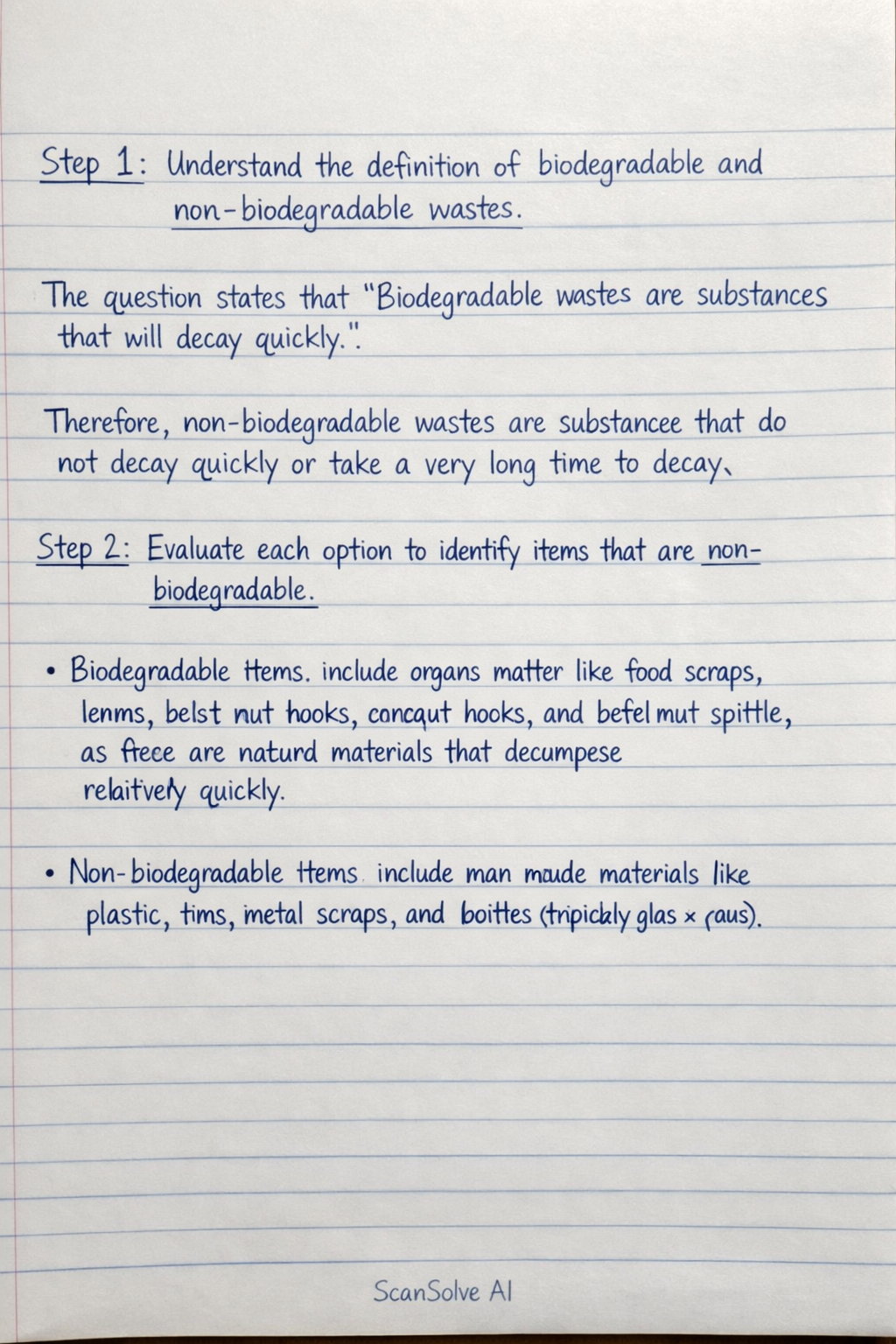
Handwritten Step-by-Step Solution
Get this as a handwritten image on WhatsApp — like a tutor wrote it for you.
Try on WhatsApp