
We read your photo as:
Explain biological classification, dichotomous keys, and prokaryotes. Differentiate between Archaebacteria and Eubacteria, and vascular and non-vascular plants.
ScanSolve AI Answer
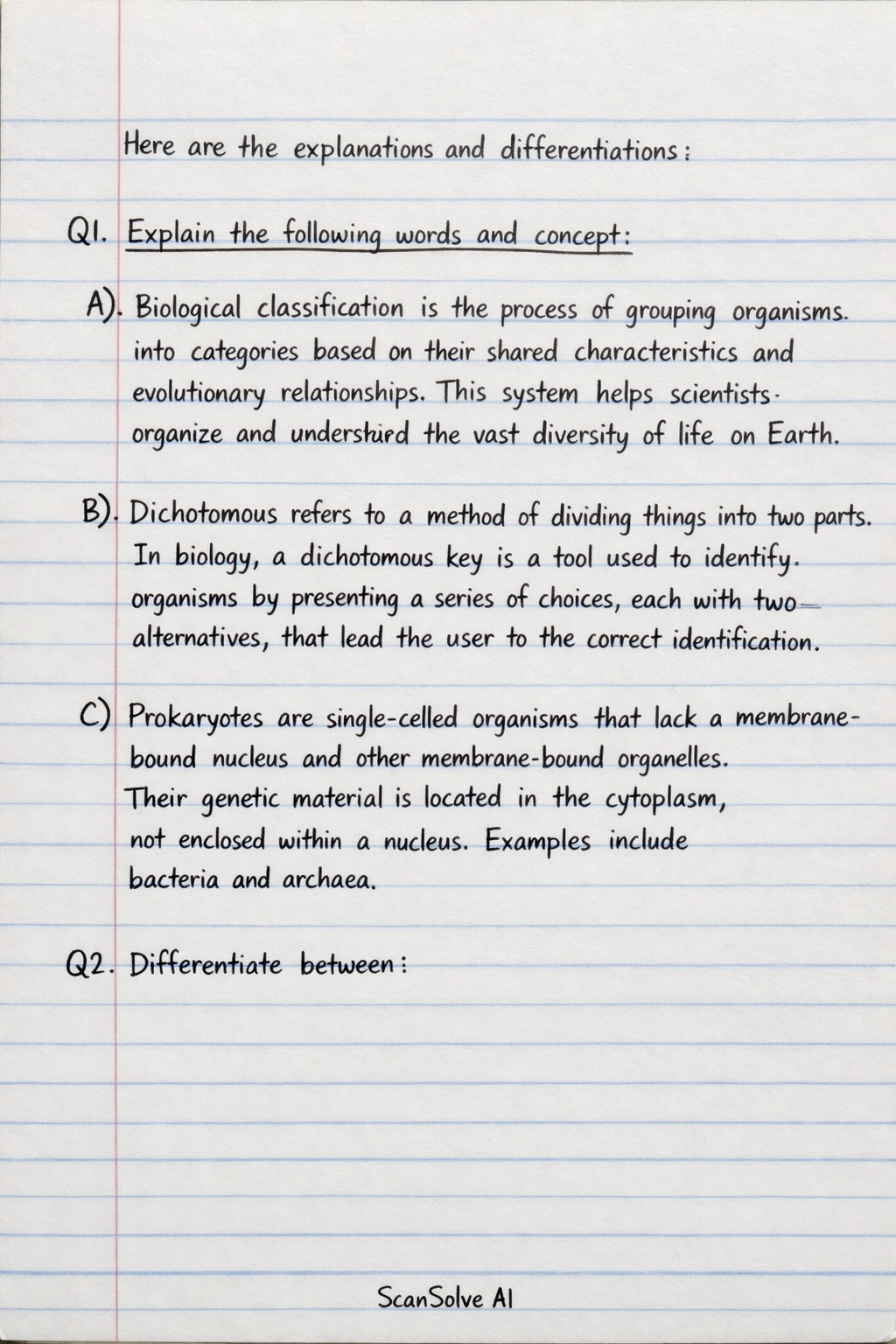
Here are the explanations and differentiations:
Q1. Explain the following words and concept.
A) Biological classification is the process of grouping organisms into categories based on their shared characteristics and evolutionary relationships. This system helps scientists organize and understand the vast diversity of life on Earth.
B) Dichotomous refers to a method of dividing things into two parts. In biology, a dichotomous key is a tool used to identify organisms by presenting a series of choices, each with two alternatives, that lead the user to the correct identification.
C) Prokaryotes are single-celled organisms that lack a membrane-bound nucleus and other membrane-bound organelles. Their genetic material is located in the cytoplasm, not enclosed within a nucleus. Examples include bacteria and archaea.
Q2. Differentiate between:
I) Archaebacteria and Eubacteria:
- Archaebacteria (Archaea) are a group of ancient, single-celled microorganisms that often live in extreme environments (e.g., hot springs, salt lakes) and have unique cell wall compositions that lack peptidoglycan.
- Eubacteria (Bacteria) are true bacteria, found almost everywhere, and their cell walls typically contain peptidoglycan. They include common bacteria like E. coli.
II) Vascular and non-vascular plants:
- Vascular plants possess specialized tissues (xylem and phloem) for transporting water, nutrients, and sugars throughout the plant body. Examples include trees and ferns.
- Non-vascular plants lack these specialized transport tissues and absorb water and nutrients directly through their surfaces. Examples include mosses and liverworts.
III) Angiosperm and gymnosperm:
- Angiosperms are flowering plants that produce seeds enclosed within a fruit. They are the most diverse group of plants.
- Gymnosperms are non-flowering plants that produce "naked" seeds, typically in cones, not enclosed within a fruit. Examples include conifers like pine trees.
IV) Living and Non-living things:
- Living things exhibit characteristics of life, such as growth, reproduction, metabolism, response to stimuli, and cellular organization.
- Non-living things do not possess these characteristics and are inanimate objects, even if they can move or change (e.g., a rock, water).
V) Vertebrates and Invertebrates:
- Vertebrates are animals that possess a backbone or spinal column, which is part of their internal skeleton. Examples include fish, birds, and mammals.
- Invertebrates are animals that lack a backbone. They make up the vast majority of animal species. Examples include insects, worms, and jellyfish.
Q3. Complete the table.
| No. | Kingdoms | Example I | Example II |
|---|---|---|---|
| 1 | Bacteria (Archebacteri/ Eubacteria) | E. coli | Methanogens |
| 2 | Protist | Amoeba | Paramecium |
| 3 | Fungi | Fungi (e.g., Mushroom) | Yeast |
| 4 | Animalia | Human | Pigs |
| 5 | Plantae | Tree | Fern |
Still stuck on this one?
Ask a follow-up, and the answer starts from this question.
More Biology Questions
Handwritten Step-by-Step Solution
Get this as a handwritten image on WhatsApp — like a tutor wrote it for you.
Try on WhatsApp