
We read your photo as:
Describe the biological details, classification, habitat, and adaptive features of millipedes, prawns, crabs, and snails.
Biology
ScanSolve AI Answer
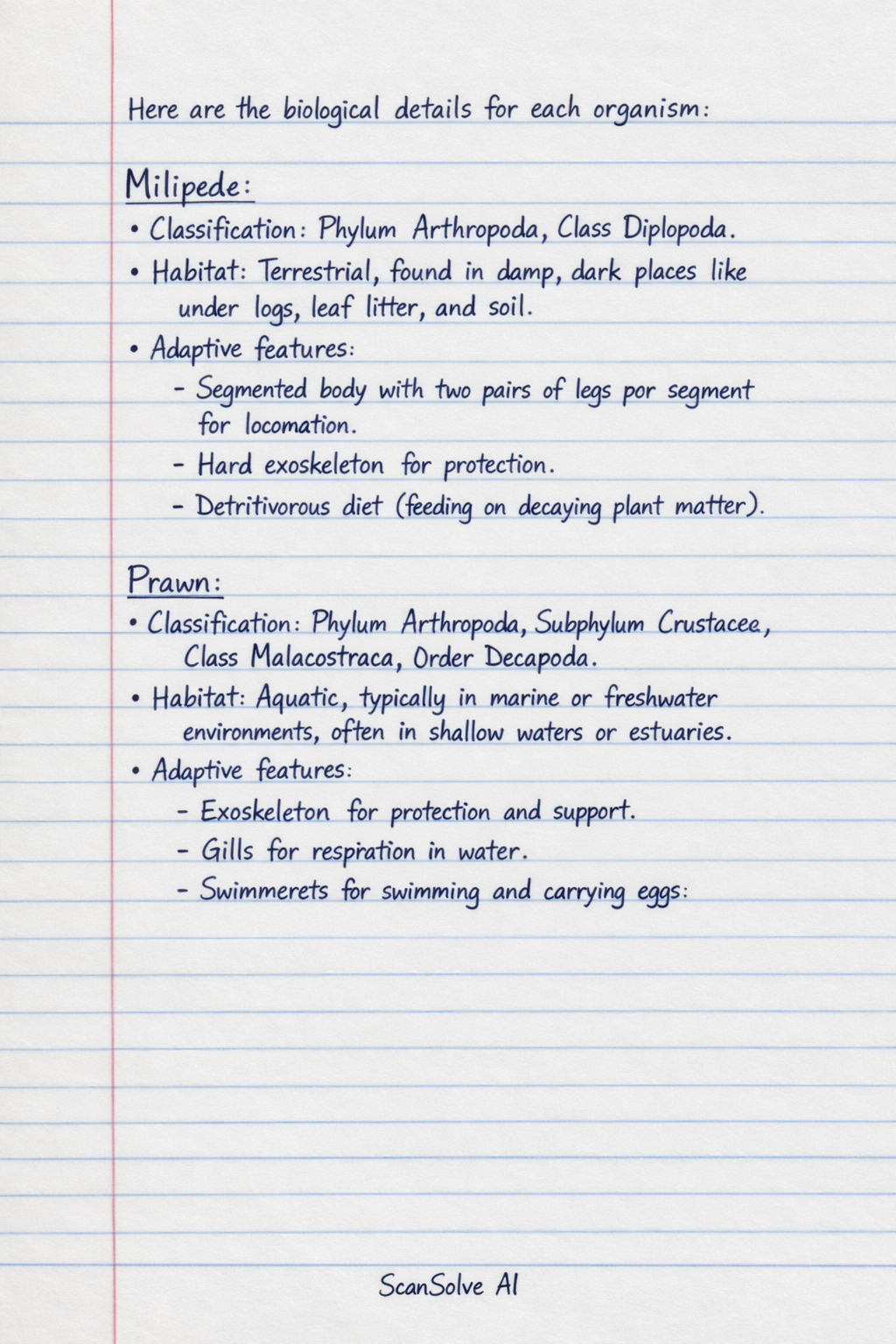
Here are the biological details for each organism:
-
Millipede
- Classification: Phylum Arthropoda, Class Diplopoda.
- Habitat: Terrestrial, found in damp, dark places like under logs, leaf litter, and soil.
- Adaptive features:
- Segmented body with two pairs of legs per segment for locomotion.
- Hard exoskeleton for protection.
- Detritivorous diet (feeding on decaying plant matter).
-
Prawn
- Classification: Phylum Arthropoda, Subphylum Crustacea, Class Malacostraca, Order Decapoda.
- Habitat: Aquatic, typically in marine or freshwater environments, often in shallow waters or estuaries.
- Adaptive features:
- Exoskeleton for protection and support.
- Gills for respiration in water.
- Swimmerets for swimming and carrying eggs.
-
Crab
- Classification: Phylum Arthropoda, Subphylum Crustacea, Class Malacostraca, Order Decapoda.
- Habitat: Aquatic (marine and freshwater) and semi-terrestrial, found on shores, reefs, and in deep seas.
- Adaptive features:
- Thick, hard exoskeleton (carapace) for robust protection.
- Claws (chelae) for defense, feeding, and fighting.
- Gills for breathing underwater.
-
Snail
- Classification: Phylum Mollusca, Class Gastropoda.
- Habitat: Terrestrial (damp environments), freshwater, and marine.
- Adaptive features:
- Muscular foot for slow, gliding locomotion.
- Shell for protection and to prevent desiccation (drying out).
- Radula for scraping food.
-
Fish
- Classification: Phylum Chordata, Subphylum Vertebrata, Superclass Pisces (includes classes like Chondrichthyes and Osteichthyes).
- Habitat: Aquatic, found in both freshwater and marine environments.
- Adaptive features:
- Streamlined body shape for efficient movement through water.
- Fins for propulsion, steering, and balance.
- Gills for extracting oxygen from water.
-
Toad
- Classification: Phylum Chordata, Subphylum Vertebrata, Class Amphibia, Order Anura.
- Habitat: Terrestrial, preferring damp environments like gardens and forests, but requires water for breeding.
- Adaptive features:
- Rough, warty skin for camouflage and reduced water loss.
- Parotoid glands secrete toxins for defense.
- Strong hind legs for hopping.
-
Earthworm
- Classification: Phylum Annelida, Class Oligochaeta.
- Habitat: Terrestrial, living in soil rich in organic matter.
- Adaptive features:
- Segmented body for flexibility and burrowing.
- Setae (bristles) on each segment for grip during movement.
- Moist skin for cutaneous respiration (breathing through skin).
-
Lizard
- Classification: Phylum Chordata, Subphylum Vertebrata, Class Reptilia, Order Squamata.
- Habitat: Terrestrial, found in diverse environments including deserts, forests, and grasslands; some are arboreal or semi-aquatic.
- Adaptive features:
- Scaly skin to prevent water loss in dry environments.
- Ectothermic (cold-blooded), regulating body temperature by basking or seeking shade.
- Claws for climbing and gripping.
Was this helpful?
Still stuck on this one?
Ask a follow-up, and the answer starts from this question.
Got a different question?Ask your own question
More Biology Questions
QIdentify and label the key anatomical features of the provided diagrams of an insect, spider…QIdentify the phylum, class, and scientific or common name for each specimen labeled A-H and describe…QExplain everything about the phylum, class, habitat, thier ecological relationship, trophic level…Q*1. Structural adaptation, Reproduction, Osmoregulation, Egestion, Respiration, Food and feeding…QState five (5) characteristic features of the Crustaceans observed from the specimen provided.
Browse by topic:Ecology
Handwritten Step-by-Step Solution
Get this as a handwritten image on WhatsApp — like a tutor wrote it for you.
Try on WhatsApp