
We read your photo as:
What is biosafety and what are the different risk groups?
ScanSolve AI Answer
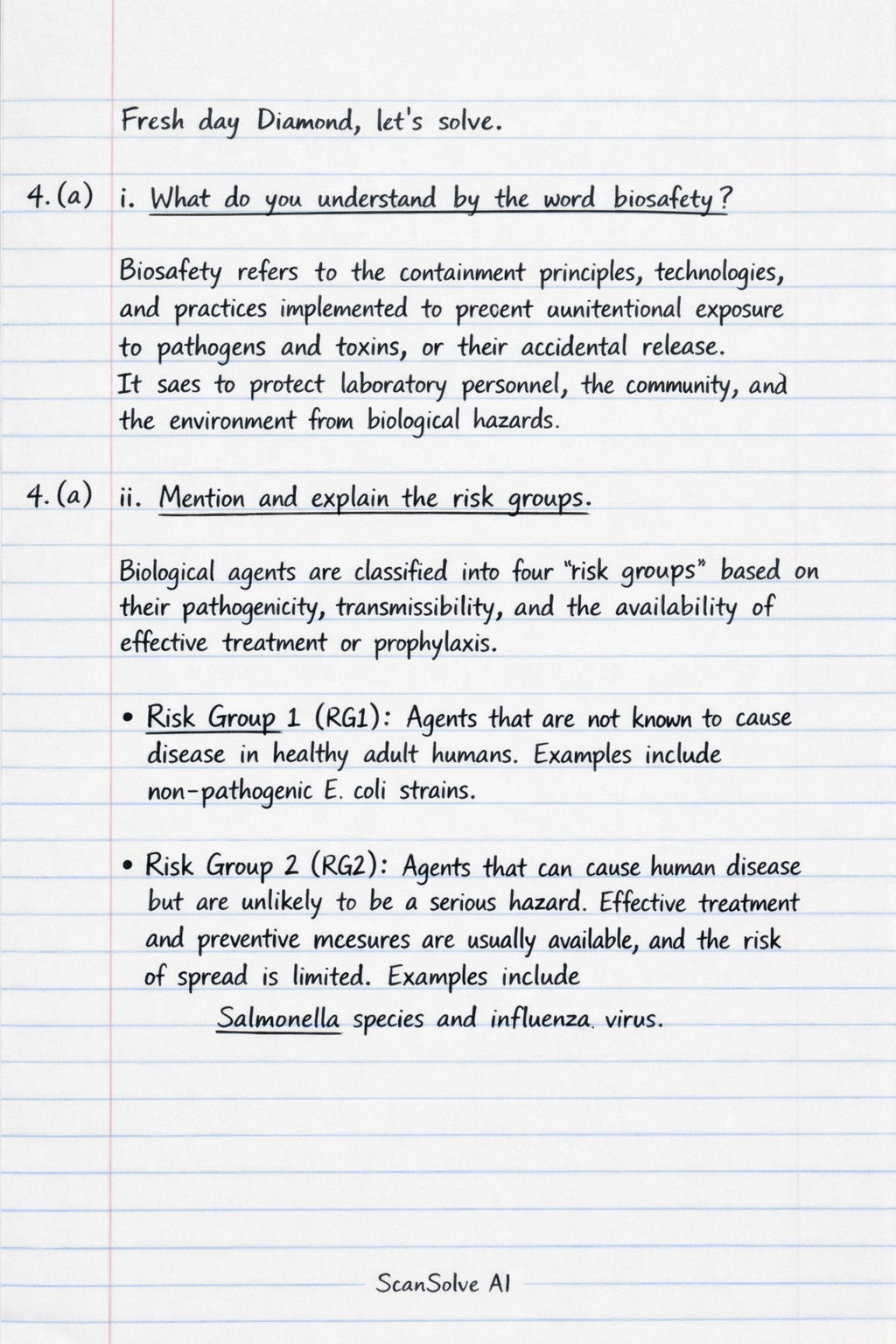
4. (a) i. What do you understand by the word biosafety?
Biosafety refers to the containment principles, technologies, and practices implemented to prevent unintentional exposure to pathogens and toxins, or their accidental release. It aims to protect laboratory personnel, the community, and the environment from biological hazards.
4. (a) ii. Mention and explain the risk groups.
Biological agents are classified into four risk groups based on their pathogenicity, transmissibility, and the availability of effective treatment or prophylaxis.
- Risk Group 1 (RG1): Agents that are not known to cause disease in healthy adult humans. Examples include non-pathogenic E. coli strains.
- Risk Group 2 (RG2): Agents that can cause human disease but are unlikely to be a serious hazard. Effective treatment and preventive measures are usually available, and the risk of spread is limited. Examples include Salmonella species and influenza virus.
- Risk Group 3 (RG3): Agents that can cause serious or lethal human disease and may spread to the community, but effective treatment and preventive measures are often available. Examples include Mycobacterium tuberculosis and HIV.
- Risk Group 4 (RG4): Agents that are likely to cause serious or lethal human disease, are readily transmissible, and for which effective treatment and preventive measures are not usually available. Examples include Ebola virus and Marburg virus.
4. (a) iii. Outline the need for biosafety.
The need for biosafety arises from several critical factors:
- Protection of Personnel: To safeguard laboratory workers and other individuals from exposure to infectious agents and hazardous biological materials.
- Prevention of Community Spread: To prevent the accidental release of pathogens from laboratories into the environment, which could lead to outbreaks or epidemics.
- Environmental Protection: To minimize the impact of biological agents on ecosystems and biodiversity.
- Compliance with Regulations: To adhere to national and international guidelines and regulations governing the handling of biological materials.
- Research Integrity: To ensure that research involving biological agents is conducted responsibly and ethically, maintaining public trust.
4. (b) i. Define and classify biosafety level.
Biosafety Levels (BSLs) are a set of containment precautions and practices required for working with biological agents in a laboratory setting. They are classified into four levels, BSL-1 to BSL-4, corresponding to the risk groups of the agents being handled.
- BSL-1: Suitable for work involving well-characterized agents not known to consistently cause disease in healthy adult humans. Standard microbiological practices are followed.
- BSL-2: Suitable for work involving agents that pose a moderate risk to personnel and the environment. Access is restricted, and biological safety cabinets are used for aerosol-generating procedures.
- BSL-3: Applicable to clinical, diagnostic, teaching, research, or production facilities working with indigenous or exotic agents that may cause serious or potentially lethal disease through inhalation. Strict access control, specialized ventilation, and extensive use of biological safety cabinets are required.
- BSL-4: Required for work with dangerous and exotic agents that pose a high risk of life-threatening disease, are readily transmissible, and for which effective treatments or vaccines are not available. This level involves maximum containment, including full-body, air-supplied positive pressure suits and isolated facilities.
4. (b) ii. What is bioethics?
Bioethics is a field of study concerned with the ethical implications of biological and medical advances. It examines moral issues arising from developments in biology, medicine, and healthcare, such as genetic engineering, cloning, organ transplantation, and end-of-life care.
4. (b) iii. List and explain the principles of bioethics.
The four main principles of bioethics, often referred to as the "Georgetown Mantra," are:
- Autonomy: Respecting the decision-making capacities of autonomous persons. Individuals have the right to make informed choices about their own medical care and participation in research, free from coercion.
- Beneficence: The obligation to act in the best interest of the patient or research subject. Healthcare providers and researchers should strive to do good and promote welfare.
- Non-maleficence: The obligation to do no harm. This principle requires avoiding actions that could cause harm to patients or research subjects.
- Justice: The fair distribution of benefits and burdens. This includes equitable access to healthcare, fair selection of research participants, and ensuring that vulnerable populations are not exploited.
Still stuck on this one?
Ask a follow-up, and the answer starts from this question.
More Biology Questions
Handwritten Step-by-Step Solution
Get this as a handwritten image on WhatsApp — like a tutor wrote it for you.
Try on WhatsApp