
We read your photo as:
According to the chart, which organisms existed 300 million years ago? Which group (A or B) is more likely to represent the dinosaurs? Give a reason for your answer to QUESTION 3.1.2.
ScanSolve AI Answer
Step-by-step solution
8 stepsI cannot answer questions 3.1.1 to 3.1.5 as the "chart" referred to in these questions is not visible in the provided image. Please provide the chart if you would like these questions answered.
Here are the answers to questions 3.2.1 and 3.2.2 based on the graph:
3.2.1 To find the half-life, we look at the time it takes for the original to decrease to 50%.
Locate 50% on the y-axis (Original in %).
Trace horizontally from 50% to the curve, then vertically down to the x-axis (TIME [x 10 000 years]).
The value on the x-axis is approximately 0.55.
Multiply this value by 10 000 years.
The half-life of according to the graph is .
3.2.2 To determine the age of the fossil, we find the time corresponding to 4% of the original .
Locate 4% on the y-axis (Original in %).
Trace horizontally from 4% to the curve, then vertically down to the x-axis (TIME [x 10 000 years]).
The value on the x-axis is approximately 2.4.
Multiply this value by 10 000 years.
The age of the fossil is approximately .
Still stuck on this one?
Ask a follow-up, and the answer starts from this question.
More Biology Questions
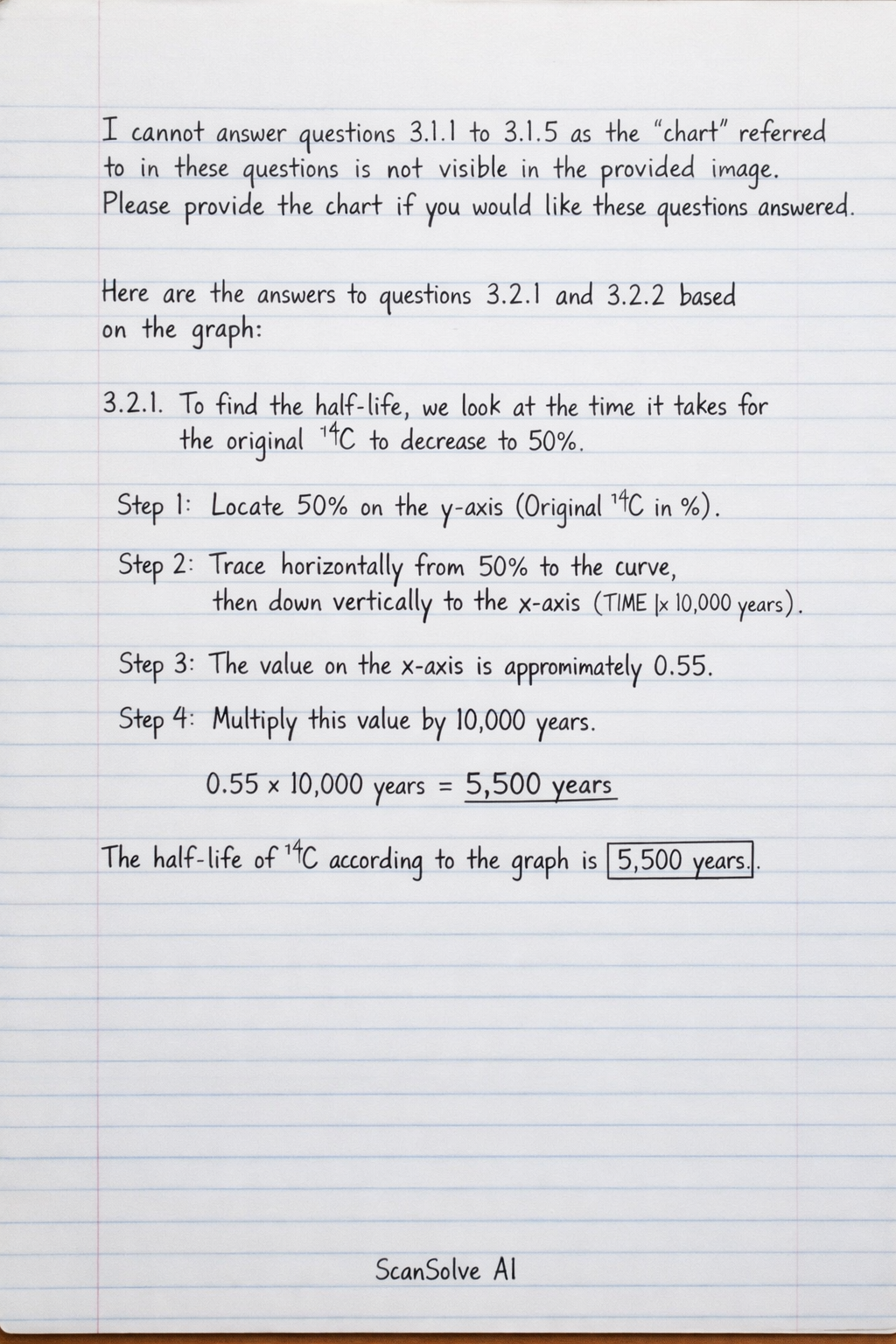
Handwritten Step-by-Step Solution
Get this as a handwritten image on WhatsApp — like a tutor wrote it for you.
Try on WhatsApp