
We read your photo as:
Give the correct sequence of the organisms (I, II and III), from most primitive to most evolved.
ScanSolve AI Answer
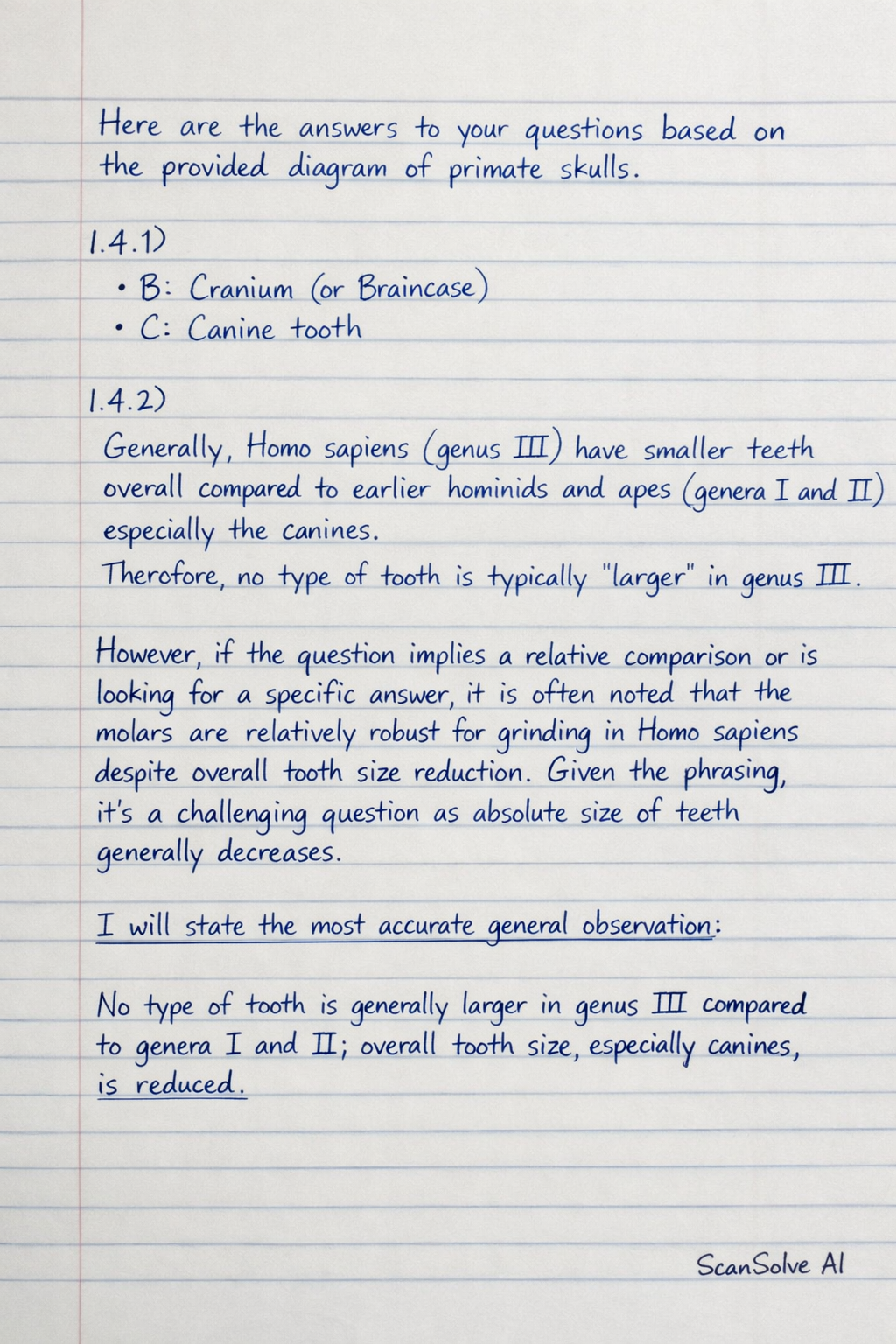
Here are the answers to your questions based on the provided diagram of primate skulls.
1.4.1)
- B: Cranium (or Braincase)
- C: Canine tooth
1.4.2)
Generally, Homo sapiens (genus III) have smaller teeth overall compared to earlier hominids and apes (genera I and II), especially the canines. Therefore, no type of tooth is typically "larger" in genus III. However, if the question implies a relative comparison or is looking for a specific answer, it is often noted that the molars are relatively robust for grinding in Homo sapiens despite overall tooth size reduction. Given the phrasing, it's a challenging question as absolute size of teeth generally decreases. I will state the most accurate general observation.
No type of tooth is generally larger in genus III compared to genera I and II; overall tooth size, especially canines, is reduced.
1.4.3)
Give only the NUMBER(S) (I, II or III) of the skull(s) that:
a) Most likely belongs to a bipedal primate: III (indicated by a more central foramen magnum, though not visible, and a flatter face)
b) Has the largest brain size: III (largest cranium)
c) Is attached to a C-shaped vertebral column: I (most prognathous, indicating quadrupedal or knuckle-walking posture)
d) Is most prognathous: I (most projecting jaw)
1.4.4)
Give only the LETTER of the structure that is more pronounced in organism III than in organisms I and II.
The question asks for a structure that is more pronounced in organism III (Homo sapiens) than in I and II.
- (a) Cranium size: More pronounced in III.
- (b) Brow ridges: Less pronounced in III.
- (c) C-shaped vertebral column: Less pronounced in III (humans have an S-shaped column).
- (d) Prognathous face: Less pronounced in III. Therefore, the structure that is more pronounced in organism III is the cranium size. The letter corresponding to the cranium is B.
1.4.5)
Give the correct sequence of the organisms (I, II and III), from most primitive to most evolved.
- Skull I: Most primitive (small brain, very prognathous, large brow ridges, large canines - ape-like).
- Skull II: Intermediate (medium brain, moderately prognathous, moderate brow ridges, medium canines - Australopithecus-like).
- Skull III: Most evolved (large brain, flat face, reduced brow ridges, small canines - Homo sapiens-like). The correct sequence is I, II, III.
Still stuck on this one?
Ask a follow-up, and the answer starts from this question.
More Biology Questions
Handwritten Step-by-Step Solution
Get this as a handwritten image on WhatsApp — like a tutor wrote it for you.
Try on WhatsApp