
We read your photo as:
Describe and identify fossil A and B. State with reason the mode of life of specimen A and B.
Biology
ScanSolve AI Answer
Here are the answers to Question 3 from the image:
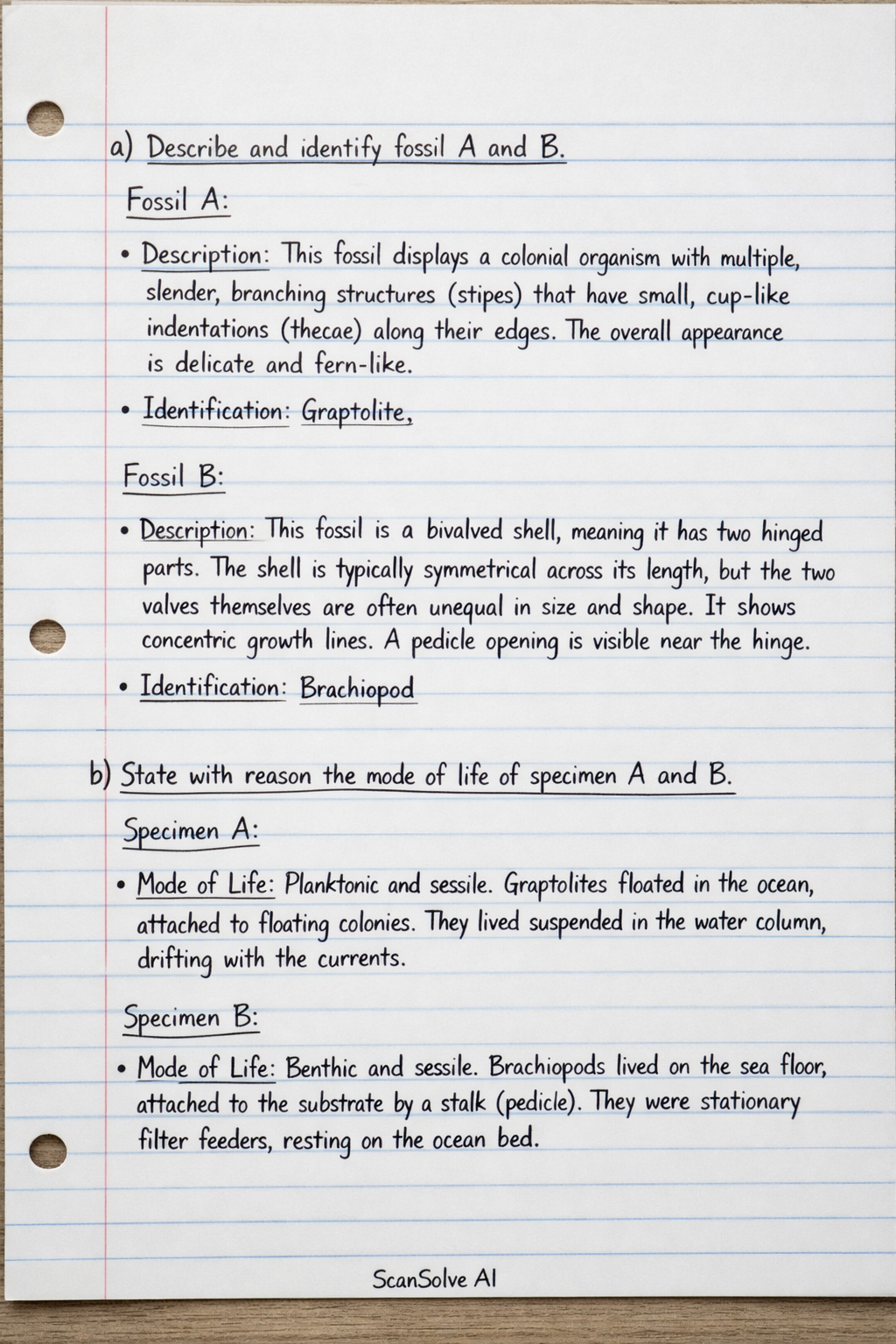
a) Describe and identify fossil A and B.
Fossil A:
- Description: This fossil displays a colonial organism with multiple, slender, branching structures (stipes) that have small, cup-like indentations (thecae) along their edges. The overall appearance is delicate and fern-like.
- Identification: Graptolite.
Fossil B:
- Description: This fossil is a bivalved shell, meaning it has two hinged parts. The shell is typically symmetrical across its length (from the hinge to the front margin) but the two valves themselves are often unequal in size and shape. It shows concentric growth lines. A pedicle opening is visible near the hinge.
- Identification: Brachiopod.
b) State with reason the mode of life of specimen A and B.
Specimen A (Graptolite):
- Mode of life: Planktonic.
- Reason: Graptolites were free-floating marine organisms that drifted in ocean currents. Their delicate, often buoyant structures and wide geographical distribution in deep-water sediments support this mode of life.
Specimen B (Brachiopod):
- Mode of life: Benthic.
- Reason: Brachiopods are bottom-dwelling marine invertebrates. Most species attach themselves to the seafloor using a fleshy stalk called a pedicle, or they lie freely on the substrate. Their heavy shells are adapted for this lifestyle.
c) State the age range of specimen A and B.
Specimen A (Graptolite):
- Age range: Cambrian to Carboniferous periods. They are particularly important as index fossils for the Ordovician and Silurian periods.
Specimen B (Brachiopod):
- Age range: Early Cambrian to Recent. They were very abundant throughout the Paleozoic and Mesozoic Eras.
Was this helpful?
Still stuck on this one?
Ask a follow-up, and the answer starts from this question.
Got a different question?Ask your own question
More Biology Questions
QThe image below shows two fossil samples. 2.1.1 Identify (a) Fossil X (b) Fossil Y. 2.1.2 Name TWO…QStudy the two fossils (Diagram A and Diagram B) which were discovered and classified as transitional…QIdentify the fossil, describe its key features, state its pygidium size relative to its cephalon…QIdentify the phylum, class, and scientific or common name for each specimen labeled A-H and describe…QTwo organisms A and B live in different habitats within a rural area. Organism A possesses gills…
Handwritten Step-by-Step Solution
Get this as a handwritten image on WhatsApp — like a tutor wrote it for you.
Try on WhatsApp