
We read your photo as:
Identify the phylum, class, and scientific or common name for each specimen labeled A-H and describe the adaptations of Specimen A to its aquatic environment.
Biology
ScanSolve AI Answer
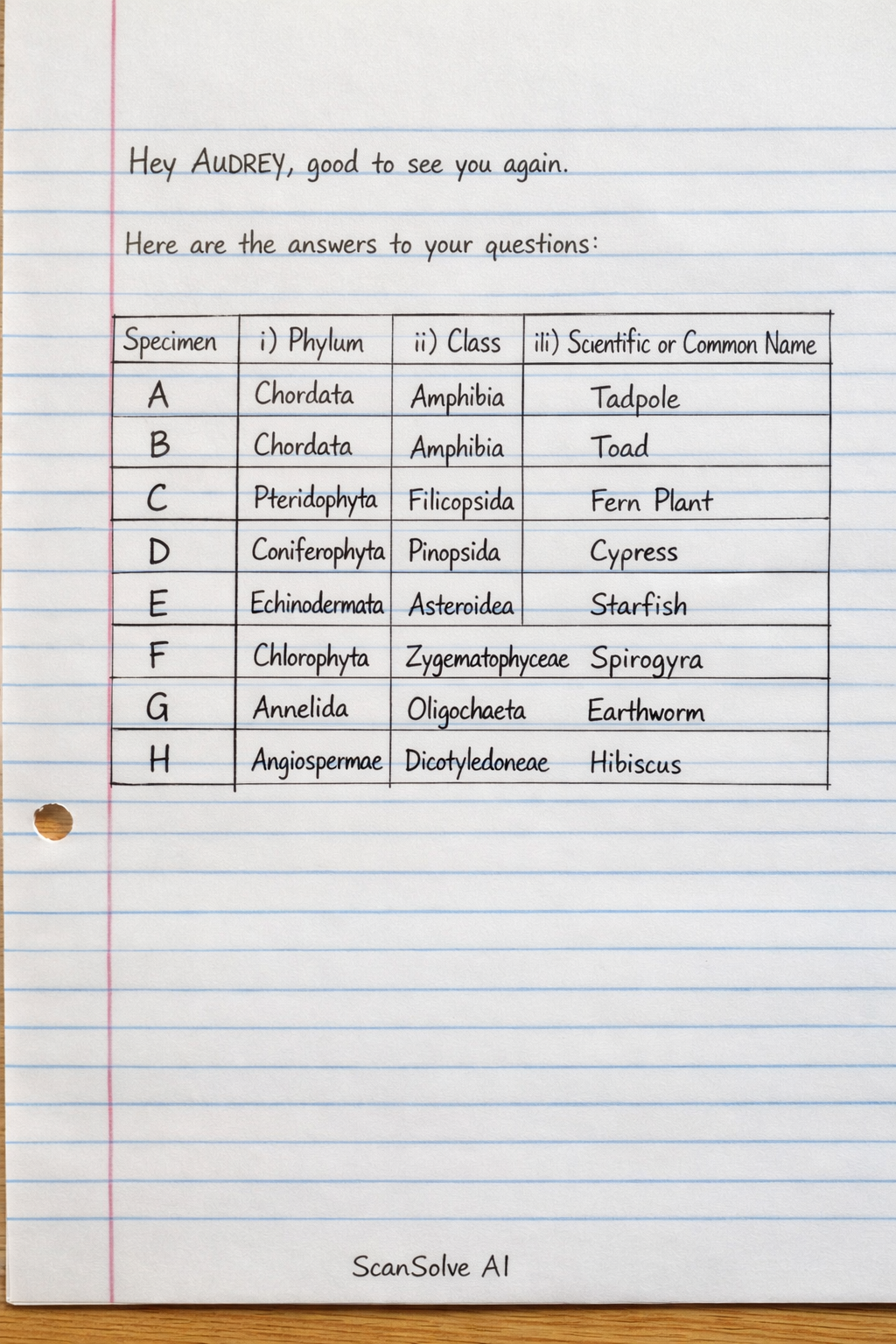
Here are the answers to your questions:
1) a)
Your answer to this question should be written in your answer book in columns as shown below:
| SPECIMEN | i (Phylum) | ii (Class) | iii (Scientific or Common Name) |
|---|---|---|---|
| A | Chordata | Amphibia | Tadpole |
| B | Chordata | Amphibia | Toad |
| C | Pteridophyta | Filicopsida | Fern Plant |
| D | Coniferophyta | Pinopsida | Cypress |
| E | Echinodermata | Asteroidea | Starfish |
| F | Chlorophyta | Zygnematophyceae | Spirogyra |
| G | Annelida | Oligochaeta | Earthworm |
| H | Angiospermae | Dicotyledoneae | Hibiscus |
1) b)
Specimen A (Tadpole) is adapted to its aquatic environment by:
- Having gills for breathing dissolved oxygen in water.
- Possessing a tail for propulsion and swimming.
- Having a streamlined body to reduce drag while moving through water.
- Feeding on algae using a herbivorous mouthpart adapted for scraping.
1) c)
i) Organisms that live in a land habitat from specimens A-H are:
- B (Toad)
- C (Fern Plant)
- D (Cypress)
- G (Earthworm)
- H (Hibiscus)
ii) Ecological relationships that exist among them:
- Competition: Fern (C), Cypress (D), and Hibiscus (H) compete for resources like sunlight, water, and soil nutrients.
- Predation: The Toad (B) preys on the Earthworm (G).
- Decomposition/Detritivory: The Earthworm (G) feeds on decaying organic matter from plants (C, D, H), contributing to nutrient cycling in the soil.
2) a)
i) Functions of four external features of specimen B (Toad) which adapt it to life in its habitat:
- Warty, dry skin: Reduces water loss, helping the toad survive in terrestrial environments, and provides camouflage. It also contains glands that secrete toxins for defense.
- Strong, muscular hind limbs: Adapted for hopping and jumping, allowing rapid movement on land to catch prey or escape predators.
- Bulging eyes: Positioned on top of the head, providing a wide field of vision to detect prey and predators effectively.
- Tympanum (eardrum): Detects sound vibrations, which is important for communication and sensing environmental changes.
Was this helpful?
Still stuck on this one?
Ask a follow-up, and the answer starts from this question.
Got a different question?Ask your own question
More Biology Questions
QFor each of the specimens A-H provided state its phylum, class and habitat of the specimensQIdentify Specimen A (frog), B (amphibian, assumed frog), C (lizard), and D (mosquito) by taxonomic…QClassify specimen P and explain its adaptations. The image is missing.Q*1. Structural adaptation, Reproduction, Osmoregulation, Egestion, Respiration, Food and feeding…QThe photograph illustrates an organism found in aquatic habitat. (a) Give the type of the plant. (b)…
Handwritten Step-by-Step Solution
Get this as a handwritten image on WhatsApp — like a tutor wrote it for you.
Try on WhatsApp