

This biology question covers important biological concepts and processes. The step-by-step explanation below helps you understand the underlying mechanisms and reasoning.
ScanSolve AI Answer
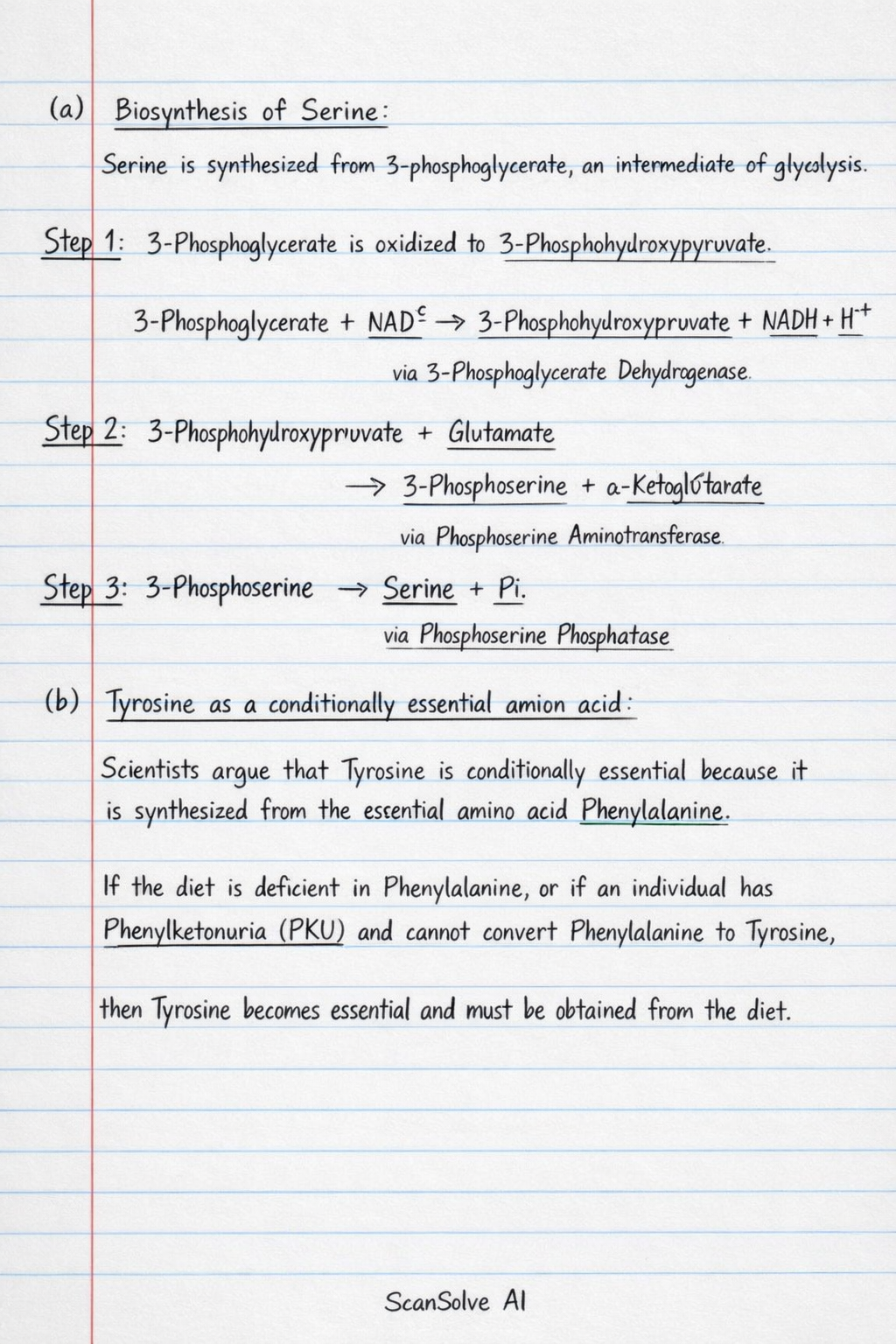
a) Biosynthesis of Serine: Serine is synthesized from 3-phosphoglycerate, an intermediate of glycolysis. Step 1: 3-phosphoglycerate is oxidized to 3-phosphohydroxypyruvate by the enzyme 3-phosphoglycerate dehydrogenase. Step 2: 3-phosphohydroxypyruvate undergoes transamination with glutamate to form 3-phosphoserine, catalyzed by phosphoserine aminotransferase. Step 3: 3-phosphoserine is dephosphorylated to Serine by phosphoserine phosphatase. b) Tyrosine as a conditionally essential amino acid: Scientists argue that Tyrosine is conditionally essential because it is synthesized from the essential amino acid Phenylalanine. If the diet is deficient in Phenylalanine, or if an individual has Phenylketonuria (PKU) and cannot convert Phenylalanine to Tyrosine, then Tyrosine becomes essential and must be obtained from the diet. c) Role of Glutamine in Asparagine biosynthesis: Glutamine provides the amino group for the synthesis of Asparagine from Aspartate. The enzyme Asparagine synthetase catalyzes this reaction, utilizing ATP for energy and Glutamine as the nitrogen donor. a) Major steps in protein synthesis: • Transcription: The genetic information from DNA is copied into messenger RNA (mRNA) in the nucleus. • Translation: The mRNA molecule moves to the ribosomes in the cytoplasm. • Initiation: The ribosome binds to the mRNA, and the first transfer RNA (tRNA) carrying methionine binds to the start codon. • Elongation: Successive tRNAs bring specific amino acids to the ribosome, where peptide bonds are formed, extending the polypeptide chain. • Termination: When a stop codon is reached, the polypeptide chain is released from the ribosome. • Post-translational modification: The polypeptide folds into its functional three-dimensional structure and may undergo further modifications. b) Fate of excess amino nitrogen: Excess amino nitrogen produced during protein catabolism is converted into highly toxic ammonia (NH_3). This ammonia is then primarily detoxified in the liver by conversion into urea through the urea cycle. Urea is subsequently transported to the kidneys and excreted in the urine. c) Importance of urea cycle and a disorder: • Importance: The urea cycle is vital for detoxifying ammonia, a toxic byproduct of amino acid metabolism, by converting it into less toxic urea for excretion. • Disorder: Hyperammonemia (e.g., due to Ornithine transcarbamylase deficiency). a) Salvage pathway for AMP, GMP, and IMP: • AMP synthesis: Adenine + PRPP Adenine phosphoribosyltransferase (APRT) AMP + PP_i • GMP synthesis: Guanine + PRPP Hypoxanthine-guanine phosphoribosyltransferase (HGPRT) GMP + PP_i • IMP synthesis: Hypoxanthine + PRPP Hypoxanthine-guanine phosphoribosyltransferase (HGPRT) IMP + PP_i b) (i) Importance of salvage pathway: Salvage pathways are energy-efficient mechanisms for synthesizing nucleotides by reusing pre-formed purine and pyrimidine bases and nucleosides. They are crucial for tissues that cannot perform de novo synthesis (e.g., brain, red blood cells) and help recycle bases from nucleic acid degradation. (ii) Orotic aciduria: Orotic aciduria is a rare genetic disorder characterized by the excretion of large amounts of orotic acid in the urine. It results from a deficiency in UMP synthase, an enzyme involved in pyrimidine synthesis. This deficiency leads to a buildup of orotic acid, causing symptoms like megaloblastic anemia, growth retardation, and neurological abnormalities. a) Abnormalities in nucleic acid metabolism: (i) Lesch-Nyhan syndrome: • Biochemical Basis: An X-linked recessive disorder caused by a deficiency in the enzyme Hypoxanthine-guanine phosphoribosyltransferase (HGPRT), which is essential for the purine salvage pathway. This leads to an accumulation of hypoxanthine and guanine, which are then converted to uric acid, and increased de novo purine synthesis. • Clinical Features: Severe hyperuricemia (leading to gout and kidney stones), neurological dysfunction (intellectual disability, dystonia, choreoathetosis), and characteristic self-mutilating behavior. • Management: Treatment involves allopurinol to reduce uric acid production. There is no cure for the neurological symptoms. (ii) Gout: • Biochemical Basis: A metabolic disorder characterized by hyperuricemia (elevated uric acid levels in the blood), resulting from either overproduction or underexcretion of uric acid. This leads to the precipitation of monosodium urate crystals in joints and soft tissues. • Clinical Features: Acute, painful arthritis (often affecting the big toe), tophi (urate crystal deposits), and kidney stones. • Management: Acute attacks are treated with NSAIDs, colchicine, or corticosteroids. Chronic management includes allopurinol (to inhibit xanthine oxidase and reduce uric acid production) or uricosuric agents (to increase uric acid excretion). (iii) Adenosine Deaminase deficiency: • Biochemical Basis: An autosomal recessive disorder caused by a deficiency in the enzyme Adenosine Deaminase (ADA), which converts adenosine to inosine and deoxyadenosine to deoxyinosine. This leads to an accumulation of deoxyadenosine, which is phosphorylated to dATP. High dATP inhibits ribonucleotide reductase, impairing DNA synthesis. • Clinical Features: Severe combined immunodeficiency (SCID), affecting both T