
We read your photo as:
c) Various parts of plants are used as planting materials for vegetative propagation, allowing new plants to grow from a part of the parent plant rather than from seeds.
ScanSolve AI Answer
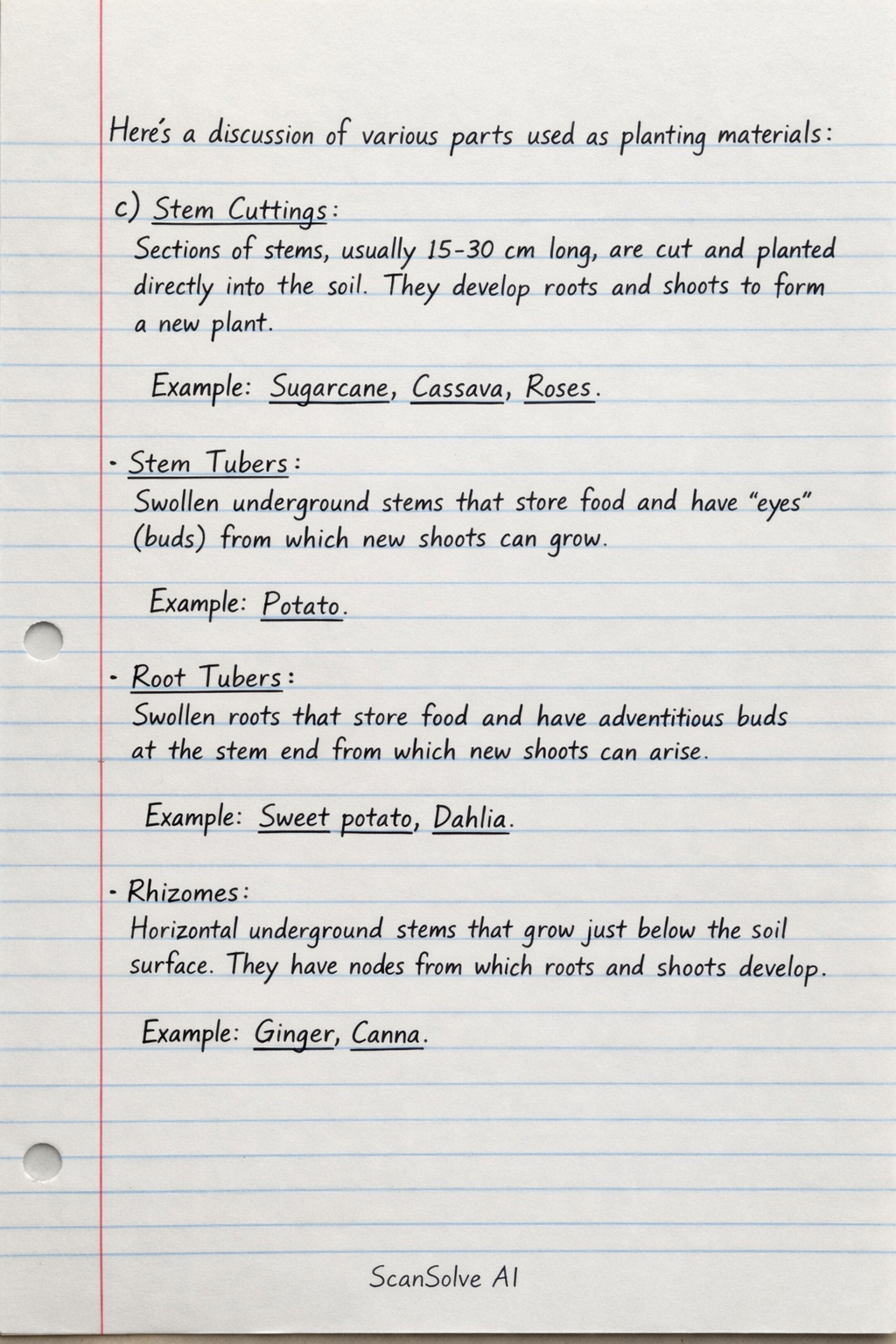
Here's a discussion of various parts used as planting materials:
c) Various parts of plants are used as planting materials for vegetative propagation, allowing new plants to grow from a part of the parent plant rather than from seeds.
-
Stem Cuttings: Sections of stems, usually 15-30 cm long, are cut and planted directly into the soil. They develop roots and shoots to form a new plant. Example: Sugarcane, Cassava, Roses.
-
Stem Tubers: Swollen underground stems that store food and have 'eyes' (buds) from which new shoots can grow. Example: Potato.
-
Root Tubers: Swollen roots that store food and have adventitious buds at the stem end from which new shoots can arise. Example: Sweet potato, Dahlia.
-
Rhizomes: Horizontal underground stems that grow just below the soil surface. They have nodes from which roots and shoots develop. Example: Ginger, Canna.
-
Corms: Short, swollen, underground stems that are solid and store food. They have nodes and internodes, and buds grow from the top to produce new plants. Example: Gladiolus, Crocus.
-
Bulbs: Underground storage organs consisting of a short, flattened stem base with fleshy leaves (scales) that store food. Buds within the bulb grow into new plants. Example: Onion, Garlic, Lily.
-
Suckers/Offsets: Young shoots that arise from the base of the parent plant or from underground stems. They can be detached and planted as new individuals. Example: Banana, Pineapple, Sisal.
-
Leaves: In some plants, new plantlets can develop directly from the margins or veins of leaves. Example: Bryophyllum (Mother of Thousands), Begonia.
Still stuck on this one?
Ask a follow-up, and the answer starts from this question.
More Biology Questions
Handwritten Step-by-Step Solution
Get this as a handwritten image on WhatsApp — like a tutor wrote it for you.
Try on WhatsApp