
We read your photo as:
Choose the correct order of events in the Nitrogen Cycle.
ScanSolve AI Answer
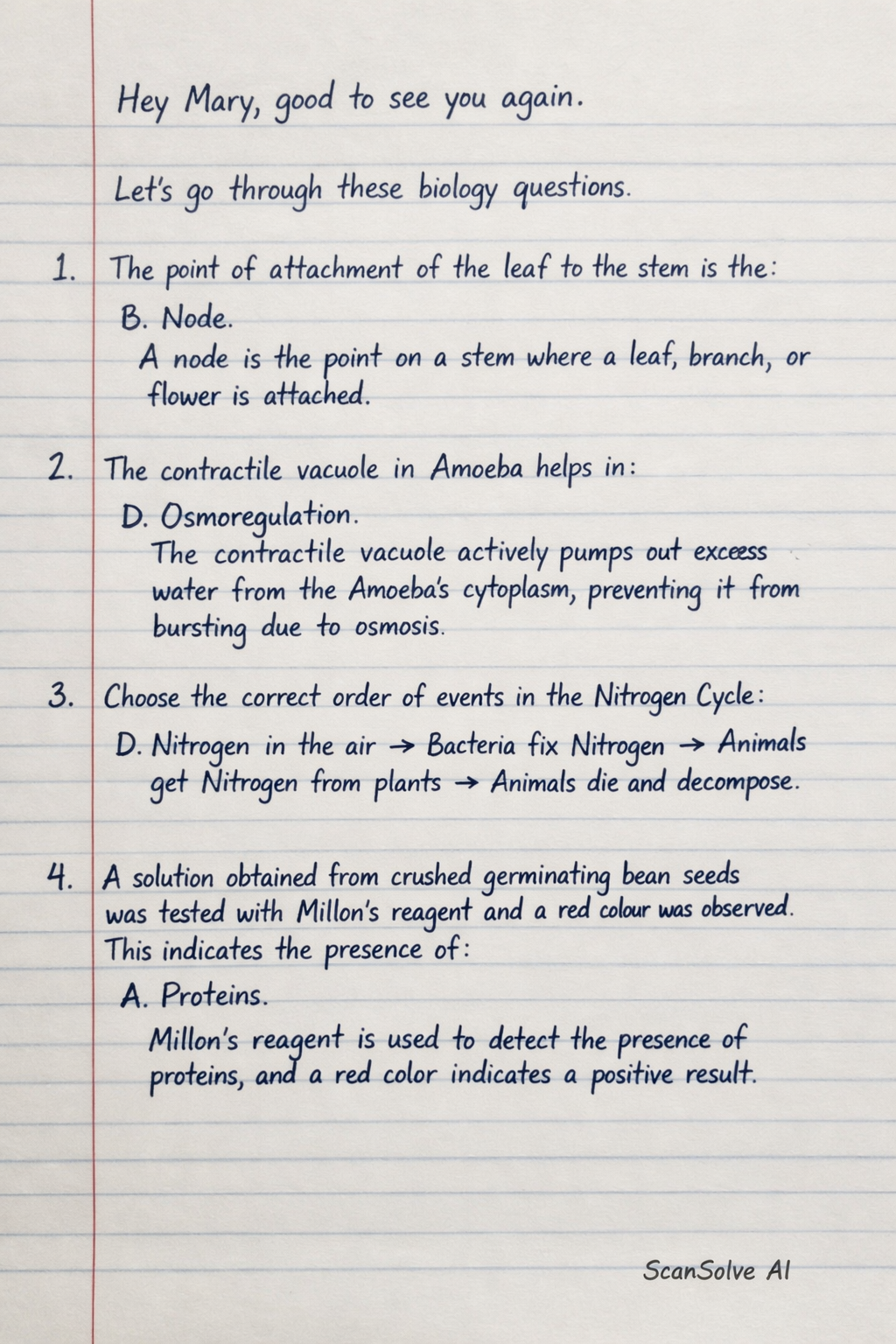
Let's go through these biology questions.
-
The point of attachment of the leaf to the stem is the:
- B. Node. A node is the point on a stem where a leaf, branch, or flower is attached.
-
The contractile vacuole in Amoeba helps in:
- D. Osmoregulation. The contractile vacuole actively pumps out excess water from the Amoeba's cytoplasm, preventing it from bursting due to osmosis.
-
Choose the correct order of events in the Nitrogen Cycle.
- D. Nitrogen In the air → Bacteria fix Nitrogen → Animals get Nitrogen from plants → Animals die and decompose. This sequence correctly illustrates nitrogen fixation, assimilation by plants and animals, and decomposition.
-
A solution obtained from crushed germinating bean seeds was tested with Millon's reagent and a red colour was observed. This indicates the presence of:
- A. Proteins. Millon's reagent is used to detect the presence of proteins, and a red color indicates a positive result.
-
Which part of the alimentary canal produces bile?
- B. Liver. The liver produces bile, which is then stored in the gall bladder before being released into the duodenum.
-
Which layer of the skin produces melanin?
- B. Malpighian layer. The Malpighian layer (also known as the stratum basale and stratum spinosum) contains melanocytes, which are cells responsible for producing melanin.
-
What structure protects the lizard's body from mechanical injury?
- A. Scales. Lizards, being reptiles, have a body covered in scales that provide protection against physical damage and desiccation.
-
The diagram below is that of a plant cell. Which of the numbered structures contain chlorophyll?
- C. 3. Structure 3 points to a chloroplast, which is the organelle in plant cells that contains chlorophyll and is the site of photosynthesis.
-
The part of the eye responsible for image formation is the:
- C. Retina. The retina is the light-sensitive layer at the back of the eye that contains photoreceptor cells (rods and cones) responsible for detecting light and forming an image.
Still stuck on this one?
Ask a follow-up, and the answer starts from this question.
More Biology Questions
Handwritten Step-by-Step Solution
Get this as a handwritten image on WhatsApp — like a tutor wrote it for you.
Try on WhatsApp