
We read your photo as:
Describe the nitrogen cycle, including labelling a diagram, defining nitrogen fixation and explaining nitrogen availability in water-logged soils.
ScanSolve AI Answer
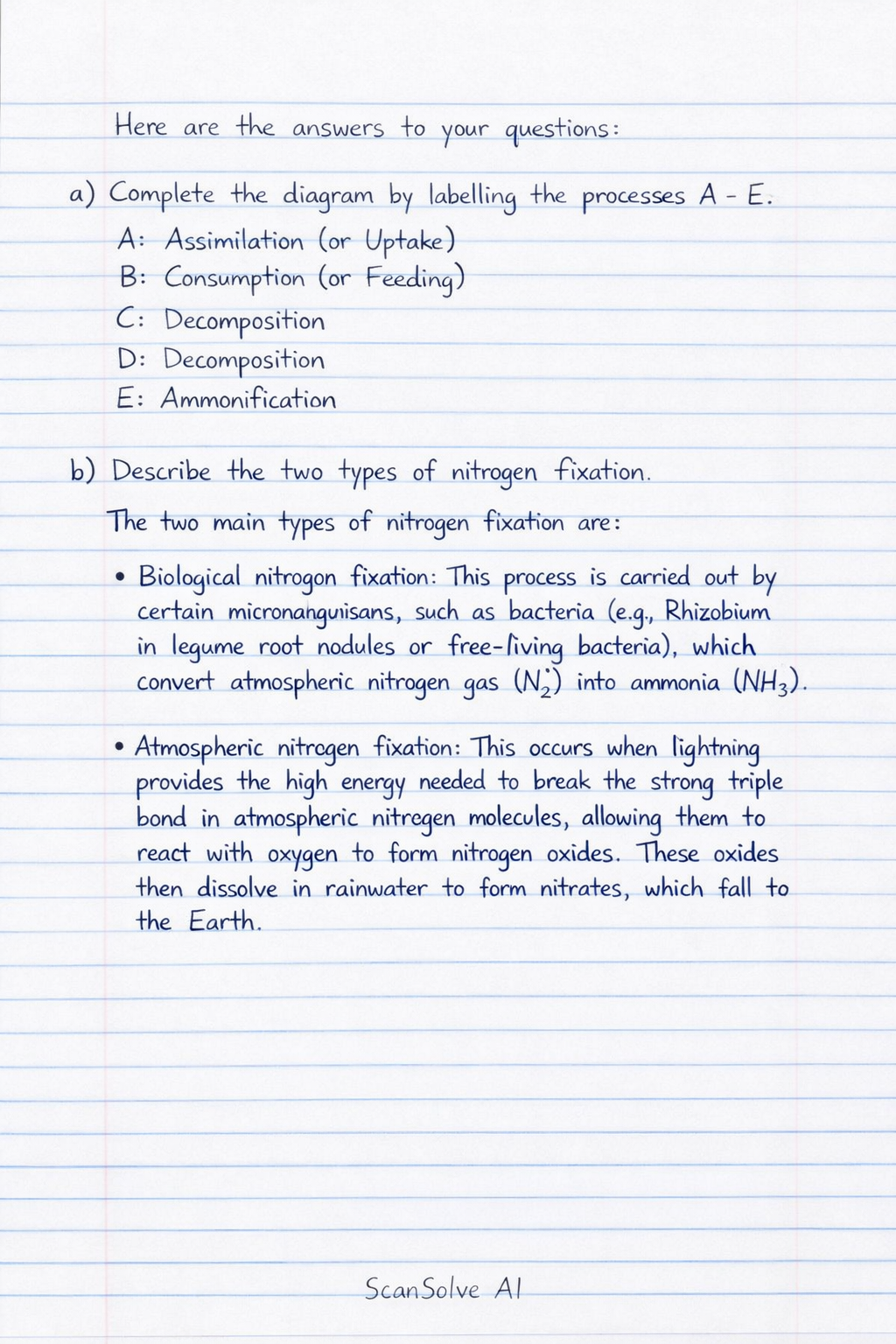
Here are the answers to your questions:
a) Complete the diagram by labelling the processes A - E.
- A: Assimilation (or Uptake)
- B: Consumption (or Feeding)
- C: Decomposition
- D: Decomposition
- E: Ammonification
b) Describe the two types of nitrogen fixation.
The two main types of nitrogen fixation are:
- Biological nitrogen fixation: This process is carried out by certain microorganisms, such as bacteria (e.g., Rhizobium in legume root nodules or free-living bacteria), which convert atmospheric nitrogen gas () into ammonia ().
- Atmospheric nitrogen fixation: This occurs when lightning provides the high energy needed to break the strong triple bond in atmospheric nitrogen molecules, allowing them to react with oxygen to form nitrogen oxides. These oxides then dissolve in rainwater to form nitrates, which fall to the Earth.
c) Explain why the availability of nitrogen-containing compounds goes down in water-logged soils.
In water-logged soils, the oxygen supply is very low, creating anaerobic conditions. These conditions favor the activity of denitrifying bacteria. These bacteria convert nitrates () in the soil back into nitrogen gas () or nitrous oxide (), which then escape into the atmosphere. This process, called denitrification, removes usable nitrogen compounds from the soil, thus reducing their availability for plants. Additionally, the activity of nitrifying bacteria, which convert ammonium to nitrates and require oxygen, is inhibited.
Still stuck on this one?
Ask a follow-up, and the answer starts from this question.
More Biology Questions
Handwritten Step-by-Step Solution
Get this as a handwritten image on WhatsApp — like a tutor wrote it for you.
Try on WhatsApp