
We read your photo as:
Explain the nitrogen cycle and define genes.
ScanSolve AI Answer
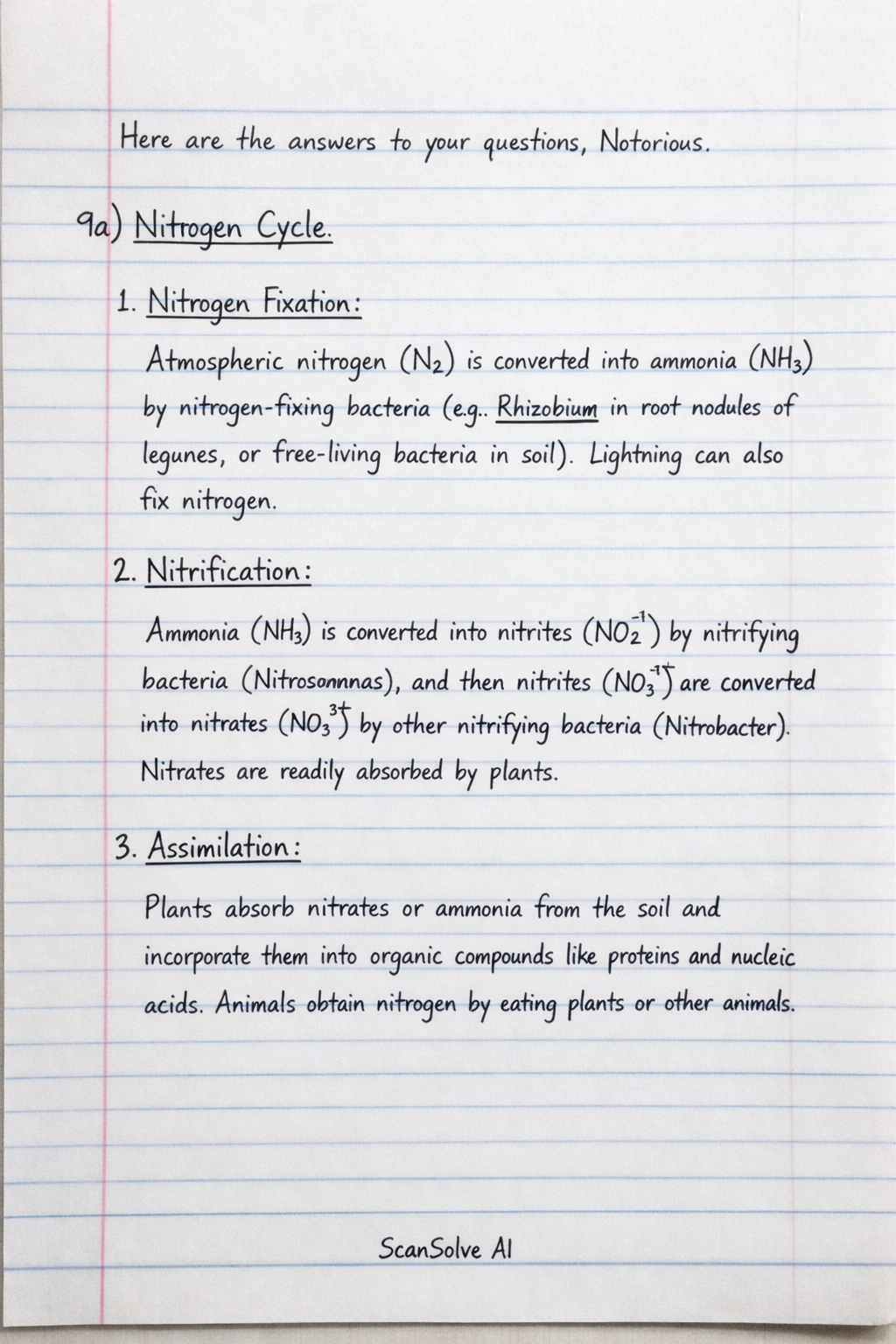
Here are the answers to your questions, Notorious.
9a)
Nitrogen Cycle
The nitrogen cycle describes the process by which nitrogen is converted into various chemical forms as it circulates between the atmosphere, terrestrial, and marine ecosystems.
- Nitrogen Fixation: Atmospheric nitrogen () is converted into ammonia () by nitrogen-fixing bacteria (e.g., Rhizobium in root nodules of legumes, or free-living bacteria in soil). Lightning can also fix nitrogen.
- Nitrification: Ammonia is converted into nitrites () by nitrifying bacteria (Nitrosomonas), and then nitrites are converted into nitrates () by other nitrifying bacteria (Nitrobacter). Nitrates are readily absorbed by plants.
- Assimilation: Plants absorb nitrates or ammonia from the soil and incorporate them into organic compounds like proteins and nucleic acids. Animals obtain nitrogen by eating plants or other animals.
- Ammonification: When organisms die or excrete waste, decomposers (bacteria and fungi) break down organic nitrogen compounds, releasing ammonia back into the soil.
- Denitrification: Denitrifying bacteria (Pseudomonas) convert nitrates back into gaseous nitrogen (), which is then released into the atmosphere, completing the cycle.
9)
Definitions:
- Genes: Fundamental units of heredity, segments of DNA that carry instructions for making proteins or functional RNA molecules, determining specific traits.
- Alleles: Different forms or versions of a gene that occupy the same locus (position) on homologous chromosomes. For example, the gene for pea plant height can have a tall allele and a dwarf allele.
- Dominance: A genetic phenomenon where one allele (the dominant allele) completely masks the expression of another allele (the recessive allele) for the same trait in a heterozygous individual.
- Recessive: An allele that is only expressed when two copies of it are present in an individual (i.e., in a homozygous recessive genotype). Its expression is masked by a dominant allele in a heterozygous state.
9b)
Let 'T' represent the dominant allele for tallness and 't' represent the recessive allele for dwarfness.
A cross between two heterozygous tall plants means both parents have the genotype 'Tt'.
Parental Genotypes:
Gametes: Each parent can produce two types of gametes: T and t.
We can use a Punnett square to determine the possible genotypes and phenotypes of the offspring:
Genotypic Ratio:
Phenotypic Ratio:
- Tall (TT and Tt) : Dwarf (tt) =
Explanation:
When two heterozygous tall pea plants (Tt) are crossed, there is a 25% chance of producing homozygous tall offspring (TT), a 50% chance of producing heterozygous tall offspring (Tt), and a 25% chance of producing homozygous dwarf offspring (tt). This results in a phenotypic ratio of 3 tall plants to 1 dwarf plant.
2a)
Definitions:
- Habitat: The natural environment or place where an organism or a population normally lives. It provides the necessary resources for survival, such as food, water, and shelter.
- Niche: The specific role and position a species has within its ecosystem, including all its interactions with the biotic (living) and abiotic (non-living) components of its environment. It describes how an organism lives and what it does.
- Population: A group of individuals of the same species living in the same geographical area at the same time, capable of interbreeding.
- Community: All the different populations of various species that live and interact in a particular area at the same time.
2b)
Differentiation between Food Chain and Food Web:
- A food chain is a linear sequence showing how energy is transferred from one organism to another through feeding relationships. It typically starts with a producer and moves through various trophic levels (e.g., grass rabbit fox).
- A food web consists of multiple interconnected food chains within an ecosystem. It illustrates the complex feeding relationships where organisms often have more than one food source and are eaten by more than one predator, providing a more realistic representation of energy flow.
Still stuck on this one?
Ask a follow-up, and the answer starts from this question.
More Biology Questions
Handwritten Step-by-Step Solution
Get this as a handwritten image on WhatsApp — like a tutor wrote it for you.
Try on WhatsApp