
We read your photo as:
This paper is in two sections: A and B. Answer Question 1 (compulsory) in Section A and any other three questions in Section B. Answer all the questions in your answer booklet. Credit will be given for clarity of expression and orderly presentation of materials.
ScanSolve AI Answer
Step-by-step solution
4 stepsAnswer 1(a)(i)
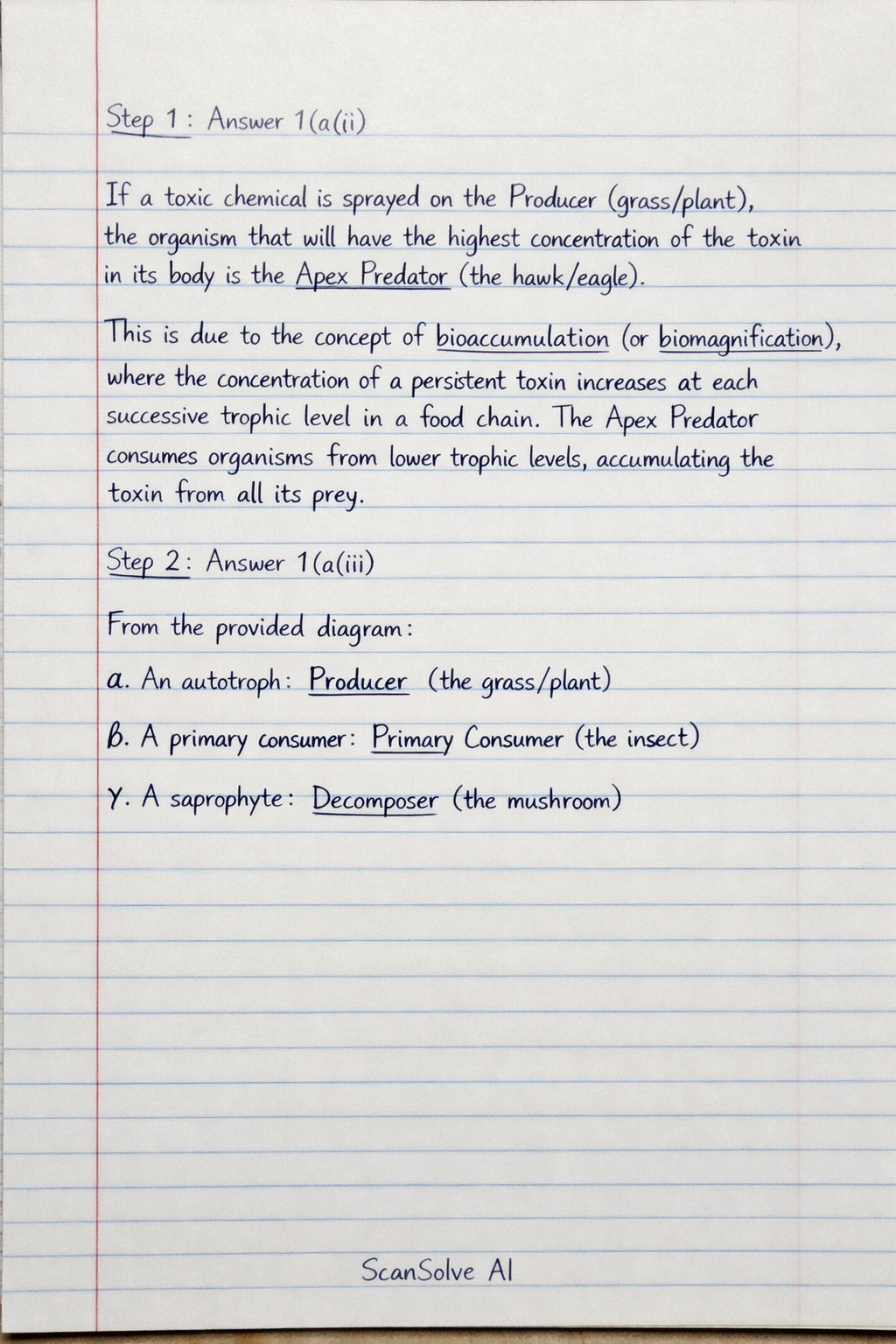
If a toxic chemical is sprayed on the Producer (grass/plant), the organism that will have the highest concentration of the toxin in its body is the Apex Predator (the hawk/eagle). This is due to the concept of bioaccumulation (or biomagnification), where the concentration of a persistent toxin increases at each successive trophic level in a food chain. The Apex Predator consumes organisms from lower trophic levels, accumulating the toxin from all its prey.
Answer 1(a)(ii)
From the provided diagram:
- α. An autotroph: Producer (the grass/plant)
- β. A primary consumer: Primary Consumer (the insect)
- γ. A saprophyte: Decomposer (the mushroom)
Answer 1(a)(iii)
The claim "Without the Producer, the Apex Predator cannot exist" is correct. Even though the Apex Predator (hawk/eagle) does not directly eat plants, it relies on the entire food chain for its survival. The Producer (grass/plant) forms the base of the food chain, converting sunlight into energy. If the Producer is absent, the Primary Consumers (insects) would have no food, leading to their decline. This would then impact the Secondary Consumers (birds), Tertiary Consumers (snakes), and ultimately the Apex Predator, as their food sources would disappear. All energy in the ecosystem originates from the producers.
Answer 1(b)(i)
The tools in Fig. 1: (b) can be classified as follows:
Hand tools Machinery Watering can Tractor Shovel/Spade Plough Hoe Wheelbarrow
Still stuck on this one?
Ask a follow-up, and the answer starts from this question.
More Biology Questions
Handwritten Step-by-Step Solution
Get this as a handwritten image on WhatsApp — like a tutor wrote it for you.
Try on WhatsApp