
We read your photo as:
Explain the classification of fungi, their general characteristics, their importance to soil, and their differences from bacteria and viruses.
ScanSolve AI Answer
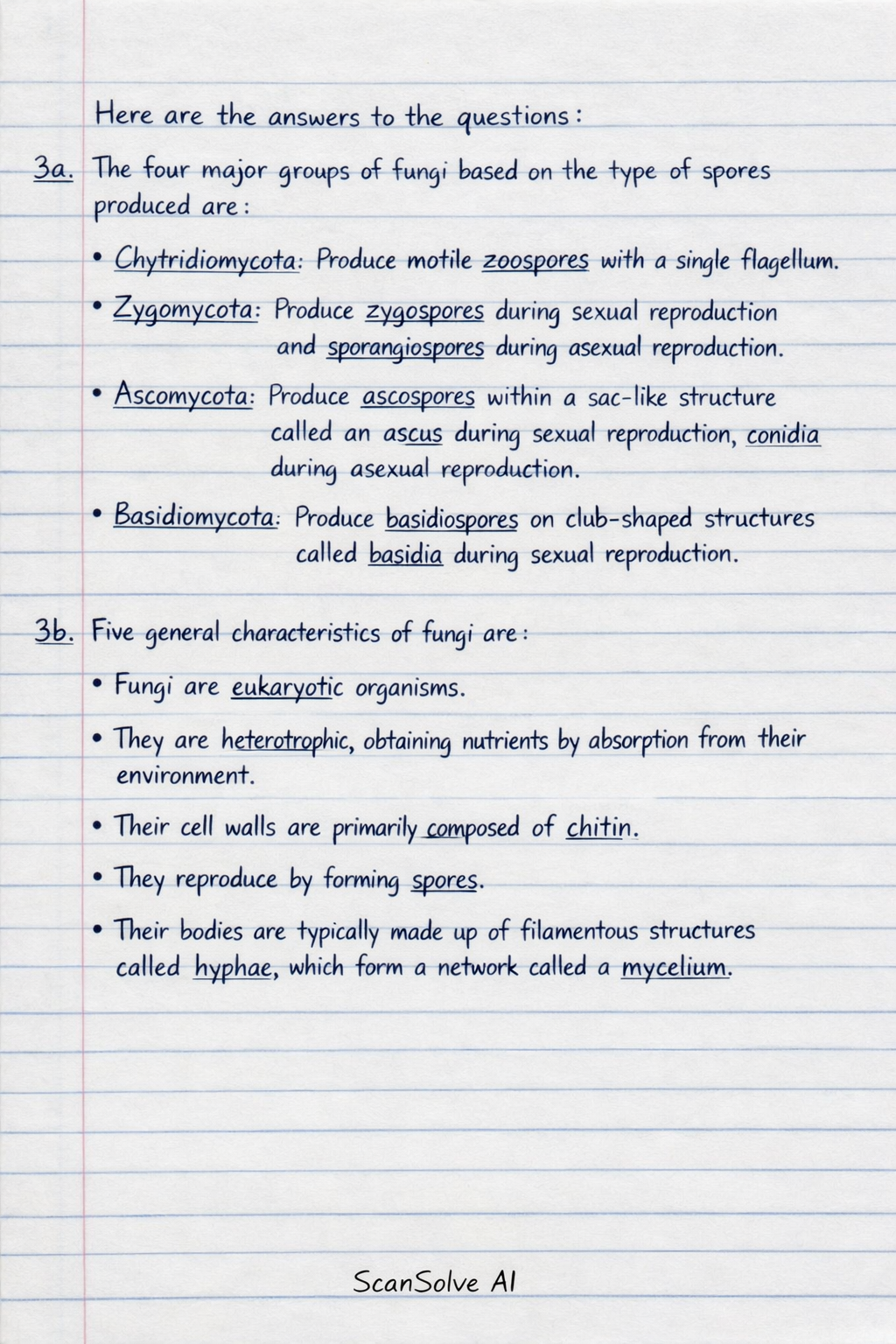
Here are the answers to the questions:
3a. The four major groups of fungi based on the type of spores produced are:
- Chytridiomycota: Produce motile zoospores with a single flagellum.
- Zygomycota: Produce zygospores during sexual reproduction and sporangiospores during asexual reproduction.
- Ascomycota: Produce ascospores within a sac-like structure called an ascus during sexual reproduction, and conidia during asexual reproduction.
- Basidiomycota: Produce basidiospores on club-shaped structures called basidia during sexual reproduction.
3b. Five general characteristics of fungi are:
- Fungi are eukaryotic organisms.
- They are heterotrophic, obtaining nutrients by absorption from their environment.
- Their cell walls are primarily composed of chitin.
- They reproduce by forming spores.
- Their bodies are typically made up of filamentous structures called hyphae, which form a network called a mycelium.
3c. Two importance of fungi to the soil are:
- Fungi act as primary decomposers of organic matter, breaking down dead plants and animals and recycling nutrients back into the soil.
- Many fungi form mycorrhizal associations with plant roots, enhancing the plant's ability to absorb water and essential nutrients from the soil.
3d. Four differences between bacteria and viruses:
- Cellular Structure: Bacteria are prokaryotic cells with a cell membrane, cytoplasm, and genetic material. Viruses are acellular and consist of genetic material (DNA or RNA) enclosed in a protein coat.
- Size: Bacteria are generally much larger than viruses, typically measured in micrometers. Viruses are significantly smaller, measured in nanometers.
- Reproduction: Bacteria reproduce independently through binary fission. Viruses are obligate intracellular parasites and can only replicate inside living host cells.
- Metabolism: Bacteria possess their own metabolic machinery to produce energy and synthesize proteins. Viruses lack metabolic machinery and rely entirely on the host cell's metabolic processes.
4a. Define the following:
- (i) Immunity: The ability of an organism to resist infection by pathogens or the effects of their harmful products.
- (ii) Antibody: A protein produced by plasma cells in response to an antigen, capable of binding specifically to that antigen to neutralize or eliminate it.
- (iii) Vaccine: A biological preparation that provides active acquired immunity to a particular infectious disease. It typically contains an agent that resembles a disease-causing microorganism.
- (iv) Antigen: A substance that can trigger an immune response, leading to the production of antibodies.
- (v) Microbial growth: An increase in the number of microbial cells, rather than an increase in the size of individual cells.
4b. Differentiate between naturally and artificially acquired immunity:
- Naturally acquired immunity is immunity gained through normal life experiences. This can be active (e.g., developing immunity after recovering from an infection) or passive (e.g., antibodies transferred from mother to fetus via the placenta).
- Artificially acquired immunity is immunity gained through medical intervention. This can be active (e.g., developing immunity after vaccination) or passive (e.g., receiving an injection of pre-formed antibodies).
4c. Theory of spontaneous generation suggests that some living creatures and organisms arise from non-living matter or source, True or False. Justify your answer.
- False.
- The theory of spontaneous generation was disproven by experiments conducted by scientists like Louis Pasteur. Pasteur's swan-neck flask experiment demonstrated that microorganisms arise from pre-existing microorganisms in the air, not spontaneously from non-living broth.
4d. What is intermediate host?
- An intermediate host is an organism that harbors the larval or asexual stage of a parasite and is essential for the completion of the parasite's life cycle. The parasite undergoes development or asexual reproduction in this host before being transmitted to a definitive host.
Still stuck on this one?
Ask a follow-up, and the answer starts from this question.
More Biology Questions
Handwritten Step-by-Step Solution
Get this as a handwritten image on WhatsApp — like a tutor wrote it for you.
Try on WhatsApp