
We read your photo as:
Describe the clinical stages of syphilis.
ScanSolve AI Answer
Step-by-step solution
21 stepsHere are the answers to your questions.
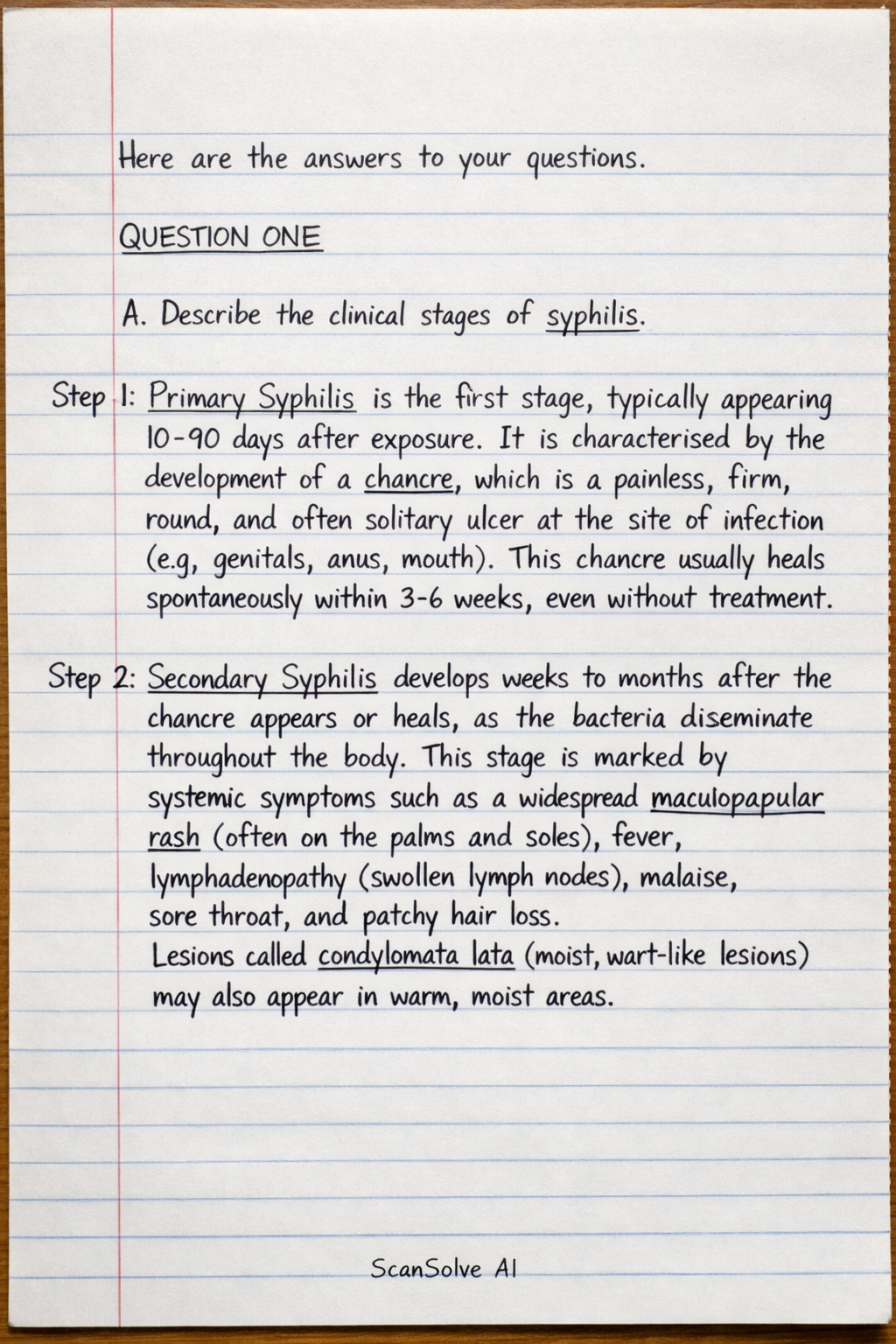
QUESTION ONE
A. Describe the clinical stages of syphilis.
Primary Syphilis* is the first stage, typically appearing 10-90 days after exposure.
It is characterized by the development of a chancre, which is a painless, firm, round, and often solitary ulcer at the site of infection (e.g., genitals, anus, mouth). This chancre usually heals spontaneously within 3-6 weeks, even without treatment.
Secondary Syphilis* develops weeks to months after the chancre appears or heals, as the bacteria disseminate throughout the body.
This stage is marked by systemic symptoms such as a widespread maculopapular rash (often on the palms and soles), fever, lymphadenopathy (swollen lymph nodes), malaise, sore throat, and patchy hair loss. Lesions called condylomata lata (moist, wart-like lesions) may also appear in warm, moist areas.
Latent Syphilis* follows the secondary stage if left untreated.
During this stage, there are no visible signs or symptoms of the disease. It can be divided into early latent (within 1 year of infection) and late latent (more than 1 year after infection). The infection remains in the body, and serological tests will still be positive. This stage can last for many years.
Tertiary Syphilis* develops in about 15-30% of untreated individuals, often years to decades after the initial infection.
This stage can affect multiple organ systems and is characterized by severe complications. These include gummas (soft, non-cancerous growths on skin, bones, or internal organs), cardiovascular syphilis (e.g., aortitis, aortic aneurysm), and neurosyphilis (affecting the brain, spinal cord, or nerves, leading to symptoms like paralysis, numbness, dementia, or blindness).
B. Explain the following approaches to STI management:
I. Etiologic approach
The etiologic approach to STI management involves identifying the specific causative pathogen through laboratory testing before initiating treatment.
This approach provides high diagnostic accuracy, allowing for targeted and specific treatment, which can reduce unnecessary antibiotic use and prevent drug resistance.
However, it requires access to laboratory facilities, trained personnel, and can lead to delays in treatment while waiting for test results.
II. Clinical approach
The clinical approach to STI management relies on the clinician's assessment of a patient's signs and symptoms, medical history, and risk factors to make a diagnosis and guide treatment.
This approach is often used when laboratory tests are unavailable or impractical.
It allows for immediate treatment based on clinical judgment, but its accuracy can vary depending on the clinician's experience and the clarity of symptoms. In many contexts, the clinical approach is closely related to or forms the basis of the syndromic approach.
III. Syndromic approach
The syndromic approach is a specific type of clinical approach where STIs are managed based on a patient's presenting syndrome (a collection of consistent signs and symptoms), without waiting for laboratory confirmation.
This approach uses standardized flowcharts or algorithms to guide diagnosis and treatment for common STI syndromes (e.g., urethral discharge, genital ulcer disease).
It facilitates rapid, accessible, and affordable treatment, especially in resource-limited settings, but may result in overtreatment or undertreatment due to its lower diagnostic specificity.
C. State any THREE (3) biological factors that may contribute to the spread of STIs.
Step 11
- Asymptomatic infections: Many STIs, such as Chlamydia, Gonorrhea, and early-stage HIV, can be asymptomatic, meaning infected individuals may not know they have the infection and can unknowingly transmit it to others.
- Host susceptibility: Biological differences, such as the larger mucosal surface area in females or the presence of an immature cervix in adolescent females, can increase their physiological vulnerability to acquiring STIs.
- Viral shedding: For viral STIs like Herpes Simplex Virus (HSV) or Human Papillomavirus (HPV), the virus can be shed from the skin or mucosa even in the absence of visible lesions, leading to transmission during asymptomatic periods.
QUESTION TWO
A. Describe what measures can be implemented to prevent and control Yaws.
Mass Drug Administration (MDA)* is a primary measure.
A single oral dose of azithromycin can effectively treat yaws. Implementing large-scale campaigns to treat entire communities, especially children, helps to interrupt transmission.
Active Case Finding and Treatment (ACFT)* involves systematically searching for individuals with yaws lesions in endemic areas and providing immediate treatment.
This helps to identify and treat cases that might not present to health facilities.
Surveillance and Monitoring* are crucial to track the prevalence of yaws, identify new outbreaks, and assess the effectiveness of control programs.
This includes regular surveys and reporting mechanisms.
Health Education and Community Engagement* are important to raise awareness about yaws, its transmission, symptoms, and the importance of seeking treatment.
Promoting good hygiene practices, such as regular washing, can also help prevent skin-to-skin transmission.
Improved Sanitation and Hygiene* can reduce the risk of skin abrasions and secondary bacterial infections, which can make individuals more susceptible to yaws.
B. Explain FOUR (4) reasons for possible eradication of Yaws.
Human-only reservoir*
Yaws is exclusively a human disease, meaning there is no animal reservoir to sustain the infection. This simplifies eradication efforts as interventions only need to target the human population.
Effective and simple treatment*
A single oral dose of azithromycin is highly effective in curing yaws. This simple, inexpensive, and easily administered treatment makes mass drug administration campaigns feasible and highly successful.
No vaccine required*
Eradication does not depend on the development or widespread distribution of a vaccine, which can be a complex and costly endeavor for other diseases. The focus is solely on treating existing infections.
Visible clinical manifestations*
Yaws lesions are typically visible and distinctive, especially in the early stages. This allows for relatively easy clinical diagnosis and identification of cases in the field, facilitating active case finding and treatment.
C. State FIVE (5) complications of Buruli ulcer.
Step 21
- Extensive skin and soft tissue destruction: The infection can lead to large, debilitating ulcers that destroy skin, subcutaneous tissue, and sometimes muscle, causing significant disfigurement.
- Contractures and deformities: Healing of large ulcers, especially over joints, can result in severe scarring, leading to contractures that limit joint movement and cause permanent physical deformities.
- Osteomyelitis: In severe cases, the infection can spread to the bone, causing osteomyelitis (bone infection), which can lead to bone destruction and pathological fractures.
- Secondary bacterial infections: The open wounds of Buruli ulcer are susceptible to secondary bacterial infections, which can worsen tissue damage, delay healing, and lead to systemic complications like sepsis.
- Functional limitations and disability: Due to tissue destruction, contractures, and bone involvement, patients can experience significant functional impairment, leading to long-term disability, especially if the lesions affect limbs or joints.
Still stuck on this one?
Ask a follow-up, and the answer starts from this question.
More Biology Questions
Handwritten Step-by-Step Solution
Get this as a handwritten image on WhatsApp — like a tutor wrote it for you.
Try on WhatsApp