

This biology question covers important biological concepts and processes. The step-by-step explanation below helps you understand the underlying mechanisms and reasoning.
ScanSolve AI Answer
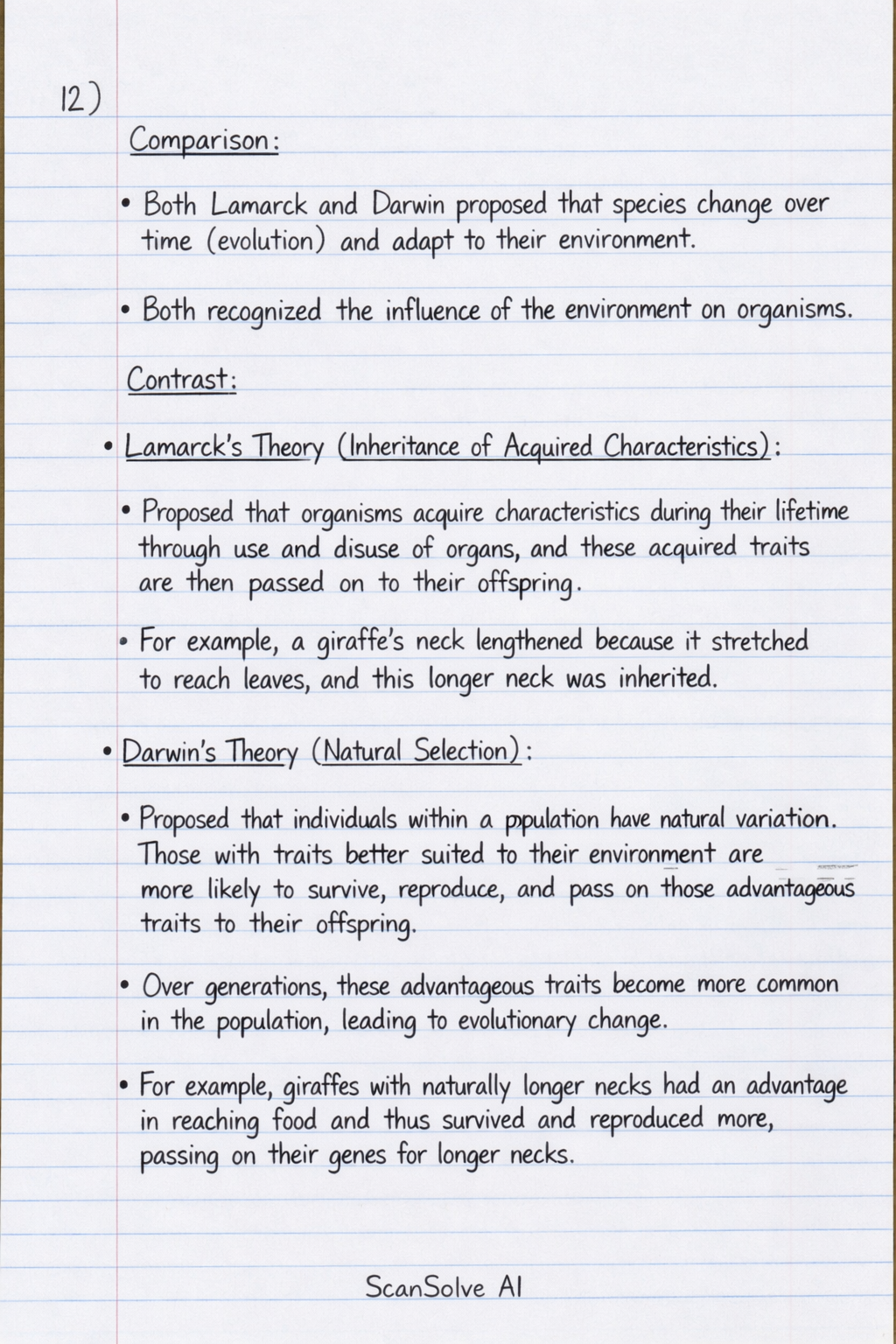
12) Comparison: • Both Lamarck and Darwin proposed that species change over time (evolution) and adapt to their environment. • Both recognized the influence of the environment on organisms. Contrast: • Lamarck's Theory (Inheritance of Acquired Characteristics): Proposed that organisms acquire characteristics during their lifetime through use and disuse of organs, and these acquired traits are then passed on to their offspring. For example, a giraffe's neck lengthened because it stretched to reach leaves, and this longer neck was inherited. • Darwin's Theory (Natural Selection): Proposed that individuals within a population have natural variation. Those with traits better suited to their environment are more likely to survive, reproduce, and pass on those advantageous traits to their offspring. Over generations, these advantageous traits become more common in the population, leading to evolutionary change. For example, giraffes with naturally longer necks had an advantage in reaching food and thus survived and reproduced more, passing on their genes for longer necks. 13) Mutations are the ultimate source of all new genetic variation in a population, which is essential for evolution. Step 1: Mutations are random changes in the DNA sequence of an organism. Step 2: These changes can create new alleles (different forms of a gene) or alter existing ones. Step 3: This new genetic variation provides the raw material upon which natural selection can act. If a mutation results in a trait that is advantageous in a particular environment, individuals with that mutation are more likely to survive and reproduce, increasing the frequency of the mutated gene in the population over time. 14) Microorganisms become resistant to drugs through the process of natural selection. Step 1: Within a population of microorganisms, there is natural genetic variation, and some individuals may possess random mutations that confer resistance to a particular drug. Step 2: When the drug is administered, it acts as a selective pressure, killing off the susceptible (non-resistant) microorganisms. Step 3: The resistant microorganisms survive and reproduce, passing on their resistance genes to their offspring. Step 4: Over time, the proportion of resistant microorganisms in the population increases, making the drug less effective or completely ineffective against that strain. 15) According to Lamarck's theory, the emergence of webbed feet in ducks would be explained as follows: Step 1: Ducks, needing to swim to find food or escape predators, would repeatedly stretch their toes to push through the water more efficiently. Step 2: This constant use and stretching of the skin between their toes would cause the webbing to develop and become more pronounced during the duck's lifetime (an acquired characteristic). Step 3: This acquired trait of webbed feet would then be passed on to their offspring, and over many generations, ducks would be born with increasingly webbed feet. Last free one today — make it count tomorrow, or type /upgrade for unlimited.