
We read your photo as:
Compare the effect of atmospheric air and exhaled air on limewater, state the aim of the experiment, and explain why limewater is essential for observing the results.
ScanSolve AI Answer
Answer
(i), (ii) and (iv)
Step-by-step solution
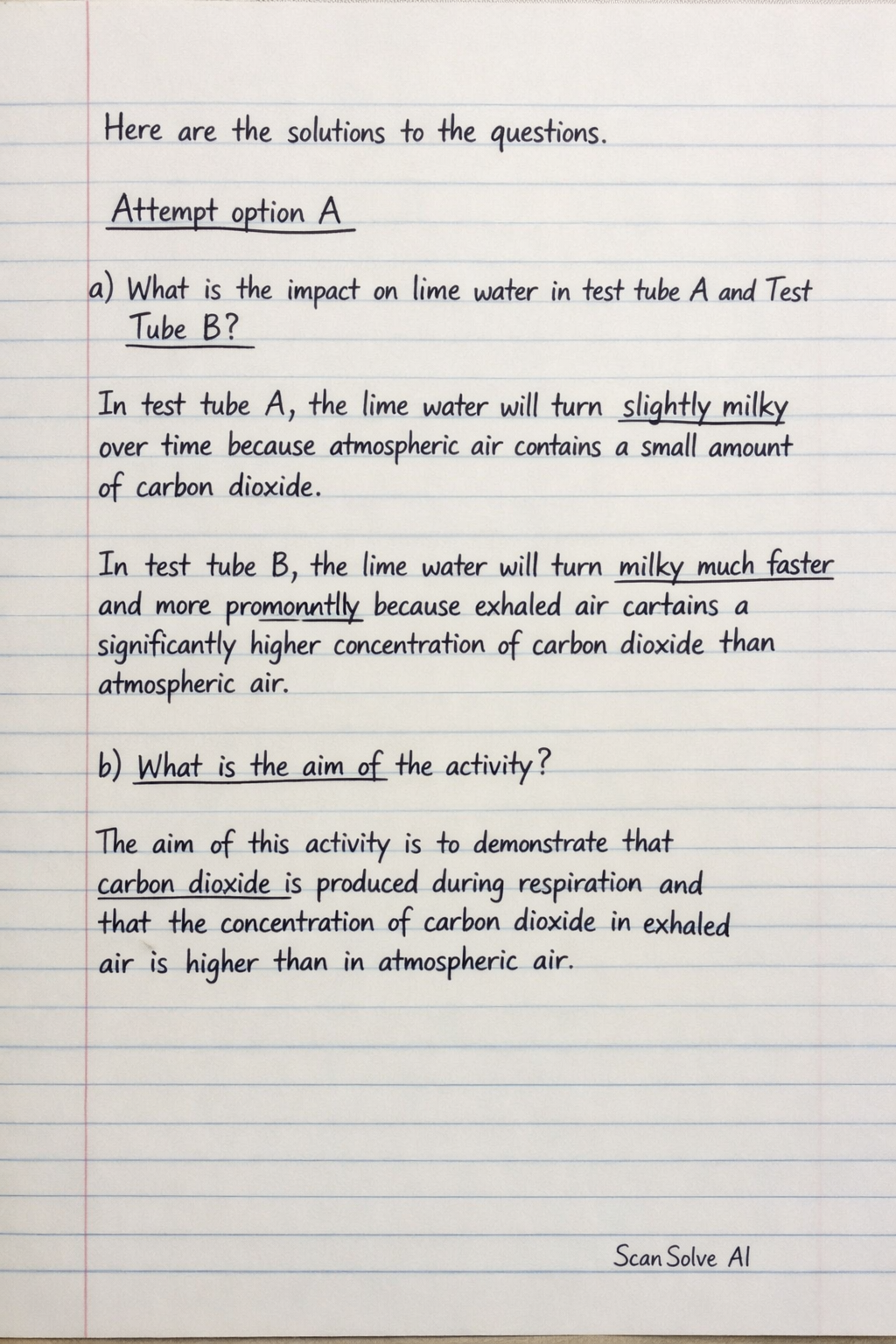
6 stepsHere are the solutions to the questions.
Attempt option A
Part a
What is the impact on lime water in test tube A and Test Tube B?
In test tube A, the lime water will turn slightly milky over time because atmospheric air contains a small amount of carbon dioxide.
In test tube B, the lime water will turn milky much faster and more prominently because exhaled air contains a significantly higher concentration of carbon dioxide than atmospheric air.
Part b
What is the aim of the activity?
The aim of this activity is to demonstrate that carbon dioxide is produced during respiration and that the concentration of carbon dioxide in exhaled air is higher than in atmospheric air.
Part c
Instead of lime water if we will take normal Luke warm water, will the result of the activity be same? Give two reasons to support your answer.
No, the result of the activity will not be the same if normal lukewarm water is used instead of lime water.
- Lime water (calcium hydroxide solution) reacts chemically with carbon dioxide to form insoluble calcium carbonate, which appears as a milky precipitate. Normal lukewarm water does not react with carbon dioxide in a way that produces a visible change.
- The activity relies on a visible indicator (the milky precipitate) to show the presence and relative concentration of carbon dioxide. Lukewarm water would simply dissolve some carbon dioxide without providing any visual evidence of its presence or difference in concentration.
Section - B (Chemistry)
Part 1· 5 steps
Which of the following statements about the given reaction are correct?
Determine the oxidation states of elements in the reactants and products.
- In , the oxidation state of Fe is 0.
- In , the oxidation state of H is and O is .
- In , the oxidation state of O is . For , , so , meaning the average oxidation state of Fe is .
- In , the oxidation state of H is 0.
Identify which species are oxidized and reduced.
- Iron (Fe) changes its oxidation state from 0 to . Since the oxidation state increases, iron is oxidised.
- Hydrogen (H) in water changes its oxidation state from to 0. Since the oxidation state decreases, water () is reduced.
- Oxygen (O) maintains its oxidation state of .
Determine the roles of reactants as oxidizing or reducing agents.
- Since Fe is oxidised, it acts as the reducing agent.
- Since is reduced, it acts as the oxidising agent.
Evaluate the given statements based on the analysis.
- (i) Iron metal is getting oxidised: Correct.
- (ii) Water is getting reduced: Correct.
- (iii) Water is acting as reducing agent: Incorrect (it is an oxidising agent).
- (iv) Water is acting as oxidising agent: Correct.
Select the option that includes all correct statements.
The correct statements are (i), (ii), and (iv).
The correct option is C. (i), (ii) and (iv).
Part 2· 1 step
Sodium hydrogen carbonate when reacts with acetic acid, evolves a gas. Which of the following statement is true about the gas evolved?
Identify the gas evolved.
Try one yourself
A new problem that tests the same skill.
Still stuck on this one?
Ask a follow-up, and the answer starts from this question.
More Biology Questions
Handwritten Step-by-Step Solution
Get this as a handwritten image on WhatsApp — like a tutor wrote it for you.
Try on WhatsApp