
We read your photo as:
A student is diluting concentrated sulfuric acid and preparing to test its properties. The experiment involves observing the reaction with water and identifying the resulting solution. The student als
ScanSolve AI Answer
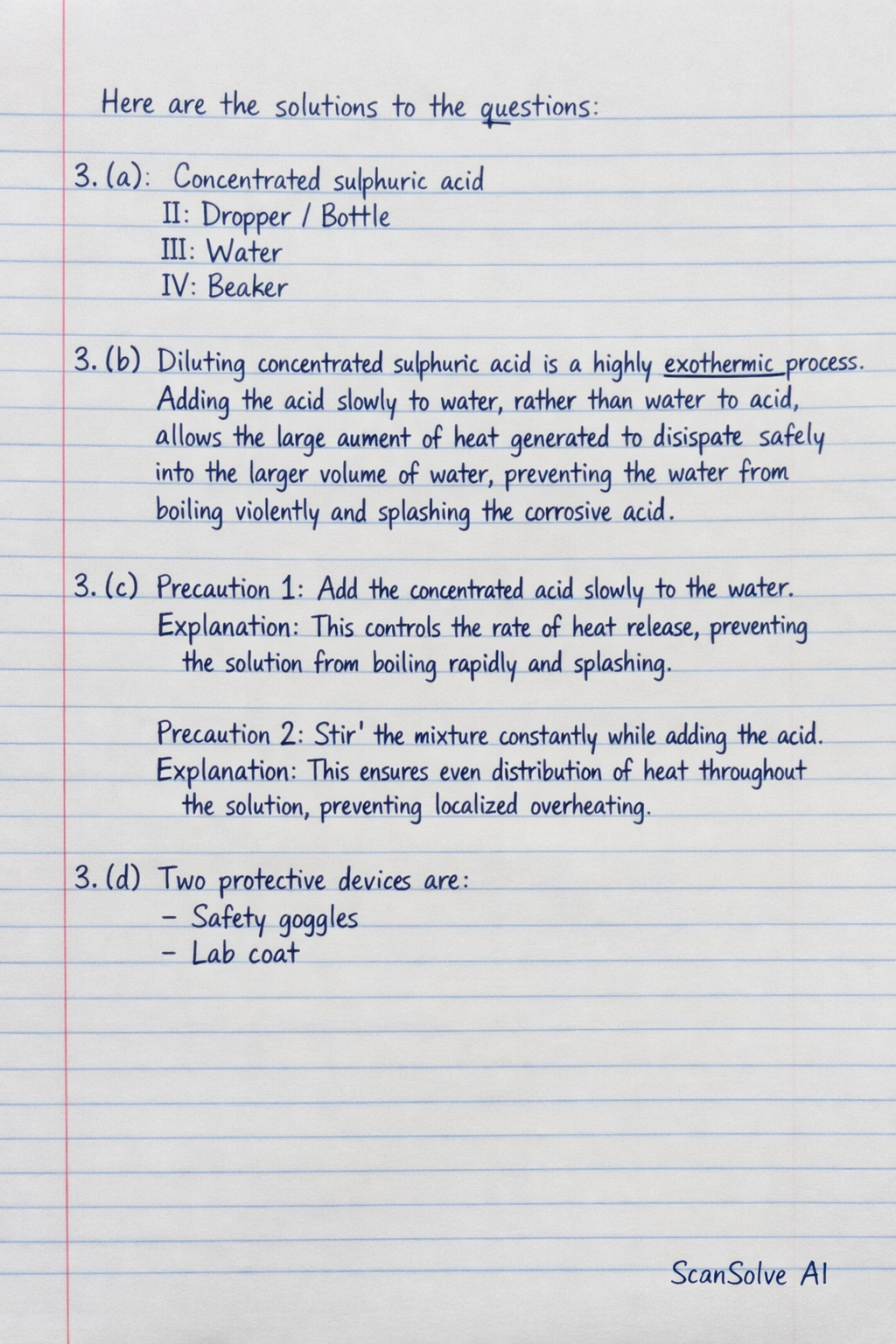
Here are the solutions to the questions:
3. (a)
- I: Concentrated sulphuric acid
- II: Dropper/Bottle
- III: Water
- IV: Beaker
3. (b)
Diluting concentrated sulfuric acid is a highly exothermic process. Adding the acid slowly to water, rather than water to acid, allows the large amount of heat generated to dissipate safely into the larger volume of water, preventing the water from boiling violently and splashing the corrosive acid.
3. (c)
- Precaution 1: Add the concentrated acid slowly to the water.
- Explanation: This controls the rate of heat release, preventing the solution from boiling rapidly and splashing.
- Precaution 2: Stir the mixture constantly while adding the acid.
- Explanation: This ensures even distribution of heat throughout the solution, preventing localized overheating.
3. (d)
Two protective devices are:
- Safety goggles
- Lab coat
3. (e)
To confirm the diluted solution is an acid, one could:
- Use blue litmus paper, which would turn red.
- Use a pH meter, which would show a pH value less than 7.
4. (i) (a)
The man is suffering from myopia (short-sightedness).
4. (i) (b)
The defect is caused by the eyeball being too long or the lens being too powerful, causing light to focus in front of the retina.
4. (i) (c)
A concave lens (diverging lens) would be needed to correct the defect.
4. (ii) (a)
- : Stopper/Cork
- : Vacuum
- : Silvered surface
4. (ii) (b)
Heat lost by conduction is prevented by the vacuum between the double walls and the stopper, which are poor conductors of heat.
4. (ii) (c)
Heat lost by convection is prevented by the vacuum between the double walls (as there is no medium for convection) and the stopper (which prevents air from entering or leaving).
4. (ii) (d)
Heat lost by radiation is prevented by the silvered surfaces of the inner and outer walls, which reflect radiant heat.
Still stuck on this one?
Ask a follow-up, and the answer starts from this question.
More Chemistry Questions
Handwritten Step-by-Step Solution
Get this as a handwritten image on WhatsApp — like a tutor wrote it for you.
Try on WhatsApp