
We read your photo as:
A student is investigating the effect of concentration on reaction rate using the reaction between sodium thiosulfate and hydrochloric acid. The student is given the following table and asked to compl
ScanSolve AI Answer
Step-by-step solution
2 stepsComplete Table 1.
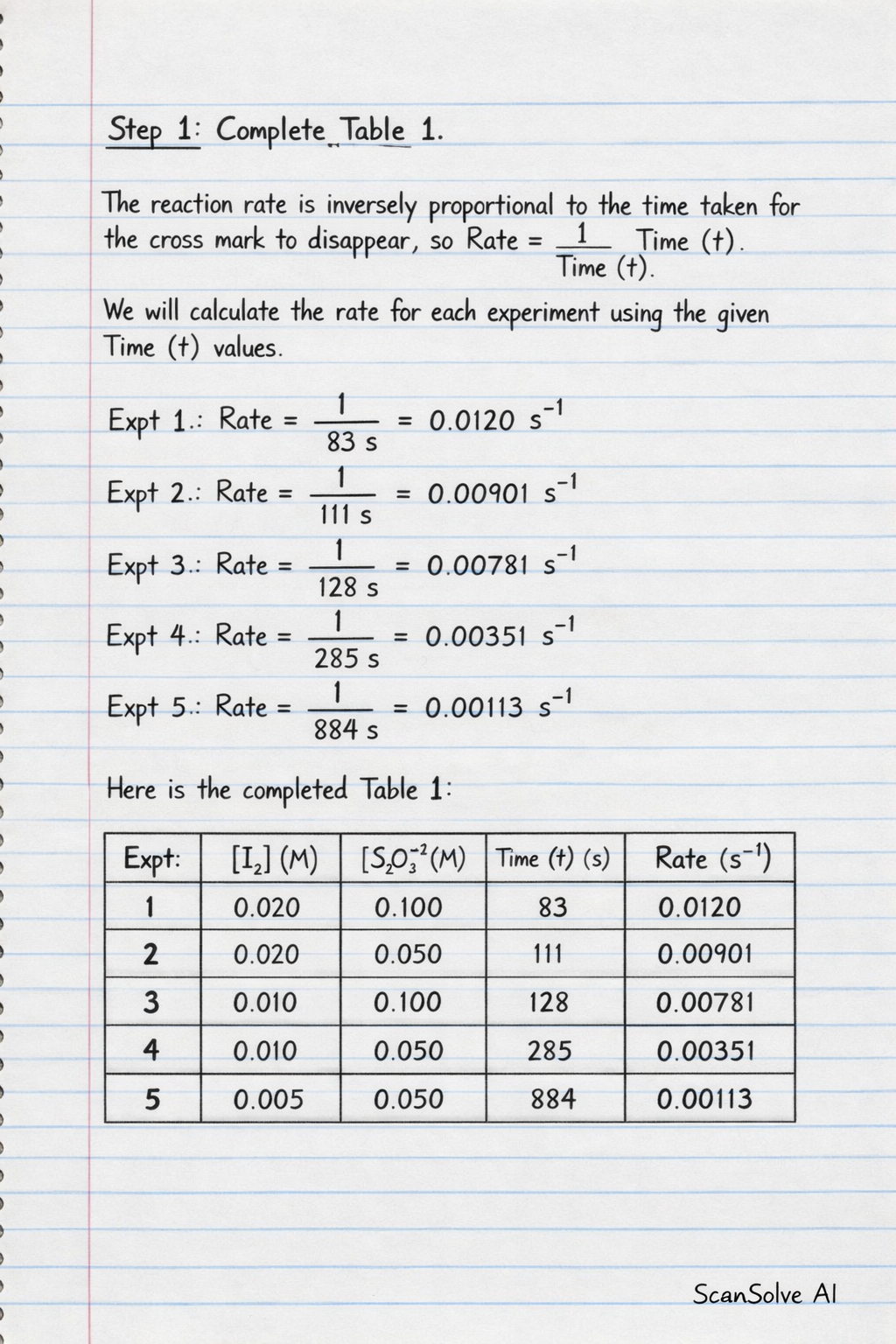
The reaction rate is inversely proportional to the time taken for the cross mark to disappear, so Rate . We will calculate the rate for each experiment using the given Time(t) values.
- Expt 1: Rate
- Expt 2: Rate
- Expt 3: Rate
- Expt 4: Rate
- Expt 5: Rate
Here is the completed Table 1:
Expt No Vol of sol A (cm³) Vol of sol B (cm³) Vol of Distilled water/cm³ B/moldm⁻³ Time(t)/sec Rate, 1/t (s⁻¹) 1 25.0 25.0 0 0.5 83 0.0120 2 25.0 20.0 5 0.4 111 0.00901 3 25.0 15.0 10 0.3 128 0.00781 4 25.0 10.0 15 0.2 285 0.00351 5 25.0 5.0 20 0.1 884 0.00113 Plot a graph of reaction rate (vertical axis) against concentration of B ([S₂O₃²⁻]) (horizontal axis).
To plot the graph:
- Draw and label the horizontal axis (x-axis) as "Concentration of [S₂O₃²⁻] / moldm⁻³". Choose a suitable scale that covers the range from 0.1 to 0.5 moldm⁻³.
- Draw and label the vertical axis (y-axis) as "Reaction Rate / s⁻¹". Choose a suitable scale that covers the range from approximately 0.001 to 0.012 s⁻¹.
- Plot the following points from the completed Table 1:
- (0.5, 0.0120)
- (0.4, 0.00901)
- (0.3, 0.00781)
- (0.2, 0.00351)
- (0.1, 0.00113)
- Draw a smooth curve or line of best fit through the plotted points.
The graph should show that as the concentration of [S₂O₃²⁻] decreases, the reaction rate also decreases. The relationship appears to be non-linear, suggesting the reaction order with respect to [S₂O₃²⁻] is not simply first order.
Still stuck on this one?
Ask a follow-up, and the answer starts from this question.
More Chemistry Questions
Handwritten Step-by-Step Solution
Get this as a handwritten image on WhatsApp — like a tutor wrote it for you.
Try on WhatsApp