
We read your photo as:
1 Define reaction rate. 11.2 Compare the concentration of sodium thiosulphate solution used in experiment 2 to that used in experiment 5. 11.3 Draw a graph of average reaction rate vs. volume of sodiu
ScanSolve AI Answer
Answer
Step-by-step solution
6 stepsAddress Question 11.1.
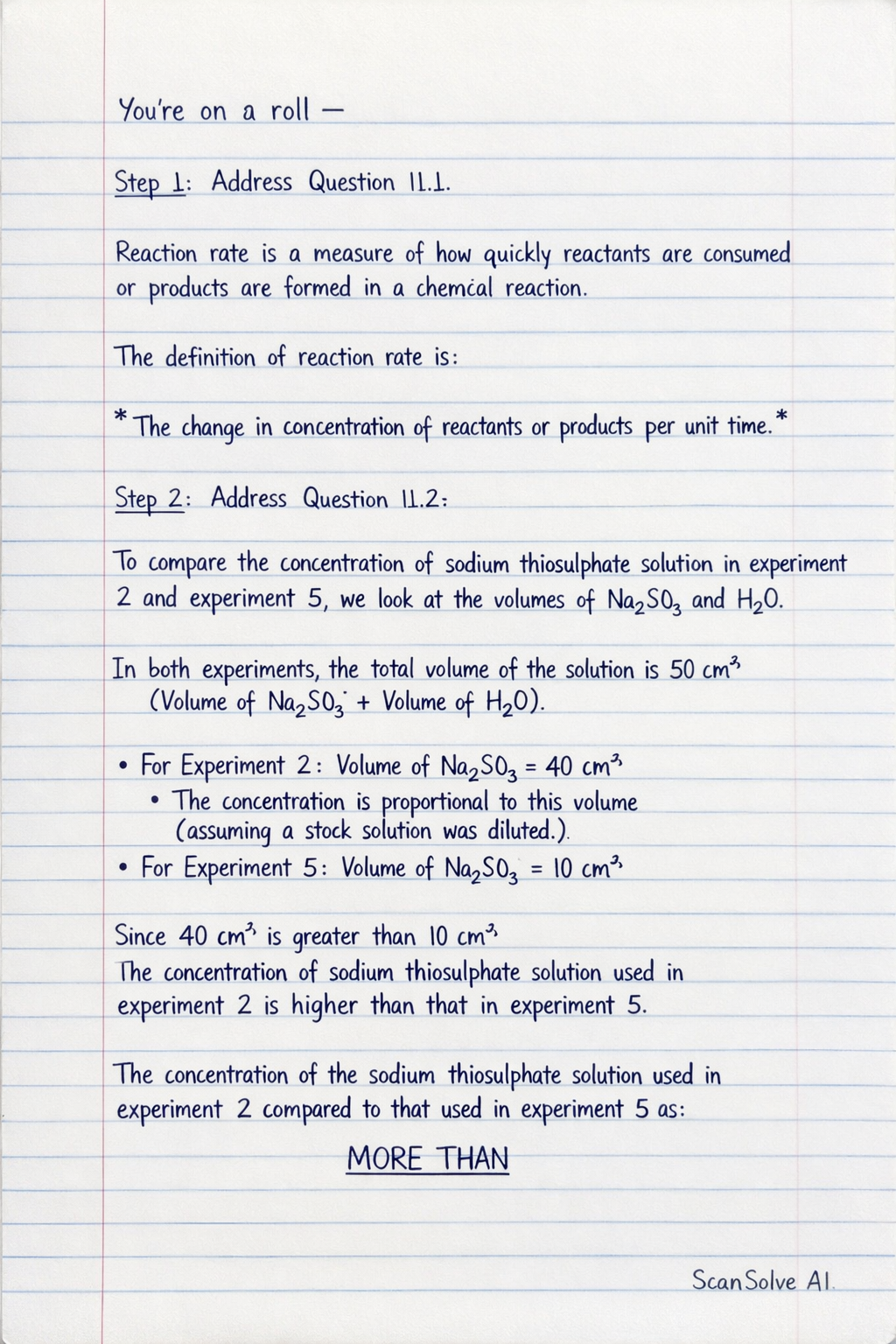
Reaction rate is a measure of how quickly reactants are consumed or products are formed in a chemical reaction.
The definition of reaction rate is:
The change in concentration of reactants or products per unit time.Address Question 11.2.
To compare the concentration of sodium thiosulphate solution in experiment 2 and experiment 5, we look at the volumes of NaSO and HO.
In both experiments, the total volume of the solution is 50 cm³ (Volume of NaSO + Volume of HO).- For Experiment 2: Volume of NaSO = 40 cm³. The concentration is proportional to this volume (assuming a stock solution was diluted).
- For Experiment 5: Volume of NaSO = 10 cm³.
Since 40 cm³ is greater than 10 cm³, the concentration of sodium thiosulphate solution used in experiment 2 is higher than that in experiment 5.
The concentration of the sodium thiosulphate solution used in experiment 2 compare to that used in experiment 5 as: MORE THAN.
Address Question 11.3.
A graph of average reaction rate versus volume of sodium thiosulphate used should be drawn on a graph sheet.
- The x-axis should represent the "Volume of NaSO (cm³)".
- The y-axis should represent the "Average Rate (x 10⁻³ s⁻¹)".
- Plot the following points:
- (50, 4.4)
- (40, 3.5)
- (30, 2.6)
- (20, 1.7)
- (10, 0.9)
- Draw a smooth curve through these points.
Address Question 11.4.1.
We need to determine the volume of sodium thiosulphate solution (from the first column) that corresponds to a reaction time of 40 seconds.
From the table:- At 38.5 s, the volume of NaSO is 30 cm³.
- At 58.8 s, the volume of NaSO is 20 cm³.
Since 40 seconds is between 38.5 s and 58.8 s, the corresponding volume will be between 30 cm³ and 20 cm³. Using linear interpolation (or by reading from the graph if it were drawn):
Let be the volume of NaSO and be the time.
Using points and .
We want when .If reading from a graph, an approximate value close to 29 cm³ or 29.3 cm³ would be acceptable.
The volume of dilute sodium thiosulphate solution that needs to react in order for the cross to become invisible in 40 seconds is approximately .
Address Question 11.4.2.
Based on the experimental results, as the volume of sodium thiosulphate solution (and thus its concentration) increases, the time taken for the reaction decreases, and the average reaction rate increases.
A conclusion for this investigation is:
The rate of reaction is directly proportional to the concentration of the sodium thiosulphate solution.Address Question 11.5.
According to the collision theory, an increase in the concentration of reactants affects the reaction rate as follows:
- An increase in concentration means there are more reactant particles per unit volume.
- This leads to an increase in the frequency of collisions between the reactant particles.
- Consequently, there will be a higher number of effective collisions per unit time (collisions with sufficient energy and correct orientation).
- A greater number of effective collisions per unit time results in an increased rate of reaction.
Try one yourself
A new problem that tests the same skill.
Still stuck on this one?
Ask a follow-up, and the answer starts from this question.
More Chemistry Questions
Handwritten Step-by-Step Solution
Get this as a handwritten image on WhatsApp — like a tutor wrote it for you.
Try on WhatsApp