

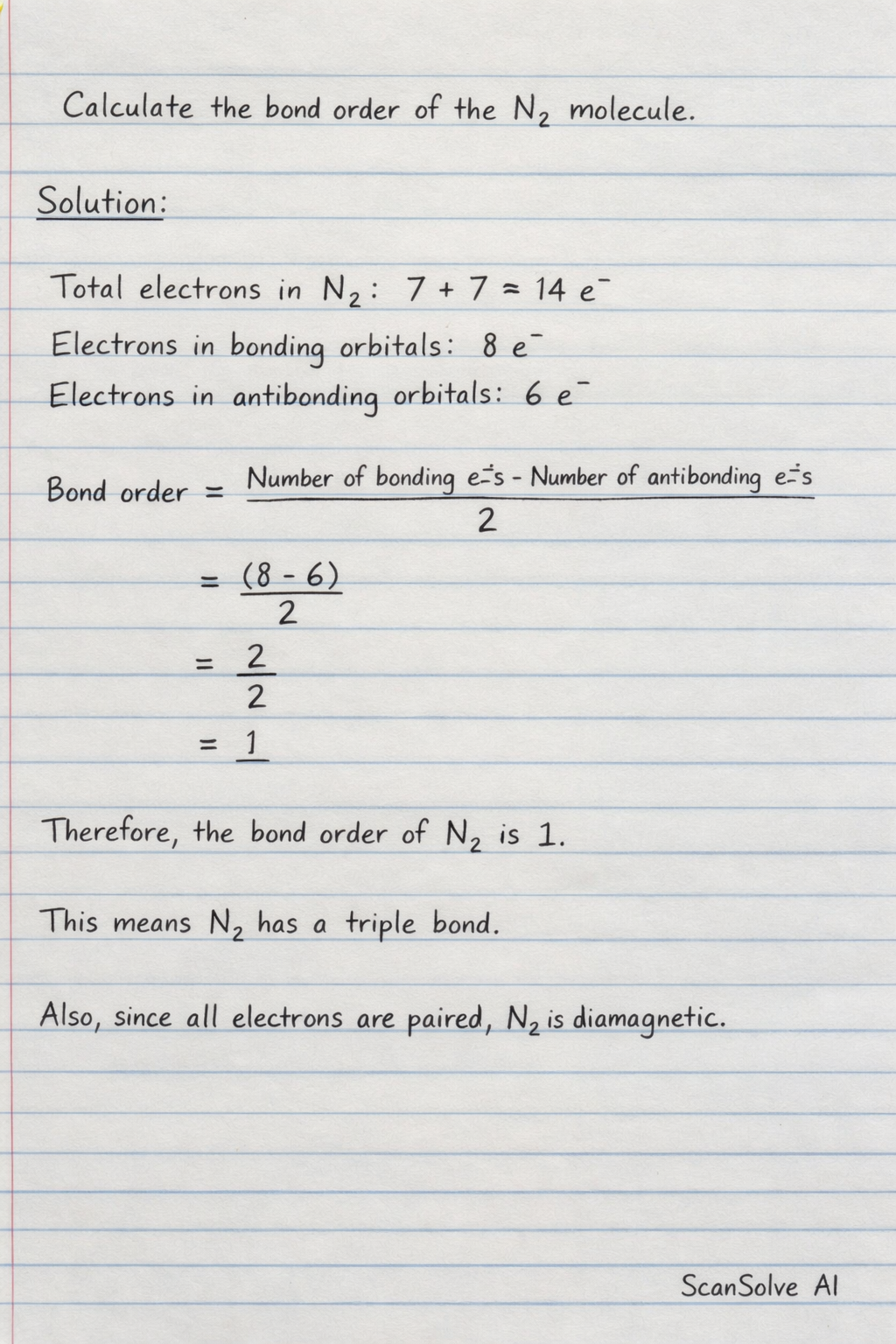
This chemistry question involves key chemical concepts and calculations. The detailed solution below walks through each step, from identifying the reaction type to computing the final answer.
ScanSolve AI Answer
1. Molecular Orbital Theory (MOT) Molecular Orbital Theory describes chemical bonding as the combination of atomic orbitals to form new molecular orbitals that extend over the entire molecule. Electrons in a molecule occupy these molecular orbitals, which can be bonding (lower energy, stabilizing) or antibonding (higher energy, destabilizing). This theory helps explain properties like paramagnetism and bond order that Valence Bond Theory cannot fully account for. 2. Valence Shell Electron Pair Repulsion Theory (VSEPR) Valence Shell Electron Pair Repulsion (VSEPR) theory predicts the three-dimensional geometry of molecules based on the repulsion between electron pairs in the valence shell of the central atom. Both bonding and non-bonding (lone) electron pairs repel each other, arranging themselves as far apart as possible to minimize repulsion and achieve the most stable molecular shape. This arrangement determines the bond angles and overall molecular geometry. Send me the next one 📸