

This chemistry question involves key chemical concepts and calculations. The detailed solution below walks through each step, from identifying the reaction type to computing the final answer.
ScanSolve AI Answer
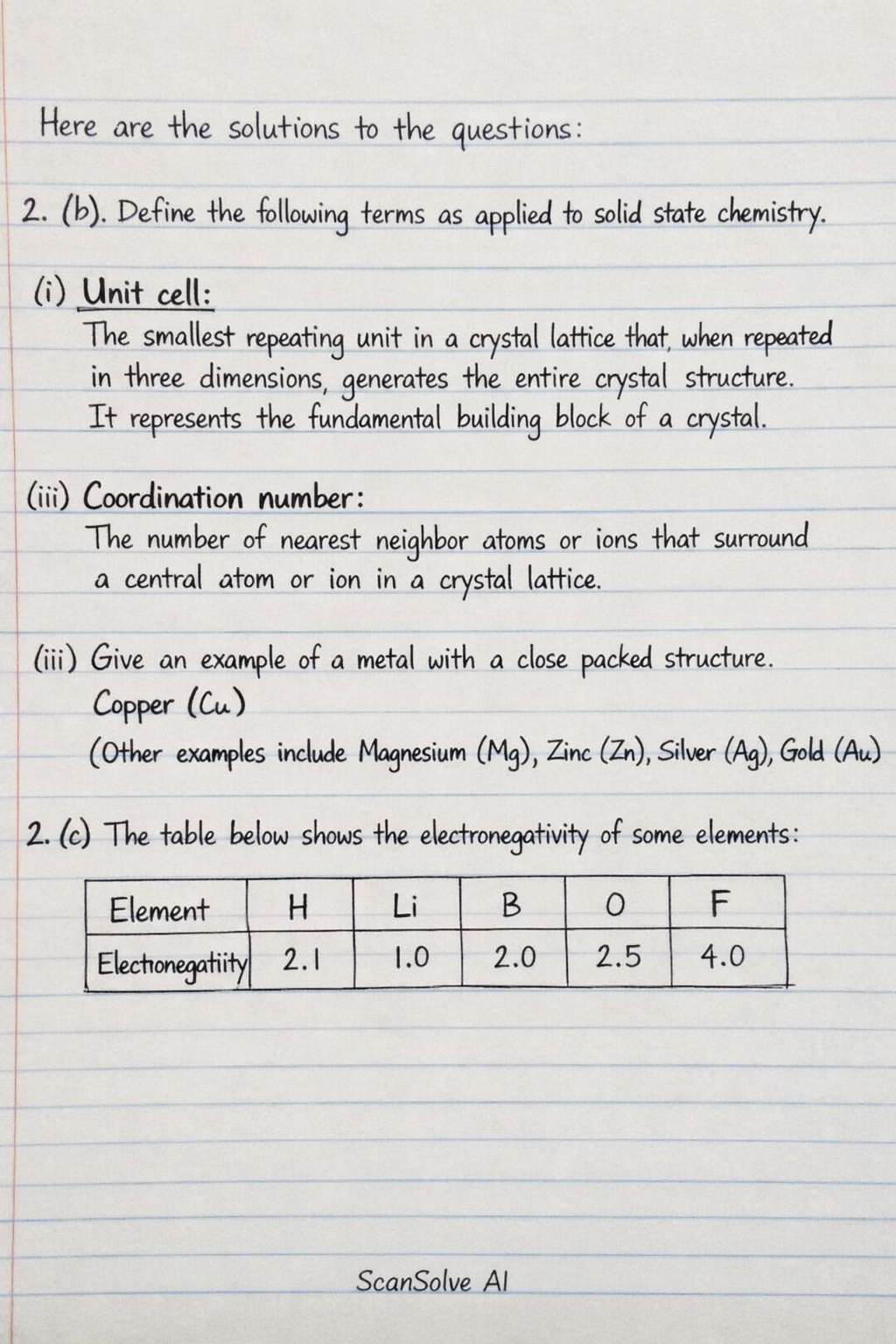
Here are the solutions to the questions: 2. (b) Define the following terms as applied to solid state chemistry (i) Unit cell: The smallest repeating unit* in a crystal lattice that, when repeated in three dimensions, generates the entire crystal structure. It represents the fundamental building block of a crystal. (i) Coordination number: The number of nearest neighbor atoms or ions* that surround a central atom or ion in a crystal lattice. (ii) Give an example of a metal with a close packed structure. Copper (Cu)* (Other examples include Magnesium (Mg), Zinc (Zn), Silver (Ag), Gold (Au)). 2. (c) The table below shows the electronegativity of some elements | Element | H | Li | B | C | O | F | | :--------------- | :---- | :---- | :---- | :---- | :---- | :---- | | Electronegativity | 2.1 | 1.0 | 2.0 | 2.5 | 3.5 | 4.0 | (i) What do you understand by the term electronegativity? Electronegativity is a measure of the tendency of an atom to attract a bonding pair of electrons towards itself in a chemical bond. (ii) Give the formula of an ionic compound formed by two elements on the table. An ionic compound typically forms between a metal and a non-metal with a large difference in electronegativity. Lithium (Li) is a metal (EN = 1.0) and Fluorine (F) is a non-metal (EN = 4.0). The difference is 4.0 - 1.0 = 3.0, indicating a highly ionic bond. Formula: LiF (iii) Suggest the formula of a molecule that has the least polar bond. The least polar bond will be formed between two elements with the smallest difference in electronegativity. Comparing the elements: H (2.1) and B (2.0) have a difference of 2.1 - 2.0 = 0.1. H (2.1) and C (2.5) have a difference of 2.5 - 2.1 = 0.4. O (3.5) and F (4.0) have a difference of 4.0 - 3.5 = 0.5. The smallest difference is between Hydrogen (H) and Boron (B). Formula: BH_3 (Borane) (iv) The boiling points of three molecules are given in the table below | Molecule | Boiling point/K | | :----------------- | :-------------- | | F_2 | 85 | | CH_3F | 194 | | HF | 293 | Explanation of the trend (assuming this is the implied question): The boiling points increase due to the strength of intermolecular forces: F_2 is a nonpolar molecule, so it only experiences weak London Dispersion Forces*. CH_3F is a polar molecule, experiencing London Dispersion Forces and stronger dipole-dipole forces*. HF is a highly polar molecule that can form hydrogen bonds* (due to H being directly bonded to the highly electronegative F atom), which are the strongest type of intermolecular force among these molecules, leading to the highest boiling point.