
We read your photo as:
Explain modern electronic theory of atoms, electronic configuration, periodicity, building up of the periodic table, hybridization, shapes of simple molecules, and valence forces.
ScanSolve AI Answer
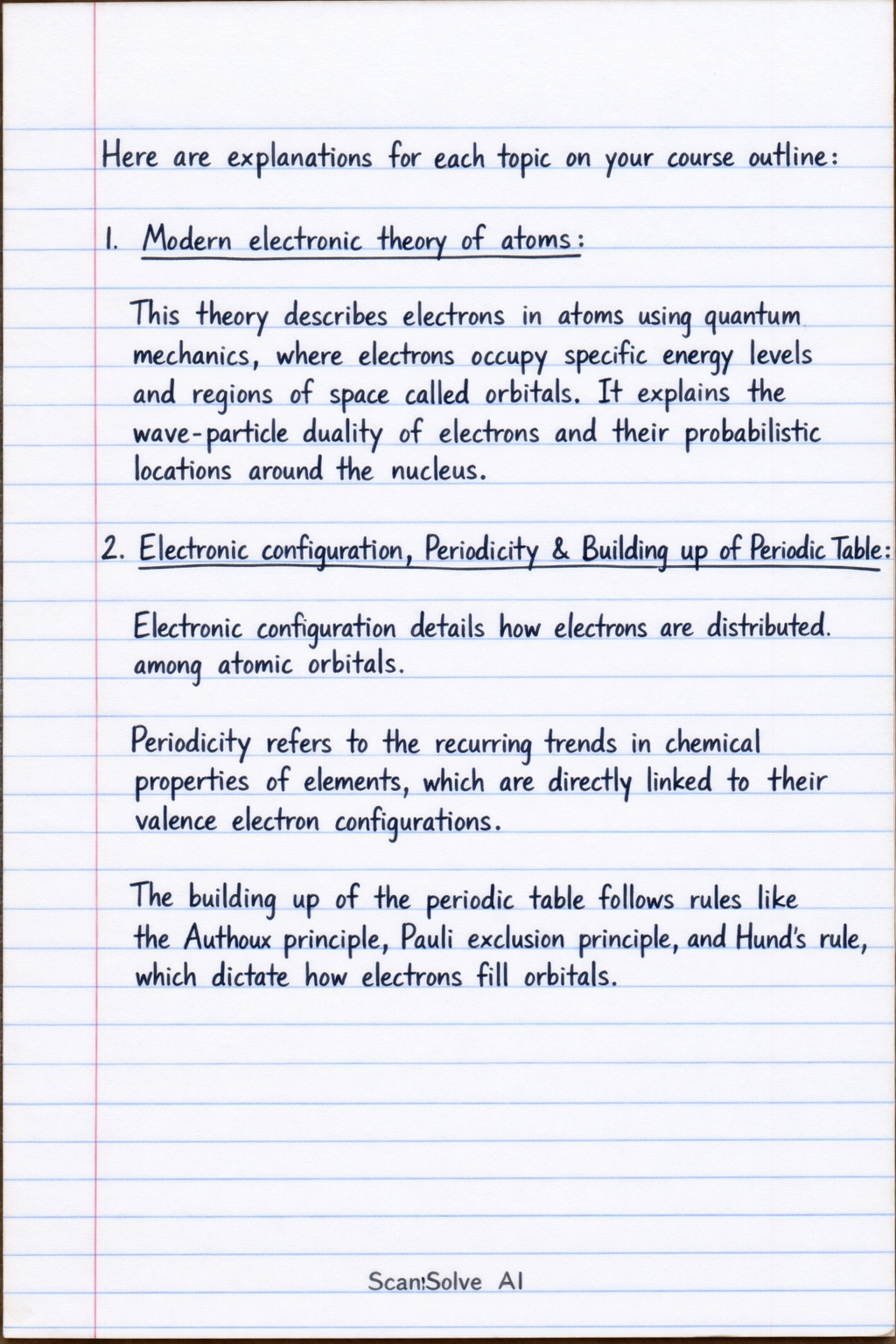
Here are explanations for each topic on your course outline:
-
Modern electronic theory of atoms: This theory describes electrons in atoms using quantum mechanics, where electrons occupy specific energy levels and regions of space called orbitals. It explains the wave-particle duality of electrons and their probabilistic locations around the nucleus.
-
Electronic configuration, Periodicity & Building up of Periodic Table: Electronic configuration details how electrons are distributed among atomic orbitals. Periodicity refers to the recurring trends in chemical properties of elements, which are directly linked to their valence electron configurations. The building up of the periodic table follows rules like the Aufbau principle, Pauli exclusion principle, and Hund's rule, which dictate how electrons fill orbitals.
-
Hybridisation and Shapes of Simple molecules: Hybridization is the concept of mixing atomic orbitals to form new hybrid orbitals that are more suitable for bonding. These hybrid orbitals determine the three-dimensional shapes of simple molecules, which are predicted by VSEPR theory based on minimizing electron pair repulsion around a central atom.
-
Valence forces: These refer to the attractive forces between atoms that lead to the formation of chemical bonds. They are primarily electrostatic forces involving the valence electrons of atoms, which are the electrons in the outermost shell.
-
Structure of Solids: Solids are characterized by particles (atoms, ions, or molecules) that are closely packed and held in fixed positions, giving them a definite shape and volume. Their structure can be highly ordered (crystalline) with repeating units or disordered (amorphous).
-
Chemical equation and Stoichiometric chemistry: A chemical equation is a symbolic representation of a chemical reaction, showing reactants and products. Stoichiometry is the quantitative study of the relationships between the amounts of reactants consumed and products formed in a balanced chemical reaction.
-
Stereochemistry: This branch of chemistry focuses on the three-dimensional arrangement of atoms within molecules and how this spatial arrangement influences their properties and reactions. It often deals with isomers that have the same molecular formula but different spatial orientations.
-
Chemical Bonding & Intermolecular forces: Chemical bonding describes the strong attractive forces that hold atoms together within a molecule (e.g., covalent, ionic). Intermolecular forces are weaker attractive forces that exist between molecules, influencing physical properties like boiling points and solubility.
-
Kinetic theory of matter: This theory states that all matter is composed of particles (atoms, molecules, ions) that are in constant, random motion. The average kinetic energy of these particles is directly proportional to the absolute temperature of the substance.
-
Elementary thermochemistry: Thermochemistry is the study of heat changes that occur during chemical reactions and physical transformations. It involves concepts like enthalpy change (), which quantifies the heat absorbed or released in a process.
-
Rate of Reaction, equilibrium & thermodynamics: The rate of reaction (kinetics) measures how quickly reactants are converted into products. Chemical equilibrium is a dynamic state where the rates of the forward and reverse reactions are equal, resulting in no net change in concentrations. Thermodynamics deals with the energy changes and spontaneity of chemical processes.
-
Acid, Bases and Salts: Acids are substances that donate protons (H⁺ ions), while bases are substances that accept protons. Salts are ionic compounds formed when an acid reacts with a base, typically consisting of a cation from the base and an anion from the acid.
-
Properties of gases: Gases have no definite shape or volume, are highly compressible, and expand to fill their container. Their behavior is described by gas laws that relate pressure, volume, temperature, and the amount of gas.
-
Redox reaction Introduction to electrochemistry: A redox reaction involves the transfer of electrons, where one species is oxidized (loses electrons) and another is reduced (gains electrons). Electrochemistry is the study of chemical reactions that produce electricity and electrical energy that drives chemical reactions.
-
Radioactivity: Radioactivity is the spontaneous emission of radiation (such as alpha, beta, or gamma particles) from the nucleus of an unstable atom. This process results in the transformation of one element into another.
Still stuck on this one?
Ask a follow-up, and the answer starts from this question.
More Chemistry Questions
Handwritten Step-by-Step Solution
Get this as a handwritten image on WhatsApp — like a tutor wrote it for you.
Try on WhatsApp