
We read your photo as:
This question asks about a Geiger-Muller counter, VSEPR theory, chemical formulas, ion formation, and atomic size trends.
ScanSolve AI Answer
Answer
Step-by-step solution
6 stepsAnswer Question 1.
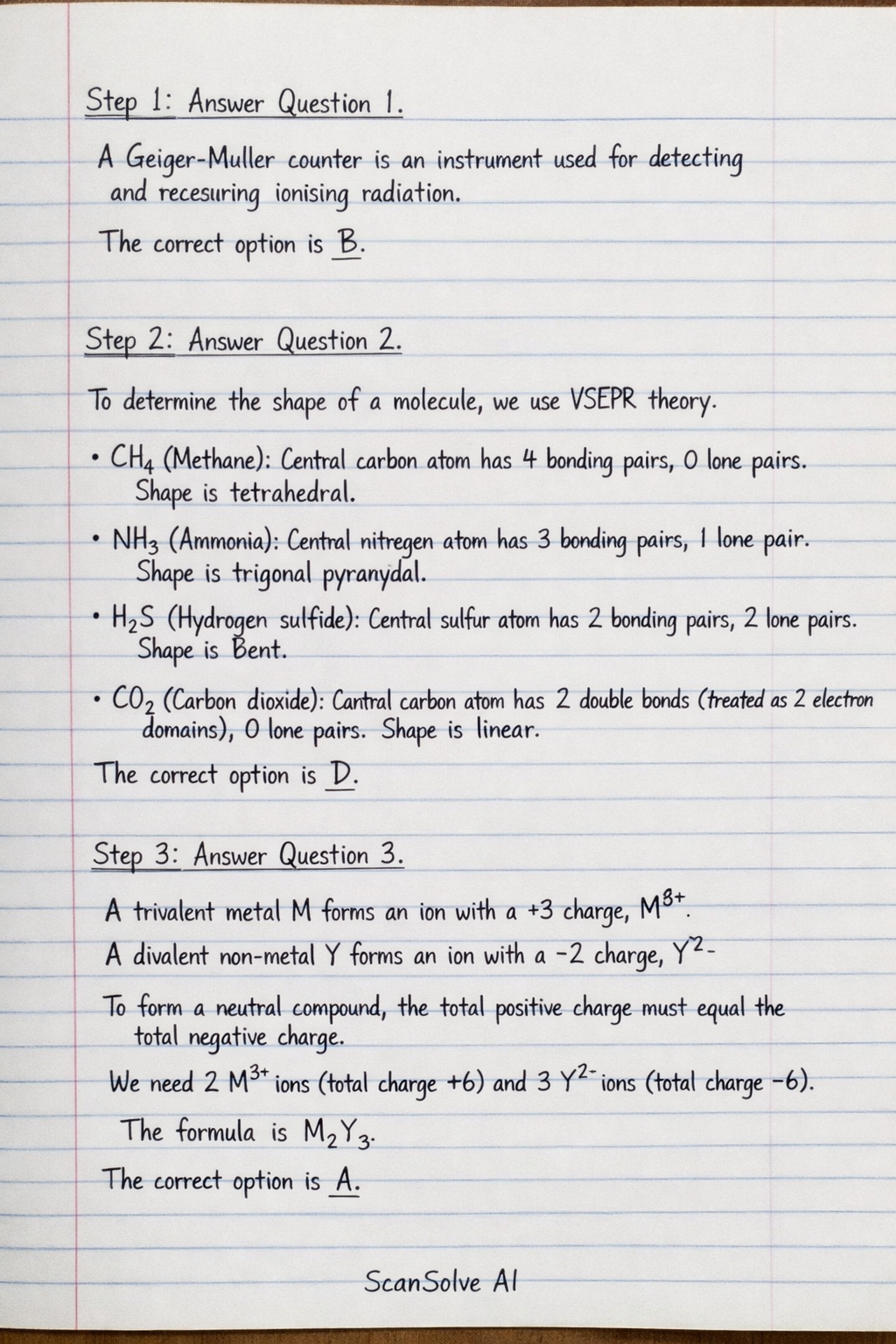
A Geiger-Muller counter is an instrument used for detecting and measuring ionizing radiation.
The correct option is B.
Answer Question 2.
To determine the shape of a molecule, we use VSEPR theory.
- CH₄ (Methane): Central carbon atom has 4 bonding pairs, 0 lone pairs. Shape is tetrahedral.
- NH₃ (Ammonia): Central nitrogen atom has 3 bonding pairs, 1 lone pair. Shape is trigonal pyramidal.
- H₂S (Hydrogen sulfide): Central sulfur atom has 2 bonding pairs, 2 lone pairs. Shape is bent.
- CO₂ (Carbon dioxide): Central carbon atom has 2 double bonds (treated as 2 electron domains), 0 lone pairs. Shape is linear.
The correct option is D.
Answer Question 3.
A trivalent metal M forms an ion with a +3 charge, M³⁺.
A divalent non-metal Y forms an ion with a -2 charge, Y²⁻.
To form a neutral compound, the total positive charge must equal the total negative charge.
We need 2 M³⁺ ions (total charge +6) and 3 Y²⁻ ions (total charge -6).
The formula is M₂Y₃.The correct option is A.
Answer Question 4.
When an atom gains electrons, it forms a negatively charged ion (anion). If an atom X gains two electrons, its charge will be -2.
The symbol of the ion formed is X²⁻.
The correct option is C.
Answer Question 5.
Let's evaluate each statement:
- A. Atomic size decreases down the group. This is incorrect; atomic size increases down a group due to the addition of new electron shells.
- B. Atomic size increases across the period. This is incorrect; atomic size decreases across a period due to increasing effective nuclear charge pulling electrons closer.
- C. Anions are smaller than the parent atom. This is incorrect; anions are larger than their parent atoms because of increased electron-electron repulsion in the added electron(s).
- D. Cations are smaller than the parent atom. This is correct; cations are smaller than their parent atoms because they lose their outermost electrons, reducing electron-electron repulsion and often resulting in the loss of an entire electron shell.
The correct option is D.
Answer Question 6.
The correct order of electronic energy levels (based on the Aufbau principle, represented by principal quantum
Try one yourself
A new problem that tests the same skill.
Still stuck on this one?
Ask a follow-up, and the answer starts from this question.
More Chemistry Questions
Handwritten Step-by-Step Solution
Get this as a handwritten image on WhatsApp — like a tutor wrote it for you.
Try on WhatsApp