We read your photo as:

CHEMISTRY TRIAL & LIKELY QUESTIONS UNDER THE PREDICTED AREAS/TOPICS Application of the Mass Spectrometer Bonding Electronegativity and Ionization Energy Hybridization Mole Concept Calculations

Chemistry

ScanSolve AI Answer

Step-by-step solution

8 steps

here are the solutions for the Mole Concept Calculations:

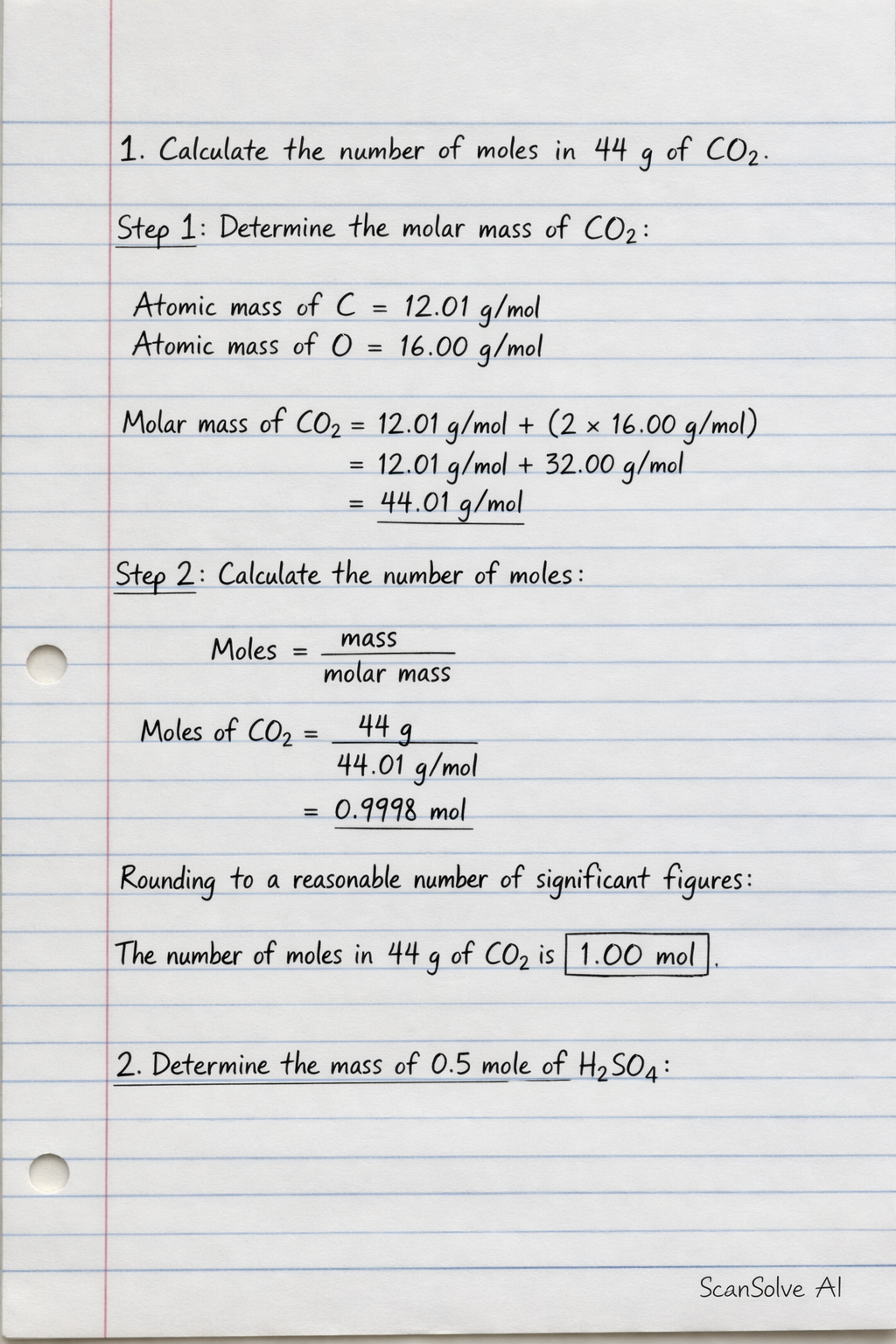
1. Calculate the number of moles in 44 g of CO₂.

  1. Determine the molar mass of CO₂.

    The atomic mass of Carbon (C) is approximately 12.01 g/mol12.01 \text{ g/mol}.
    The atomic mass of Oxygen (O) is approximately 16.00 g/mol16.00 \text{ g/mol}.

    Molar mass of CO2=12.01 g/mol+(2×16.00 g/mol)=12.01 g/mol+32.00 g/mol=44.01 g/mol\text{Molar mass of CO}_2 = 12.01 \text{ g/mol} + (2 \times 16.00 \text{ g/mol}) = 12.01 \text{ g/mol} + 32.00 \text{ g/mol} = 44.01 \text{ g/mol}
  2. Calculate the number of moles using the formula

    moles=massmolar mass\text{moles} = \frac{\text{mass}}{\text{molar mass}}.

    Moles of CO2=44 g44.01 g/mol≈0.9998 mol\text{Moles of CO}_2 = \frac{44 \text{ g}}{44.01 \text{ g/mol}} \approx 0.9998 \text{ mol}

    Rounding to a reasonable number of significant figures:
    The number of moles in 44 g of CO₂ is 1.00 mol\boxed{\text{1.00 mol}}.

    2. Determine the mass of 0.5 mole of H₂SO₄.

  3. Determine the molar mass of H₂SO₄.

    The atomic mass of Hydrogen (H) is approximately 1.01 g/mol1.01 \text{ g/mol}.
    The atomic mass of Sulfur (S) is approximately 32.07 g/mol32.07 \text{ g/mol}.
    The atomic mass of Oxygen (O) is approximately 16.00 g/mol16.00 \text{ g/mol}.

    Molar mass of H2SO4=(2×1.01 g/mol)+32.07 g/mol+(4×16.00 g/mol)\text{Molar mass of H}_2\text{SO}_4 = (2 \times 1.01 \text{ g/mol}) + 32.07 \text{ g/mol} + (4 \times 16.00 \text{ g/mol}) =2.02 g/mol+32.07 g/mol+64.00 g/mol=98.09 g/mol= 2.02 \text{ g/mol} + 32.07 \text{ g/mol} + 64.00 \text{ g/mol} = 98.09 \text{ g/mol}
  4. Calculate the mass using the formula

    mass=moles×molar mass\text{mass} = \text{moles} \times \text{molar mass}.

    Mass of H2SO4=0.5 mol×98.09 g/mol=49.045 g\text{Mass of H}_2\text{SO}_4 = 0.5 \text{ mol} \times 98.09 \text{ g/mol} = 49.045 \text{ g}

    The mass of 0.5 mole of H₂SO₄ is 49.05 g\boxed{\text{49.05 g}}.

    3. Calculate the number of molecules in 2 moles of oxygen.

  5. Recall Avogadro's number.

    Avogadro's number is 6.022×10²³ molecules/mol6.022 \times 10^{23} \text{ molecules/mol}.

  6. Calculate the number of molecules using the formula

    number of molecules=moles×Avogadro’s number\text{number of molecules} = \text{moles} \times \text{Avogadro's number}.
    Oxygen gas exists as diatomic molecules, O₂.

    Number of O2 molecules=2 mol×(6.022×1023 molecules/mol)\text{Number of O}_2 \text{ molecules} = 2 \text{ mol} \times (6.022 \times 10^{23} \text{ molecules/mol}) =1.2044×1024 molecules= 1.2044 \times 10^{24} \text{ molecules}

    The number of molecules in 2 moles of oxygen is 1.204×1024 molecules\boxed{1.204 \times 10^{24} \text{ molecules}}.

    4. What volume will 0.25 mole of a gas occupy at s.t.p.?

  7. Recall the molar volume of a gas at s.t.p.

    At Standard Temperature and Pressure (s.t.p.), 1 mole of any ideal gas occupies 22.4 dm322.4 \text{ dm}^3 (or 22.4 L22.4 \text{ L}).

  8. Calculate the volume using the formula

    volume=moles×molar volume at s.t.p.\text{volume} = \text{moles} \times \text{molar volume at s.t.p.}.

    Volume=0.25 mol×22.4 dm3/mol=5.6 dm3\text{Volume} = 0.25 \text{ mol} \times 22.4 \text{ dm}^3\text{/mol} = 5.6 \text{ dm}^3

    The volume occupied by 0.25 mole of a gas at s.t.p. is 5.6 dm3\boxed{5.6 \text{ dm}^3}.

Was this helpful?

Still stuck on this one?

Ask a follow-up, and the answer starts from this question.

Got a different question?Ask your own question
Handwritten step-by-step solution preview

Handwritten Step-by-Step Solution

Get this as a handwritten image on WhatsApp — like a tutor wrote it for you.

Try on WhatsApp