
We read your photo as:
QUESTION 3 (Start on a new page.) A learner investigates bond energies in two similar compounds: Chloromethane Bromomethane Refer to the table of bond energies below:
ScanSolve AI Answer
Answers
2 partsStep-by-step solution
8 stepsPart 3.1
Bond energy is the amount of energy required to break one mole of a specific type of bond in the gaseous state.
Part 3.2
The C-Cl bond has a higher bond energy (340 kJ/mol) than the C-Br bond (280 kJ/mol). This difference is primarily due to the atomic size of chlorine versus bromine. Chlorine is a smaller atom than bromine, leading to a shorter and stronger C-Cl bond compared to the C-Br bond. Shorter bonds generally require more energy to break.
Part 3.3
Calculate the molar mass of chloromethane ().
Calculate the number of moles of chloromethane in the sample.
Calculate the total energy required to break all bonds in 1 mole of chloromethane.
Set up an equation for the total bond energy in 1 mole of .
A molecule of contains three C-H bonds and one C-Cl bond.
We know from the table.
Solve for the bond energy of the C-H bond ().
The bond energy of the C-H bond is .
Part 3.4
Identify the bonds present in 1 mole of bromomethane () and their quantities.
A molecule of contains three C-H bonds and one C-Br bond.
Use the calculated C-H bond energy from 3.3 and the given C-Br bond energy.
(from the table)Calculate the total energy required to break all bonds in 1 mole of bromomethane.
The energy required to break all bonds in 1 mole of bromomethane is .
Try one yourself
A new problem that tests the same skill.
Still stuck on this one?
Ask a follow-up, and the answer starts from this question.
More Chemistry Questions
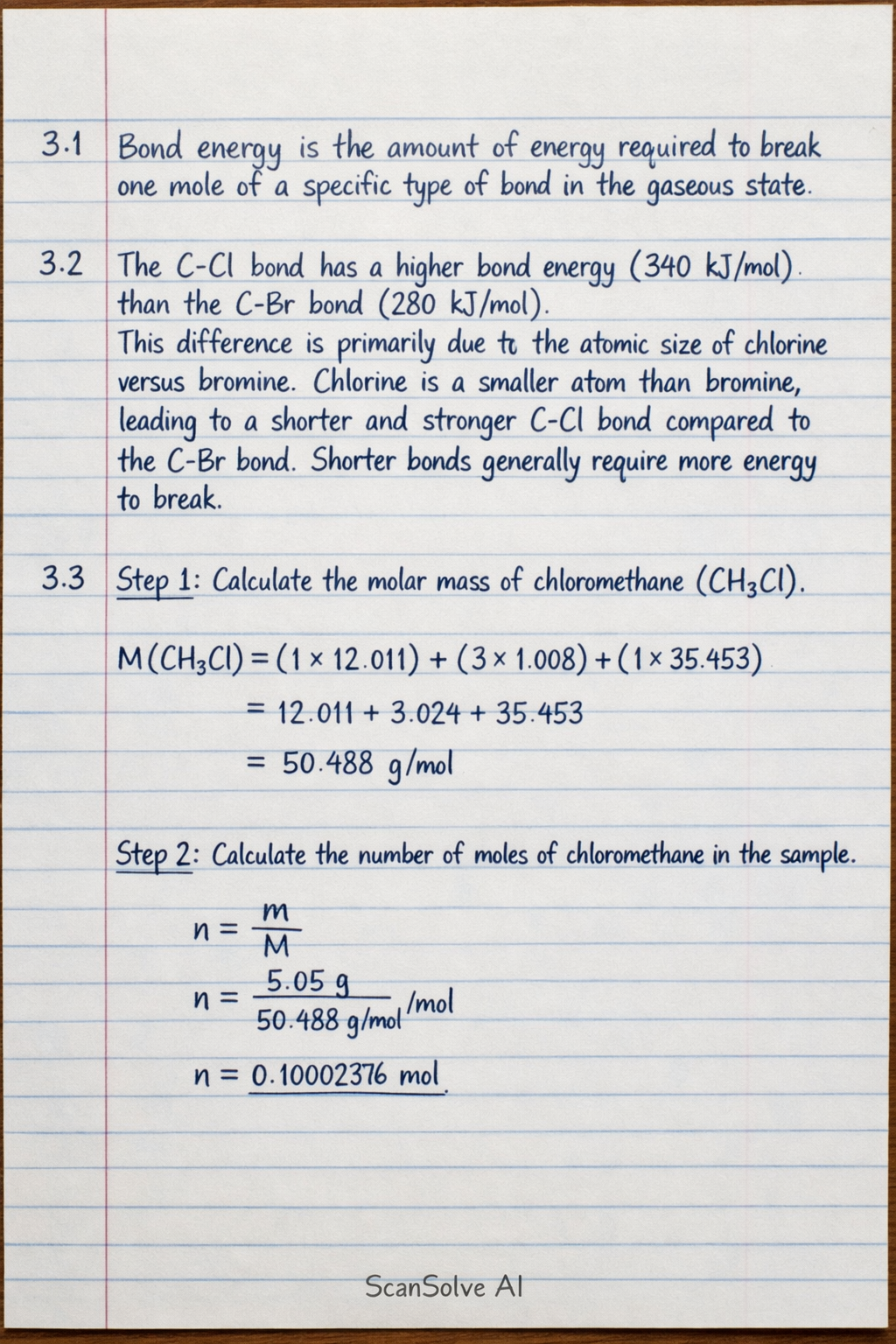
Handwritten Step-by-Step Solution
Get this as a handwritten image on WhatsApp — like a tutor wrote it for you.
Try on WhatsApp