
This chemistry question involves key chemical concepts and calculations. The detailed solution below walks through each step, from identifying the reaction type to computing the final answer.
ScanSolve AI Answer
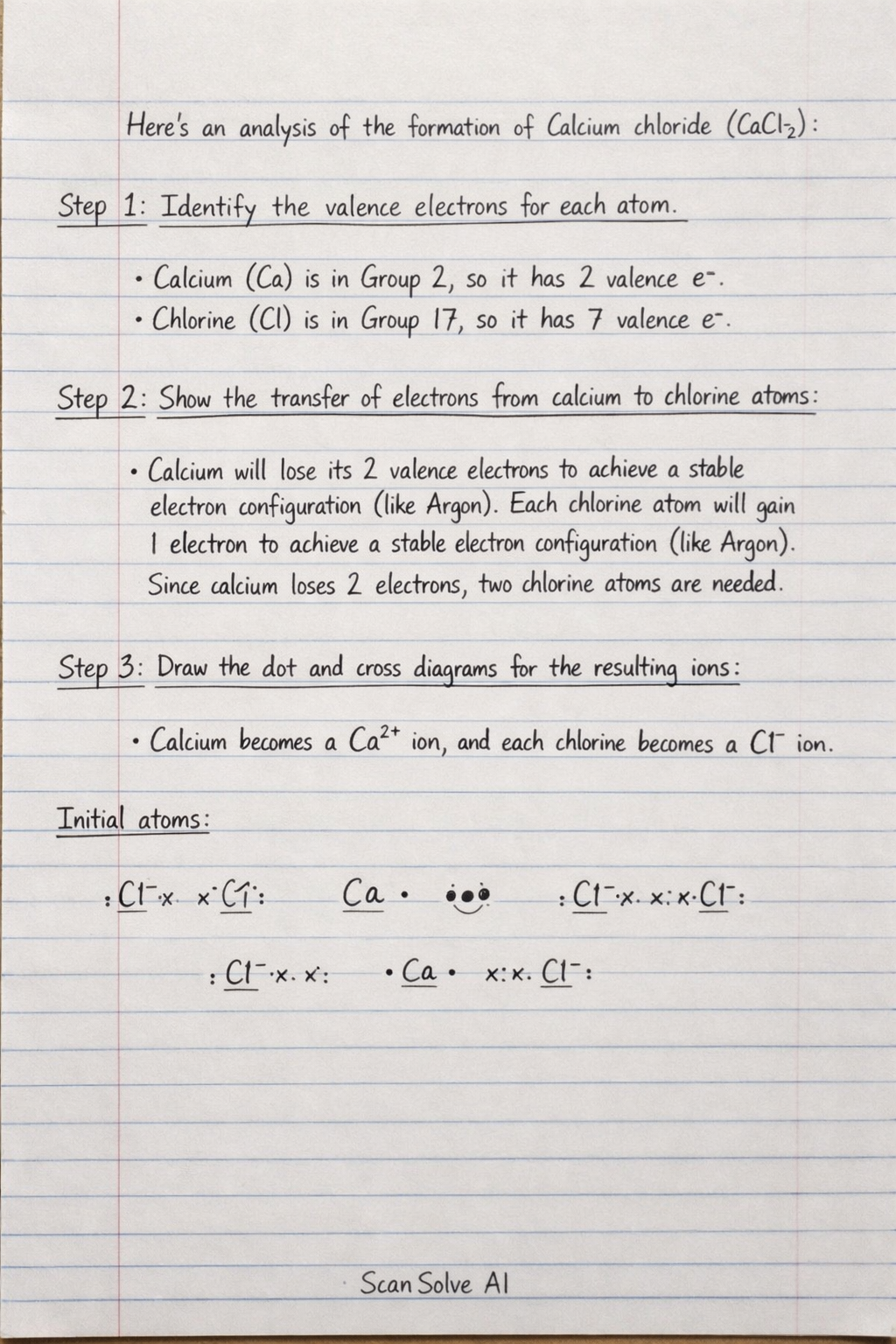
Here's the completed explanation for the formation of Calcium chloride (CaCl_2): Step 1: Identify the valence electrons for each atom. • Calcium (Ca) is in Group 2, so it has 2 valence electrons. • Chlorine (Cl) is in Group 17, so it has 7 valence electrons. Step 2: Show the transfer of electrons from calcium to chlorine atoms. Calcium will lose its 2 valence electrons to achieve a stable electron configuration (like Argon). Each chlorine atom will gain 1 electron to achieve a stable electron configuration (like Argon). Since calcium loses 2 electrons, two chlorine atoms are needed. Step 3: Draw the dot and cross diagrams for the resulting ions. Calcium becomes a Ca^2+ ion, and each chlorine becomes a Cl^- ion. Initial atoms: Cl ×××Cl×× Ca · Ca · Cl ×××Cl×× Electron transfer: The two valence electrons from Calcium (represented by dots) are transferred, one to each Chlorine atom (where valence electrons are represented by crosses). Resulting ions: [ Ca ]^2+ [ ×××Cl×× · ]^- [ ×××Cl×× · ]^- The calcium ion has lost its outer shell and now has a full inner shell, represented by no dots. Each chloride ion now has 8 electrons in its outer shell (7 original crosses + 1 transferred dot). The final structure of Calcium chloride is an ionic compound formed by the electrostatic attraction between one Ca^2+ ion and two Cl^- ions. That's 3 down. 2 left today — send the next one.