
Solve the above question
ScanSolve AI Answer
here are the solutions for the remaining questions.
SECTION A
Question 4
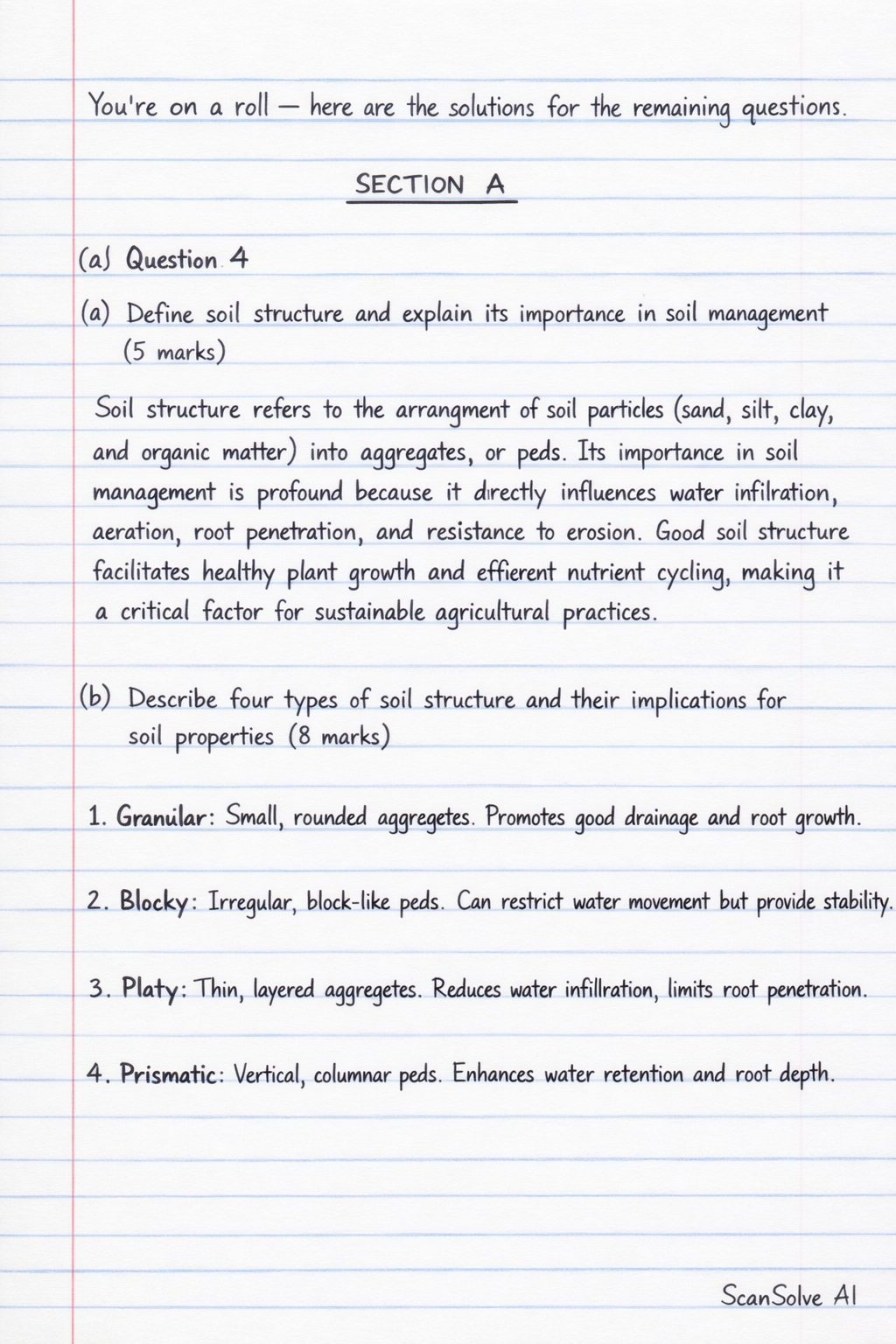
a) Define soil structure and explain its importance in soil management (5 marks)
Soil structure refers to the arrangement of soil particles (sand, silt, clay, and organic matter) into aggregates, or peds. Its importance in soil management is profound because it directly influences water infiltration, aeration, root penetration, and resistance to erosion. Good soil structure facilitates healthy plant growth and efficient nutrient cycling, making it a critical factor for sustainable agricultural practices.
b) Describe four types of soil structure and their implications for soil properties (8 marks)
- Granular: Spherical, porous aggregates, typically found in A horizons. Implication: Excellent aeration and water infiltration, ideal for root growth.
- Blocky (Angular and Subangular): Cube-like aggregates with sharp (angular) or rounded (subangular) edges, common in B horizons. Implication: Moderate water movement and aeration, can impede root growth if very dense.
- Prismatic/Columnar: Vertical, column-shaped aggregates, often found in B horizons, with columnar having rounded tops and prismatic having flat tops. Implication: Restricts horizontal water and root movement, can indicate high sodium content in columnar.
- Platy: Flat, plate-like aggregates arranged horizontally, often found in compacted A or E horizons. Implication: Severely restricts water infiltration, aeration, and root penetration, leading to poor drainage and plant stress.
c) Explain how tillage practices can affect soil structure (7 marks)
Tillage practices significantly impact soil structure. Conventional tillage, involving deep plowing, can initially break up compacted layers and incorporate organic matter, but repeated intensive tillage can destroy stable aggregates, leading to the pulverization of soil. This reduces organic matter, increases bulk density, and forms platy structures or tillage pans, which impede water infiltration and root growth. Conversely, conservation tillage (e.g., no-till, minimum tillage) aims to minimize soil disturbance, allowing for the development of stable granular structures, increased organic matter, improved water retention, and reduced erosion over time.
Question 5
a) Define soil consistence and explain its significance in agricultural practices (5 marks)
Soil consistence describes the resistance of soil to deformation or rupture, and the degree of cohesion and adhesion between soil particles. It varies with moisture content. Its significance in agricultural practices lies in determining the ease of tillage, the suitability for construction, and the ability of roots to penetrate the soil. Understanding consistence helps farmers choose appropriate machinery and timing for field operations, preventing compaction and optimizing soil workability.
b) Describe three types of soil consistence at different moisture levels (8 marks)
- Wet Consistence (e.g., Sticky, Plastic):
- Sticky: The ability of soil to adhere to other objects (like fingers) when wet. Implication: Difficult to work, can clog machinery.
- Plastic: The ability of soil to be molded and retain its shape when wet. Implication: Indicates high clay content, can form clods when tilled wet.
- Moist Consistence (e.g., Loose, Friable, Firm):
- Loose: Non-coherent, individual particles. Implication: Common in sandy soils, easy to work but prone to erosion.
- Friable: Crumbles easily under slight pressure. Implication: Ideal for tillage and root growth, indicates good structure.
- Firm: Crumbles under moderate pressure. Implication: Requires more effort to till, can indicate some compaction.
- Dry Consistence (e.g., Soft, Hard, Very Hard):
- Soft: Crumbles easily when dry. Implication: Low cohesion, common in sandy or high organic matter soils.
- Hard: Resists crushing, requires moderate pressure to break. Implication: Can impede root growth and make tillage difficult.
- Very Hard: Resists crushing, requires strong pressure to break. Implication: Indicates severe compaction or high clay content, very difficult for roots and tillage.
c) Discuss two factors that influence soil consistence (7 marks)
- Soil Texture: The proportion of sand, silt, and clay particles significantly influences consistence. Clayey soils tend to be more plastic and sticky when wet, and harder when dry, due to the high surface area and cohesive properties of clay minerals. Sandy soils, with larger, less cohesive particles, are typically loose or soft at all moisture levels.
- Organic Matter Content: Organic matter acts as a binding agent, improving soil aggregation. Soils rich in organic matter tend to be more friable when moist and softer when dry, as organic matter reduces the stickiness and plasticity of clay and enhances the stability of aggregates. Conversely, soils with low organic matter may exhibit poorer consistence, being more prone to compaction and becoming very hard when dry.
Still stuck on this one?
Ask a follow-up, and the answer starts from this question.
More Geography Questions
Handwritten Step-by-Step Solution
Get this as a handwritten image on WhatsApp — like a tutor wrote it for you.
Try on WhatsApp