
We read your photo as:
Federal College of Education, Pankshin, School of Secondary Education, Science Programme, First Semester 2024/2025 Examination, Department: Chemistry, Level: NCE III, Course Code: CHE 324, Course Title: Chemical Equilibrium and Thermodynamics. Instructions: Attempt any two questions.
ScanSolve AI Answer
Step-by-step solution
9 stepsHere are the solutions to the questions from the image:
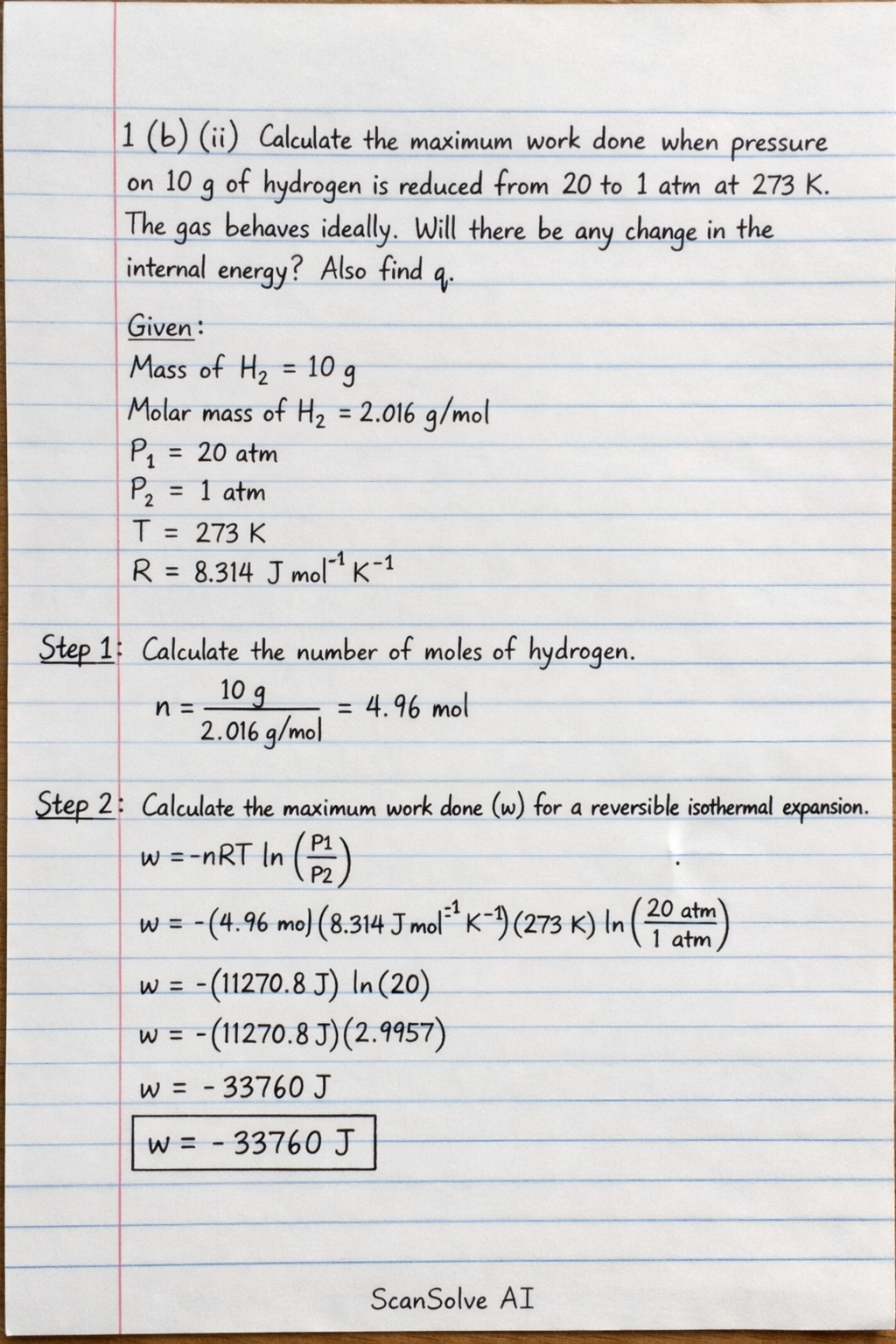
1(b) (ii) Calculate the maximum work done when pressure on 10 g of hydrogen is reduced from 20 to one atm at a constant temperature of 273 k. The gas behave ideally. Will there be any change in the internal energy? Also find q. (6mks)
Given:
Mass of g
Molar mass of g/mol
atm
atm
K
J mol K
Calculate the number of moles of hydrogen.
Calculate the maximum work done () for a reversible isothermal expansion.
Determine the change in internal energy ().
For an ideal gas undergoing an isothermal process, the internal energy depends only on temperature. Since the temperature is constant, there is no change in the internal energy ().
Calculate the heat ().
According to the first law of thermodynamics, .
1(c) Define the term heat capacity, specific heat capacity and molar heat capacity. (6mks)
- Heat capacity () is the amount of heat energy required to raise the temperature of a given quantity of a substance by one degree Celsius or one Kelvin. It is an extensive property.
- Specific heat capacity ( or ) is the amount of heat energy required to raise the temperature of one unit mass (e.g., 1 gram) of a substance by one degree Celsius or one Kelvin. It is an intensive property.
- Molar heat capacity () is the amount of heat energy required to raise the temperature of one mole of a substance by one degree Celsius or one Kelvin. It is also an intensive property.
2(a) (ii) State the third law of thermodynamics ? (5mks)
The third law of thermodynamics states that the entropy of a perfect crystal at absolute zero (0 Kelvin) is exactly zero. This law provides a reference point for the determination of absolute entropies.
2(b) Calculate the entropy change in the evaporation of 1 mole of water at 100 °C.Latent heat of evaporation of water is 9650 cals ml. (3mks)
Given:
mol of water
K
Latent heat of evaporation = 9650 cals ml.
Assumption: The unit "cals ml" is interpreted as "cals mol" as it's for 1 mole of water and the value is consistent with molar latent heat of vaporization.Identify the formula for entropy change during a phase transition.
For a reversible phase transition, the entropy change () is:
where is the latent heat of evaporation.
Substitute the given values.
2(c) (i) Calculate for the synthesis of ammonia: at 298 k. (5mks)
To calculate the standard entropy change () for this reaction, the standard molar entropies () of each reactant and product at 298 K are required. These values are not provided in the question.
The formula to calculate is:For the given reaction:
Without the numerical values for , , and , a numerical answer for cannot be determined.
2(c) (ii) Calculate the for the formation of from and at 298 K: . Is the reaction spontaneous under this circumstances? ( KJ, J/K) (5mks)
Given:
K
KJ
J/KConvert from J/K to KJ/K.
Calculate using the Gibbs-Helmholtz equation.
Determine if the reaction is spontaneous.
Since is positive (), the reaction is not spontaneous under these circumstances.
3(a) (i) What is a Reversible reaction ? (4mks)
A reversible reaction is a chemical reaction where the reactants form products, and simultaneously, the products react to form the original reactants. This means the reaction can proceed in both the forward and reverse directions, typically represented by a double arrow ().
3(a) (ii) With the aid of a graph, define the term Chemical equilibrium. (4mks)
Chemical equilibrium is a state in a reversible reaction where the rate of the forward reaction is equal to the rate of the reverse reaction. At this point, the concentrations of reactants and products remain constant over time. Graphically, this is represented by plotting the concentrations of reactants and products (or reaction rates) against time, where the curves would initially change and then flatten out, indicating constant concentrations at equilibrium.
3(a) (iii) Mention the characteristics of Chemical equilibrium. (6mks)
Characteristics of chemical equilibrium include:
- It is a dynamic state, with ongoing forward and reverse reactions at equal rates.
- The concentrations of reactants and products remain constant over time.
- It can be approached from either direction.
- It requires a closed system.
- It is affected by changes in temperature, pressure, and concentration (Le Chatelier's Principle).
- The Gibbs free energy change () for the reaction is zero at equilibrium.
3(a) (iv) What do you understand by Law of mass action (4mks)
The Law of Mass Action states that the rate of a chemical reaction is directly proportional to the product of the concentrations of the reactants, each raised to a power equal to its stoichiometric coefficient in the balanced chemical equation. For a reversible reaction at equilibrium, this law defines the equilibrium constant.
3(b) Give the equilibrium constant expression for the following reactions: (4mks each)
(i)
(ii)
(iii)
Still stuck on this one?
Ask a follow-up, and the answer starts from this question.
More Chemistry Questions
Handwritten Step-by-Step Solution
Get this as a handwritten image on WhatsApp — like a tutor wrote it for you.
Try on WhatsApp