
We read your photo as:
Federal University of Health Sciences, Otukpo Department of Medical Physics Second Semester Continuous Assessment Test 2025/2026 Session COURSE CODE: PHY102 (GENERAL PHYSICS II) Instruction: Answer All Questions Constants: K= 9 x 10° m/F and c= 3 x 10⁸ m/s Time: 1 hr
ScanSolve AI Answer
This answer stops before the end.
It was cut off when it was first written. Ask ScanSolve this question again for the full working.
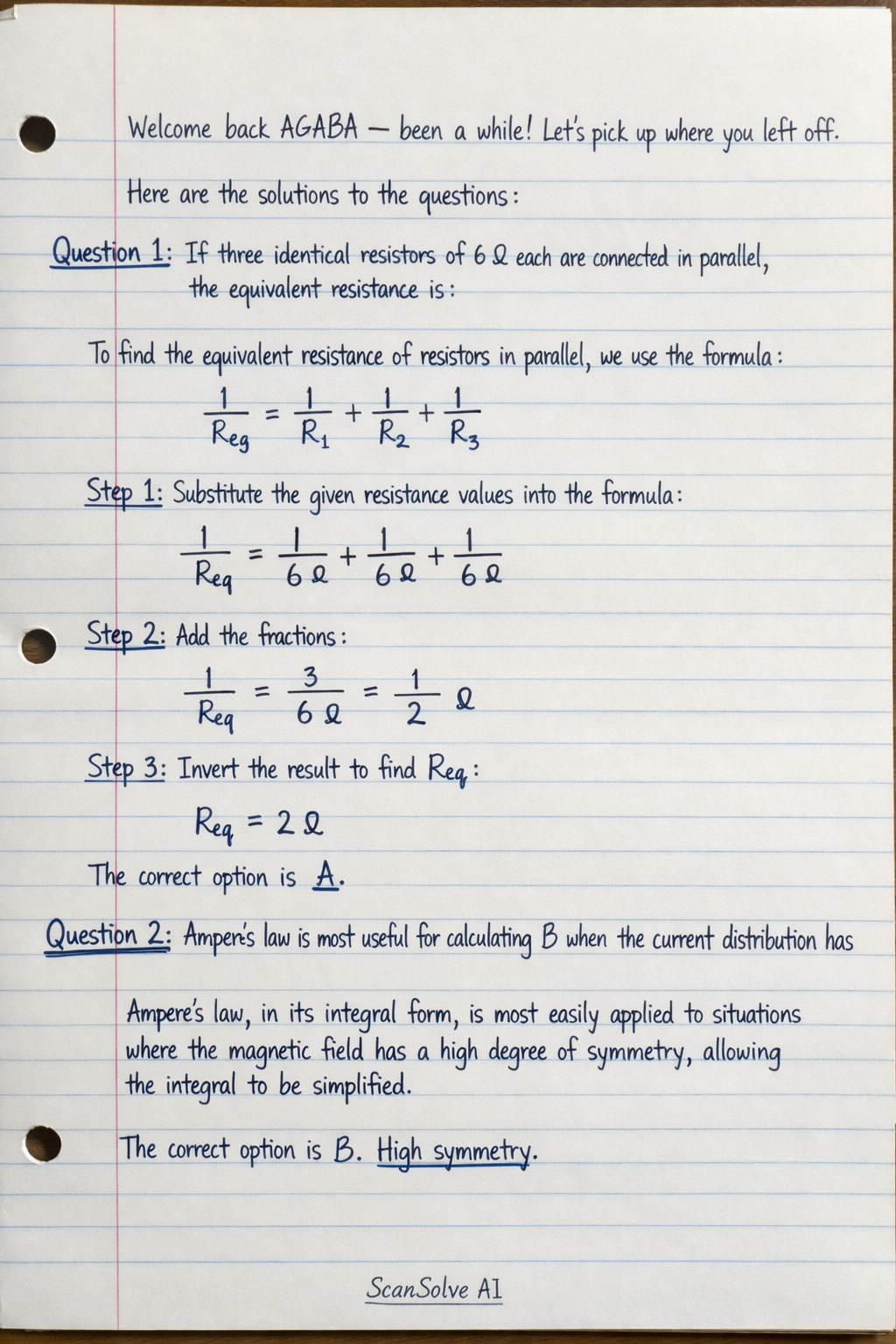
Here are the solutions to the questions:
Question 1: If three identical resistors of each are connected in parallel, the equivalent resistance is:
To find the equivalent resistance of resistors in parallel, we use the formula:
Step 1: Substitute the given resistance values into the formula.
Step 2: Add the fractions.
Step 3: Invert the result to find .
The correct option is A.
Question 2: Ampere's law is most useful for calculating B when the current distribution has
Ampere's law, in its integral form, is most easily applied to situations where the magnetic field has a high degree of symmetry, allowing the integral to be simplified.
The correct option is B. High symmetry.
Question 3: A transformer steps voltage from to . If the primary has 1000 turns, the secondary has:
For an ideal transformer, the ratio of voltages is equal to the ratio of the number of turns:
Step 1: Rearrange the formula to solve for .
Step 2: Substitute the given values: , , turns.
Step 3: Calculate the number of turns in the secondary coil.
The correct option is B.
Question 4: What is the force of attraction or repulsion if the distance in Coulomb's law is reduced by half?
Coulomb's Law states that the electrostatic force between two point charges is inversely proportional to the square of the distance between them:
Step 1: Let the original force be at distance .
Step 2: The new distance is half the original distance, so .
Step 3: Calculate the new force with the new distance.
Step 4: Compare with .
The force will D. Increase 4 times.
Question 5: In electromagnetic waves, the electric and magnetic fields are:
In an electromagnetic wave, the electric field, magnetic field, and the direction of wave propagation are all mutually perpendicular to each other.
The correct option is B. Perpendicular to each other and to the direction of propagation.
Question 6: In a step-up transformer, which inductance plays the key role in voltage transformation?
Transformers operate on the principle of mutual induction, where a changing current in one coil induces an electromotive force (EMF) in a nearby coil.
The correct option is C. Mutual inductance.
Question 7: What is the magnitude of the electrostatic force between two particles separated by if the charge on the alpha-particle is ?
We use Coulomb's Law: .
Given:
- Charge (assuming two such particles).
- Distance .
- Coulomb's constant .
Note: There appears to be a discrepancy between the calculated answer using the given values and the provided options. To match options A and C, the distance would need to be instead of . We will proceed with the calculation assuming the distance was intended to be to align with the multiple-choice options.
Step 1: Convert the distance to meters (assuming for option matching).
Step 2: Substitute the values into Coulomb's Law.
Step 3: Calculate the square of the charge and distance.
Step 4: Perform the multiplication and division.
Step 5: Express the force in scientific notation.
The correct option is A (or C, as they are identical).
Question 8: Which of the following expressions represents Gauss' law?
Gauss's law relates the electric flux through a closed surface to the enclosed electric charge. In terms of the electric displacement field , it is given by:
The correct option is C.
Question 9: In an AC circuit, the opposition offered by an inductor to AC is called:
The opposition to alternating current (AC) flow offered by an inductor is known as inductive reactance.
The correct option is C. Inductive reactance.
Question 10: A point charge of is placed in an electric field of intensity in a medium of permittivity . The electric flux density of the field is:
The electric flux density is related to the electric field intensity and the permittivity of the medium by the formula:
Given:
- Permittivity .
- Electric field intensity . Note: Similar to Question 7, there appears to be a mismatch between the calculated answer using the given values and the provided options. To match option B, the electric field intensity would need to be . We will proceed with the calculation assuming to align with the multiple-choice options.
Step 1: Substitute the values into the formula (assuming ).
Step 2: Calculate the electric flux density.
The correct option is B.
Question 11: The electric potential due to a charge of at a point away from it is
The electric potential due to a point charge at a distance is given by:
Given:
- Charge .
- Distance .
- Coulomb's constant .
Step 1: Convert the distance to meters.
Step 2: Substitute the values into the formula.
Step 3: Perform the calculation.
The closest option is A. 563.
Question 12: Given that , , . Find the inductance.
The self-inductance of a solenoid is given by the formula:
Given:
- Number of turns .
- Area .
- Length .
- Permeability of free space .
Step 1: Substitute the given values into the formula.
Step 2: Calculate .
Step 3: Simplify the powers of 10.
Step 4: Perform the multiplication in the numerator.
Step 5: Calculate the final value.
Step 6: Convert to millihenries (mH).
The correct option is A.
Question 13: When the R.M.S voltage of a source of electricity supply is given as , calculate the peak value of the supply.
The relationship between the RMS voltage () and the peak voltage () for a sinusoidal AC supply is:
Step 1: Substitute the given RMS voltage.
Step 2: Calculate the peak voltage.
The closest option is D. .
Question 14: The Biot-Savart law states that the magnetic field due to a current element is proportional to
The Biot-Savart law describes the magnetic field produced by a current element at a distance . It is given by:
The magnitude of is proportional to .
The options provided are in the form of or similar.
The term (or ) represents the vector cross product, and the magnitude is proportional to .
Option B, , is dimensionally incorrect as has units of length, making the denominator effectively .
Option C, , is the correct vector form of the proportionality for the Biot-Savart law.
The correct option is C. .
Question 15: Two straight parallel superconducting wires apart carrying equal current of in opposite direction. Should we worry about the mechanical strength of those wires?
The force per unit length between two parallel wires carrying currents and separated by a distance is given by:
If the currents are in opposite directions, the force is repulsive.
Given:
- .
- .
- .
Step 1: Substitute the values into the formula.
Step 2: Simplify the expression.
Still stuck on this one?
Ask a follow-up, and the answer starts from this question.
More Physics Questions
Handwritten Step-by-Step Solution
Get this as a handwritten image on WhatsApp — like a tutor wrote it for you.
Try on WhatsApp