

This chemistry question involves key chemical concepts and calculations. The detailed solution below walks through each step, from identifying the reaction type to computing the final answer.
ScanSolve AI Answer
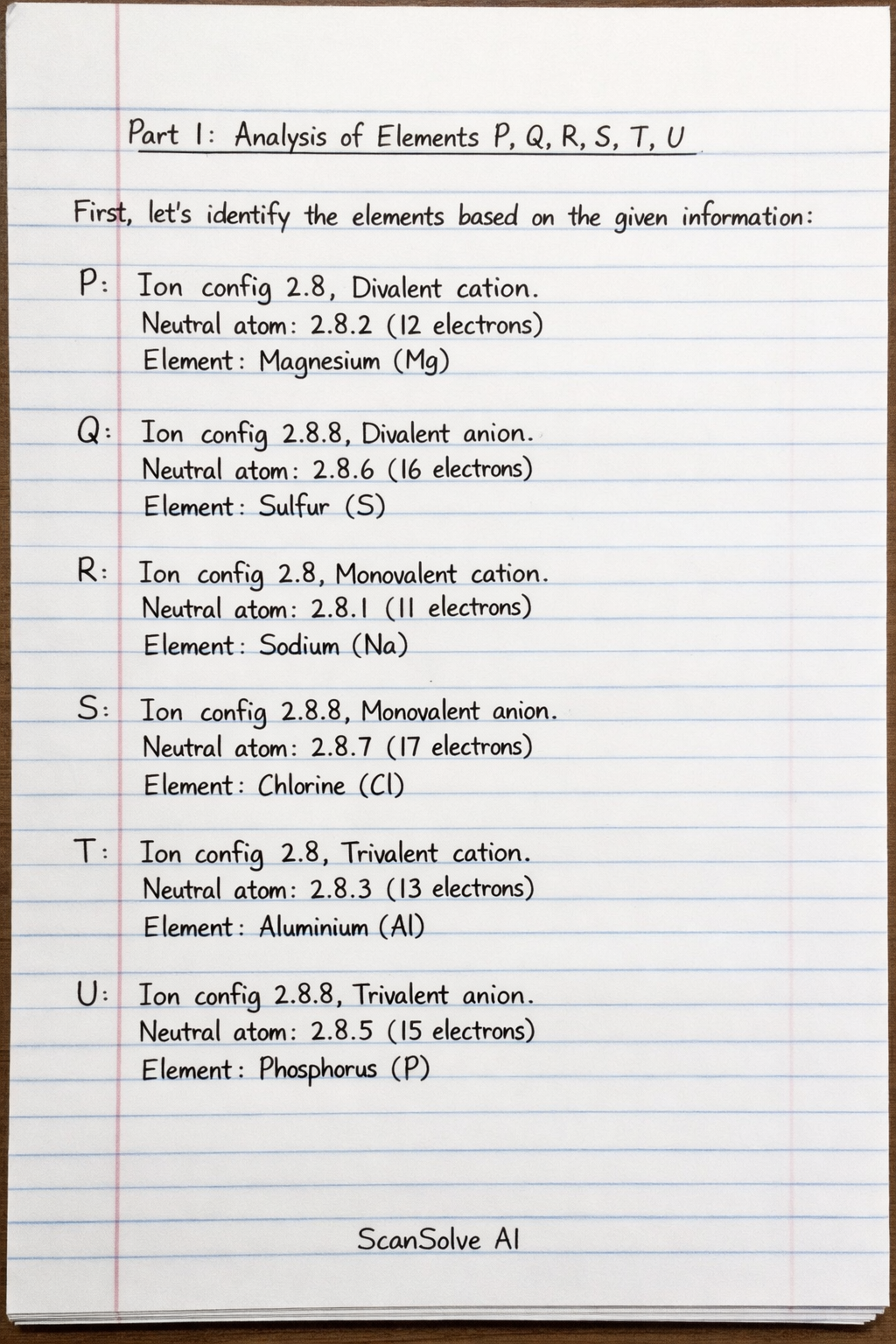
Part 1: Analysis of Elements P, Q, R, S, T, U First, let's identify the elements based on the given information: P: Ion config 2.8, Divalent cation. Neutral atom: 2.8.2 (12 electrons). Element: Magnesium (Mg). Q: Ion config 2.8.8, Divalent anion. Neutral atom: 2.8.6 (16 electrons). Element: Sulfur (S). R: Ion config 2.8, Monovalent cation. Neutral atom: 2.8.1 (11 electrons). Element: Sodium (Na). S: Ion config 2.8.8, Monovalent anion. Neutral atom: 2.8.7 (17 electrons). Element: Chlorine (Cl). T: Ion config 2.8, Trivalent cation. Neutral atom: 2.8.3 (13 electrons). Element: Aluminium (Al). U: Ion config 2.8.8, Trivalent anion. Neutral atom: 2.8.5 (15 electrons). Element: Phosphorus (P). i) Arrange the elements PQRST and U in terms of increasing atomic sizes. All these elements are in Period 3 of the periodic table. Atomic size decreases across a period from left to right due to increasing nuclear charge pulling the electrons closer to the nucleus. The order of elements in Period 3 from left to right is: Na (R), Mg (P), Al (T), P (U), S (Q), Cl (S). Therefore, in terms of increasing atomic size (smallest to largest): Cl (S) < S (Q) < P (U) < Al (T) < Mg (P) < Na (R) Answer: S < Q < U < T < P < R ii) Name the period of the periodic table to which these elements belong? All the ions have either 2 or 3 electron shells (e.g., 2.8 or 2.8.8). This indicates that the neutral atoms have electrons in 3 main energy levels. Answer: Period 3 iii) Write an equation for the reaction between element R and S. Element R is Sodium (Na). Element S is Chlorine (Cl). Sodium is a Group 1 metal, and Chlorine is a Group 17 non-metal. They react to form an ionic compound, sodium chloride. 2Na(s) + Cl_2(g) 2NaCl(s) Answer: 2Na(s) + Cl_2(g) 2NaCl(s) iv) Compare the electrical conductivity of elements P and T. Explain. Element P is Magnesium (Mg). Element T is Aluminium (Al). Both are metals and conduct electricity. Comparison: Aluminium (T) has higher electrical conductivity than Magnesium (P). Explanation: Electrical conductivity in metals depends on the number of delocalized valence electrons per atom. Magnesium (P) has 2 valence electrons per atom, while Aluminium (T) has 3 valence electrons per atom. A greater number of delocalized electrons per unit volume allows for more efficient charge transport, hence higher electrical conductivity. Answer: Aluminium (T) has higher electrical conductivity than Magnesium (P). Aluminium has 3 delocalized valence electrons per atom, while Magnesium has 2, leading to better charge transport in Aluminium. v) Compare the first ionization energies of elements P and R. Explain. Element P is Magnesium (Mg). Element R is Sodium (Na). Both are in Period 3. Sodium is in Group 1, and Magnesium is in Group 2. Comparison: Magnesium (P) has a higher first ionization energy than Sodium (R). Explanation: First ionization energy generally increases across a period from left to right. Magnesium has a greater nuclear charge (+12) than Sodium (+11). Although both have the same number of electron shells, the stronger attraction from the nucleus in Magnesium pulls the valence electrons closer, requiring more energy to remove the first electron. Answer: Magnesium (P) has a higher first ionization energy than Sodium (R). Magnesium has a greater nuclear charge and a smaller atomic radius than Sodium, resulting in a stronger attraction for its valence electrons. vi) Which element is the strongest oxidizing agent? An oxidizing agent is a substance that gains electrons (gets reduced). Non-metals are generally good oxidizing agents, and their strength increases across a period and up a group. The non-metals among the given elements are U (Phosphorus), Q (Sulfur), and S (Chlorine). Chlorine (S) is in Group 17 (halogens) and is the most electronegative among these Period 3 non-metals. It has the strongest tendency to gain an electron to achieve a stable octet. Answer: S (Chlorine) Part 2: Aluminium Chloride (AlCl_3) Analysis i) State the type of bond and structure in AlCl_3. From the table, AlCl_3 has a melting point of -70 ^. This is a very low melting point, characteristic of simple molecular substances, not typical ionic compounds (e.g., NaCl at 801 ^). This indicates that the bonding is predominantly covalent. In the solid and gaseous states, AlCl_3 exists as a dimer, Al_2Cl_6. Bond type: Covalent Structure: Simple molecular (dimeric Al_2Cl_6) ii) What type of bond would AlCl_3 be expected to have? Give a reason. Expected bond type: Ionic Reason: Aluminium is a metal (Group 13) and Chlorine is a non-metal (Group 17). Typically, metals react with non-metals by transferring electrons to form ionic bonds. Aluminium would be expected to lose 3 electrons to form an Al^3+ ion, and Chlorine would gain 1 electron to form a Cl^- ion. Answer: Ionic. Aluminium is a metal and Chlorine is a non-metal; metals are expected to transfer electrons to non-metals to form ionic bonds.