
We read your photo as:
For a rxn A+B+C -> D, the following results were obtained from 4 experiments. Write the rate law of the rxn, derive the rate law, derive the order of the reaction
ScanSolve AI Answer
Answer
Step-by-step solution
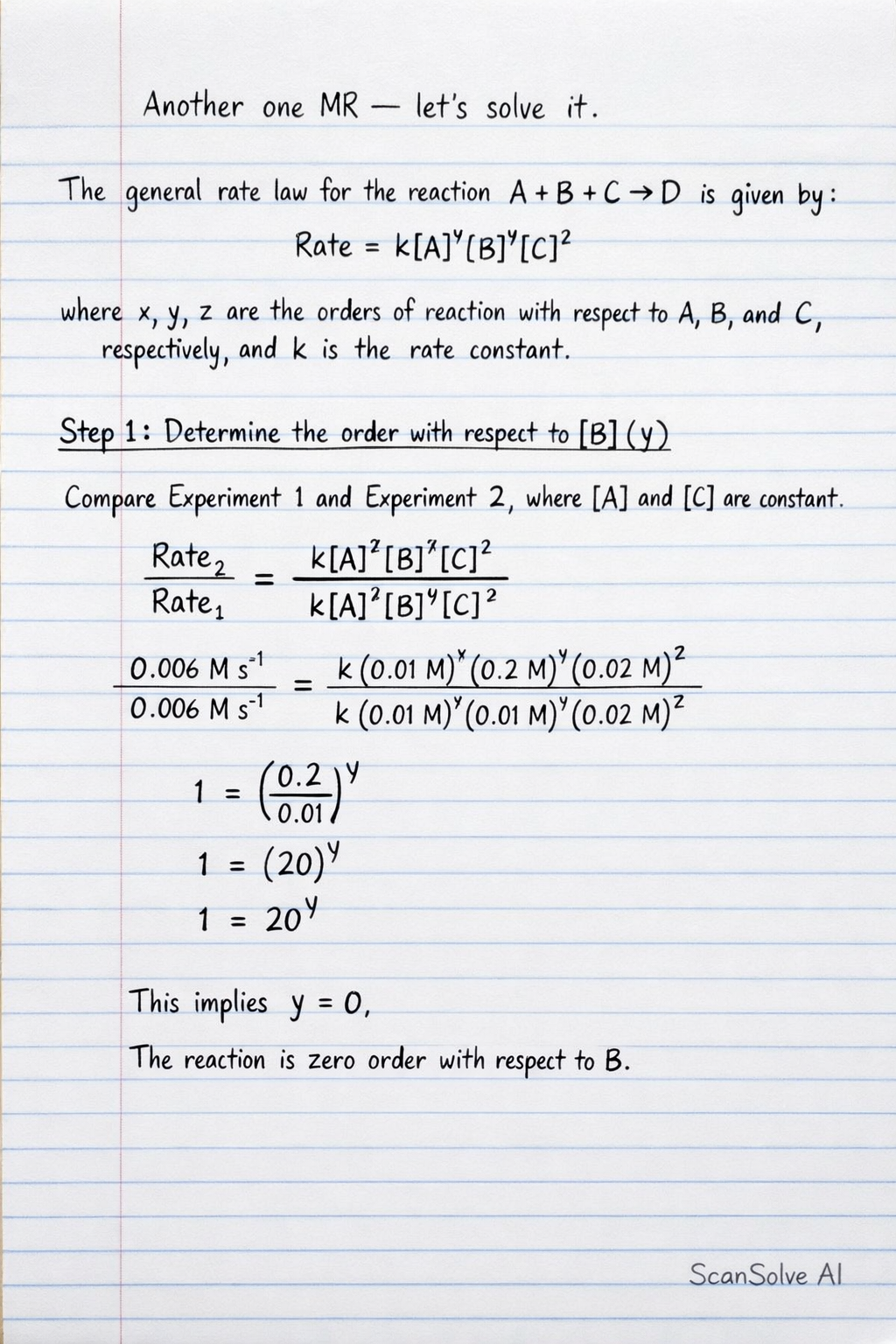
6 stepsThe general rate law for the reaction is given by:
where are the orders of reaction with respect to A, B, and C, respectively, and is the rate constant.
Determine the order with respect to [B] ()
Compare Experiment 1 and Experiment 2, where [A] and [C] are constant.
This implies .
The reaction is zero order with respect to B.Determine the order with respect to [C] ()
Compare Experiment 1 and Experiment 4, where [A] and [B] are constant.
This implies .
The reaction is first order with respect to C.Determine the order with respect to [A] ()
Compare Experiment 1 and Experiment 3. We know and .
This implies .
The reaction is first order with respect to A.Write the rate law (Question 1 and part of Question 2)
Using the determined orders :
The rate law is:
Calculate the rate constant () (Remaining part of Question 2)
Using data from Experiment 1:
Rate =
The rate constant is:
Derive the overall order of the reaction (Question 3)
The overall order of the reaction is the sum of the individual orders:
Overall order = .
The overall order of the reaction is:
Try one yourself
A new problem that tests the same skill.
Still stuck on this one?
Ask a follow-up, and the answer starts from this question.
More Chemistry Questions
Handwritten Step-by-Step Solution
Get this as a handwritten image on WhatsApp — like a tutor wrote it for you.
Try on WhatsApp