
We read your photo as:
Is the mass of an ion the same as the mass of its parent atom? Explain your answer. 9. Predict how many electrons are in each ion. a. an oxygen ion with a -2 charge b. chlorine ion with a -1 charge
ScanSolve AI Answer
Step-by-step solution
6 stepsHere are the answers to your questions:
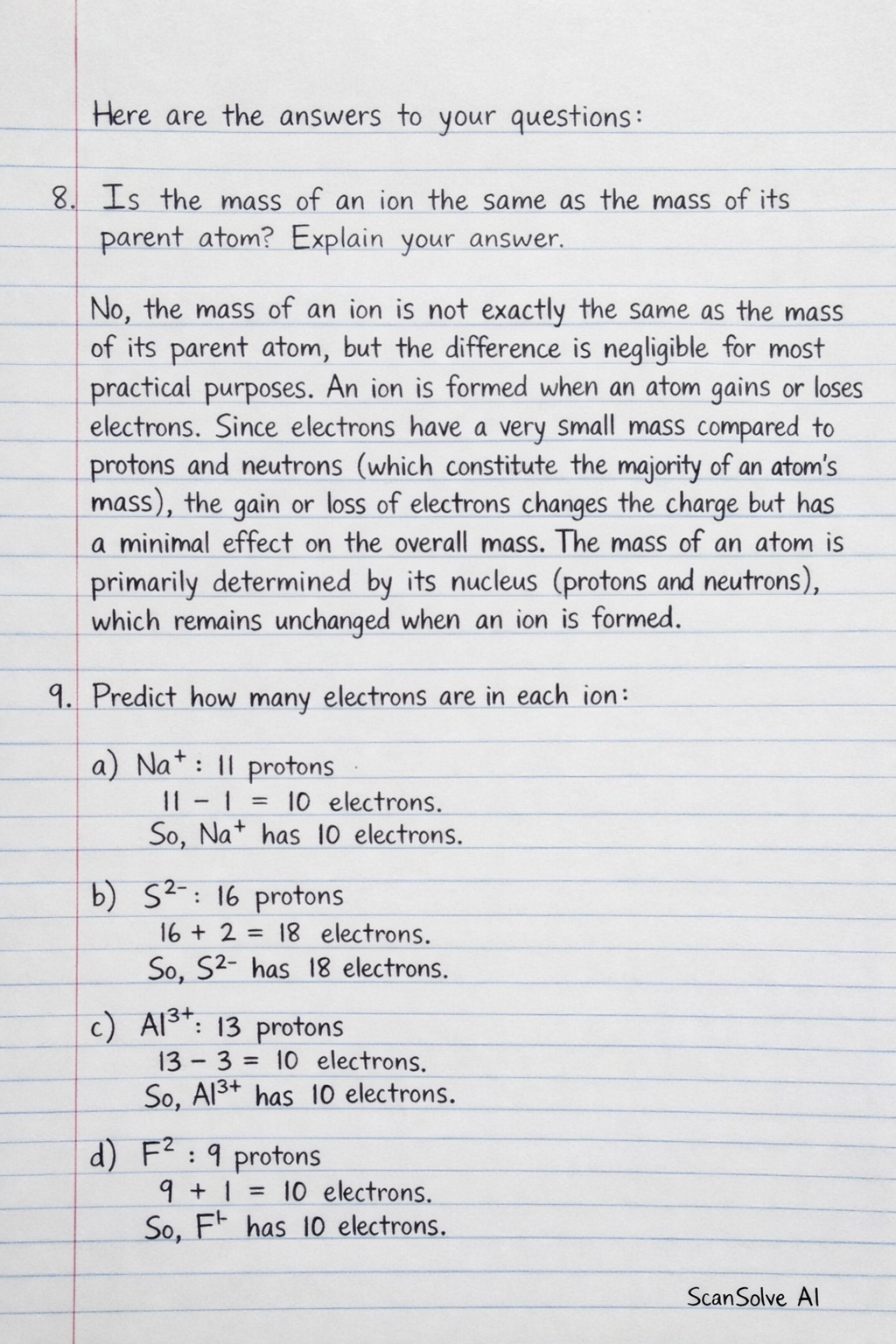
8. Is the mass of an ion the same as the mass of its parent atom? Explain your answer.
No, the mass of an ion is not exactly the same as the mass of its parent atom, but the difference is negligible for most practical purposes. An ion is formed when an atom gains or loses electrons. Since electrons have a very small mass compared to protons and neutrons (which constitute the majority of an atom's mass), the gain or loss of electrons changes the charge but has a minimal effect on the overall mass. The mass of an atom is primarily determined by its nucleus (protons and neutrons), which remains unchanged when an ion is formed.
9. Predict how many electrons are in each ion.
- a. an oxygen ion with a -2 charge
Determine the number of electrons in a neutral oxygen atom.
Oxygen (O) has an atomic number of 8, meaning a neutral oxygen atom has 8 protons and 8 electrons.Account for the ion's charge.
A -2 charge means the oxygen atom has gained 2 electrons.Calculate the total number of electrons.
Total electrons = $8 + 2 = \boxed{\text{10 electrons}}$- b. a chlorine ion with a -1 charge
Determine the number of electrons in a neutral chlorine atom.
Chlorine (Cl) has an atomic number of 17, meaning a neutral chlorine atom has 17 protons and 17 electrons.Account for the ion's charge.
A -1 charge means the chlorine atom has gained 1 electron.Calculate the total number of electrons.
Total electrons = $17 + 1 = \boxed{\text{18 electrons}}$
Still stuck on this one?
Ask a follow-up, and the answer starts from this question.
More Chemistry Questions
Handwritten Step-by-Step Solution
Get this as a handwritten image on WhatsApp — like a tutor wrote it for you.
Try on WhatsApp