
We read your photo as:
A) Explain why S is not an ion. b) Determine the number of electrons in the neutral atoms of P, Q, R and S.
ScanSolve AI Answer
Answer
Step-by-step solution
11 stepsPart 8
Part a· 3 steps
Analyze the electronic arrangement of S.
The electronic arrangement for S is . This means it has electrons.
Define an ion.
An ion is an atom or molecule that has gained or lost one or more electrons, resulting in a net electrical charge (positive or negative).
Explain why S is not an ion.
The species P, Q, and R all have charges indicated, signifying they are ions. S has no charge indicated, meaning it is a neutral species. A neutral atom has an equal number of protons and electrons. Therefore, S represents a neutral atom, not an ion. The electronic configuration corresponds to the noble gas Argon, which exists as a neutral atom.
Part b· 3 steps
Determine the number of electrons and identify the neutral atoms for P, Q, R, and S.
- P has electrons. The neutral atom P would have electrons, which is Sulfur (S).
- Q has electrons. The neutral atom Q would have electrons, which is Magnesium (Mg).
- R has electrons. The neutral atom R would have electrons, which is Sodium (Na).
- S has electrons. The neutral atom S has 18 electrons, which is Argon (Ar).
Compare the atomic radii of the neutral atoms (Sulfur, Magnesium, Sodium, Argon).
All these elements are in Period 3 of the periodic table. Atomic radius generally decreases across a period from left to right due to an increasing nuclear charge pulling the electrons closer to the nucleus.
Identify the element with the largest atomic radius.
Among Sodium (Group 1), Magnesium (Group 2), Sulfur (Group 16), and Argon (Group 18), Sodium is furthest to the left in Period 3. Therefore, Sodium has the largest atomic radius.
The element with the largest atomic radius is R.
Reason: R is Sodium, which is in Group 1, Period 3. Atomic radius decreases across a period due to increasing nuclear charge. As Sodium is the furthest left among the elements in Period 3, it has the largest atomic radius.
Part 9
Calculate the mass of of the solution.
Given density .
Volume .
Mass of solutionCalculate the mass of pure HCl in of the solution.
Percentage purity .
Mass of pure HClCalculate the molar mass of HCl.
Molar mass of H
Molar mass of Cl
Molar mass of HClCalculate the moles of HCl in of the solution.
Moles of HCl
Determine the molarity of the solution.
Molarity
Rounding to a reasonable number of significant figures (e.g., three, based on 37% purity):
The molarity of the solution is .
Part 10
The question is incomplete as it provides pH values and solution labels but does not ask for a specific task or calculation.
Try one yourself
A new problem that tests the same skill.
Still stuck on this one?
Ask a follow-up, and the answer starts from this question.
More Chemistry Questions
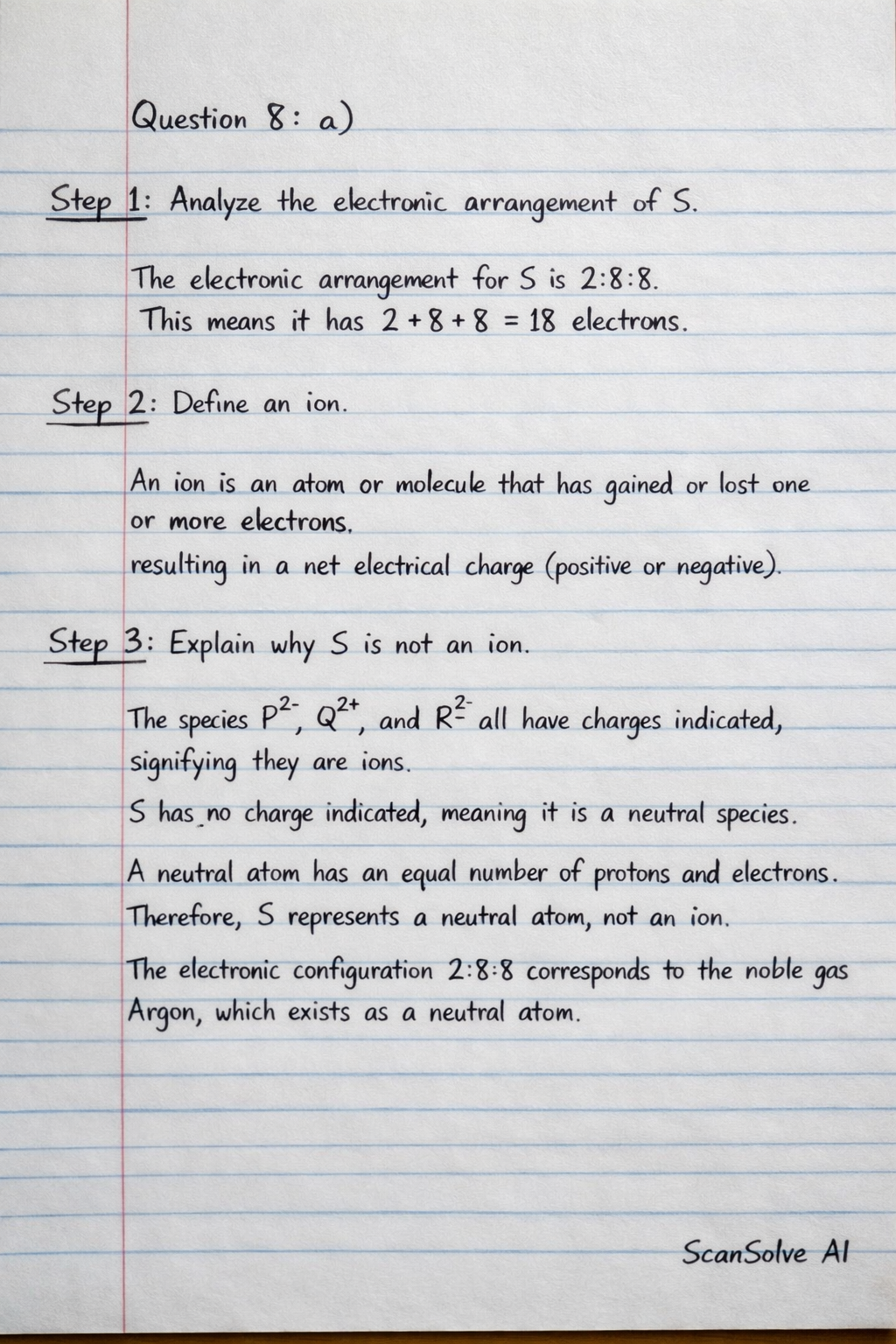
Handwritten Step-by-Step Solution
Get this as a handwritten image on WhatsApp — like a tutor wrote it for you.
Try on WhatsApp