
We read your photo as:
Answer the following questions regarding electrolysis and iodine sublimation: a) Identify the electrode that decreased in mass during electrolysis and explain why. b) Calculate the quantity of charge
ScanSolve AI Answer
Answer
Step-by-step solution
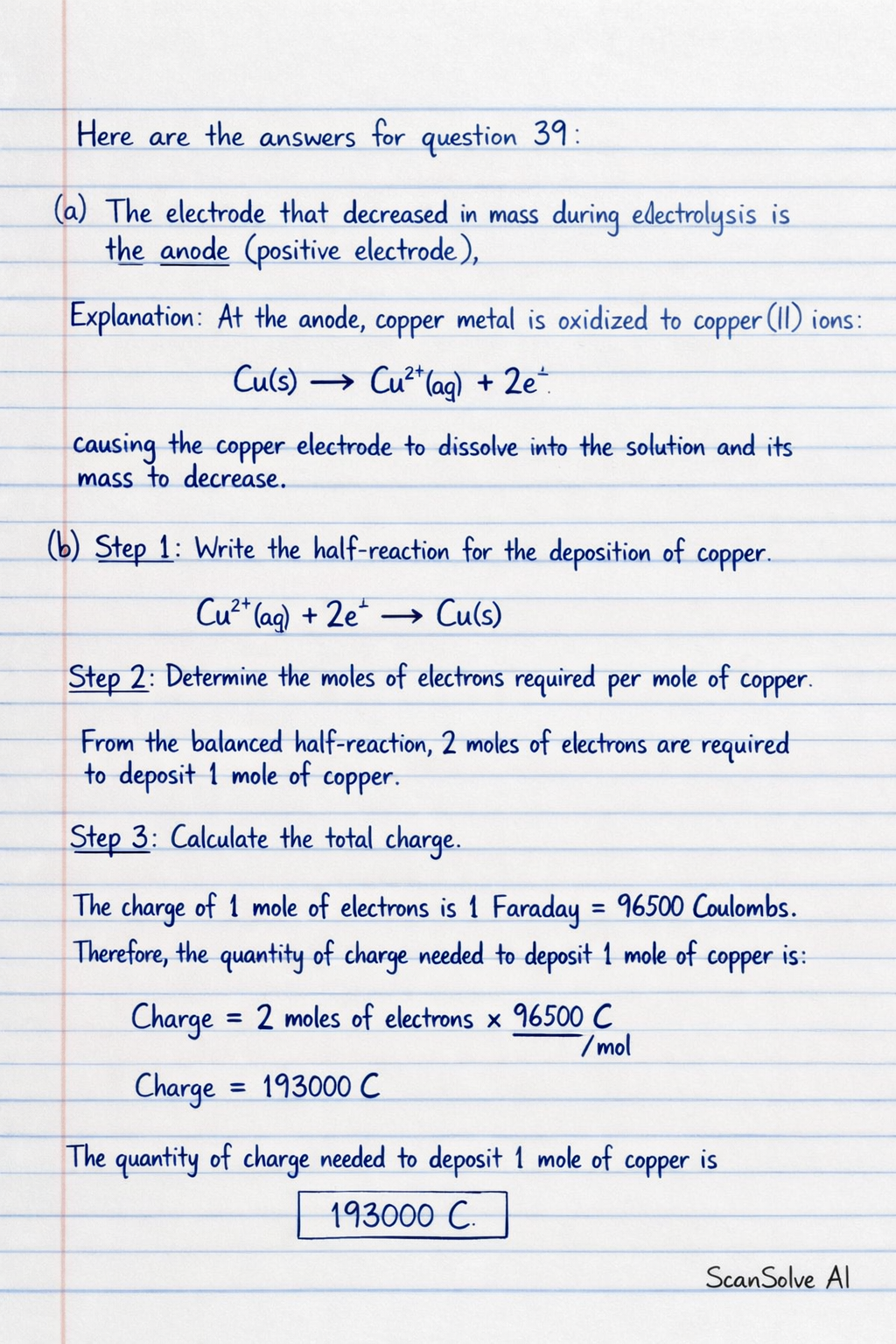
3 stepsHere are the answers for question 39:
Part a
The electrode that decreased in mass during electrolysis is the anode (positive electrode).
Explanation: At the anode, copper metal is oxidized to copper(II) ions (), causing the copper electrode to dissolve into the solution and its mass to decrease.
Part b
Write the half-reaction for the deposition of copper.
The deposition of copper at the cathode is given by the half-reaction:
Determine the moles of electrons required per mole of copper.
From the balanced half-reaction, 2 moles of electrons are required to deposit 1 mole of copper.
Calculate the total charge.
The charge of 1 mole of electrons is 1 Faraday, which is 96500 Coulombs.
Therefore, the quantity of charge needed to deposit 1 mole of copper is:The quantity of charge needed to deposit 1 mole of copper is .
Part c
Observation: When crystals of iodine are heated gently, purple/violet vapor is observed.
Explanation: Iodine undergoes sublimation, which is the direct change from a solid to a gaseous state without passing through a liquid phase. The iodine vapor has a characteristic purple color.
Try one yourself
A new problem that tests the same skill.
Still stuck on this one?
Ask a follow-up, and the answer starts from this question.
More Chemistry Questions
Handwritten Step-by-Step Solution
Get this as a handwritten image on WhatsApp — like a tutor wrote it for you.
Try on WhatsApp