
Atomic structure and bonding The concept of atoms molecules and ions the works of Dalton, millikam,Rutherford, Moseley, Thompson and Bohr. Atomic structure, electron configuration, atomic number, mass number and isotopes, specific examples should be drawn from elements of atomic number 1to 20 Shapes of s and p orbitals. The periodic table and periodicity of elements, presentation of the periodic table with a view to recognizing families of elements e.g alkali metals, halogens, the noble gases and transition metals. The variation of the following properties: ionization energy, ionic radii ,electron affinity and electro negativity Chemical bonding Shapes of simple molecules. Nuclear chemistry
ScanSolve AI Answer
-
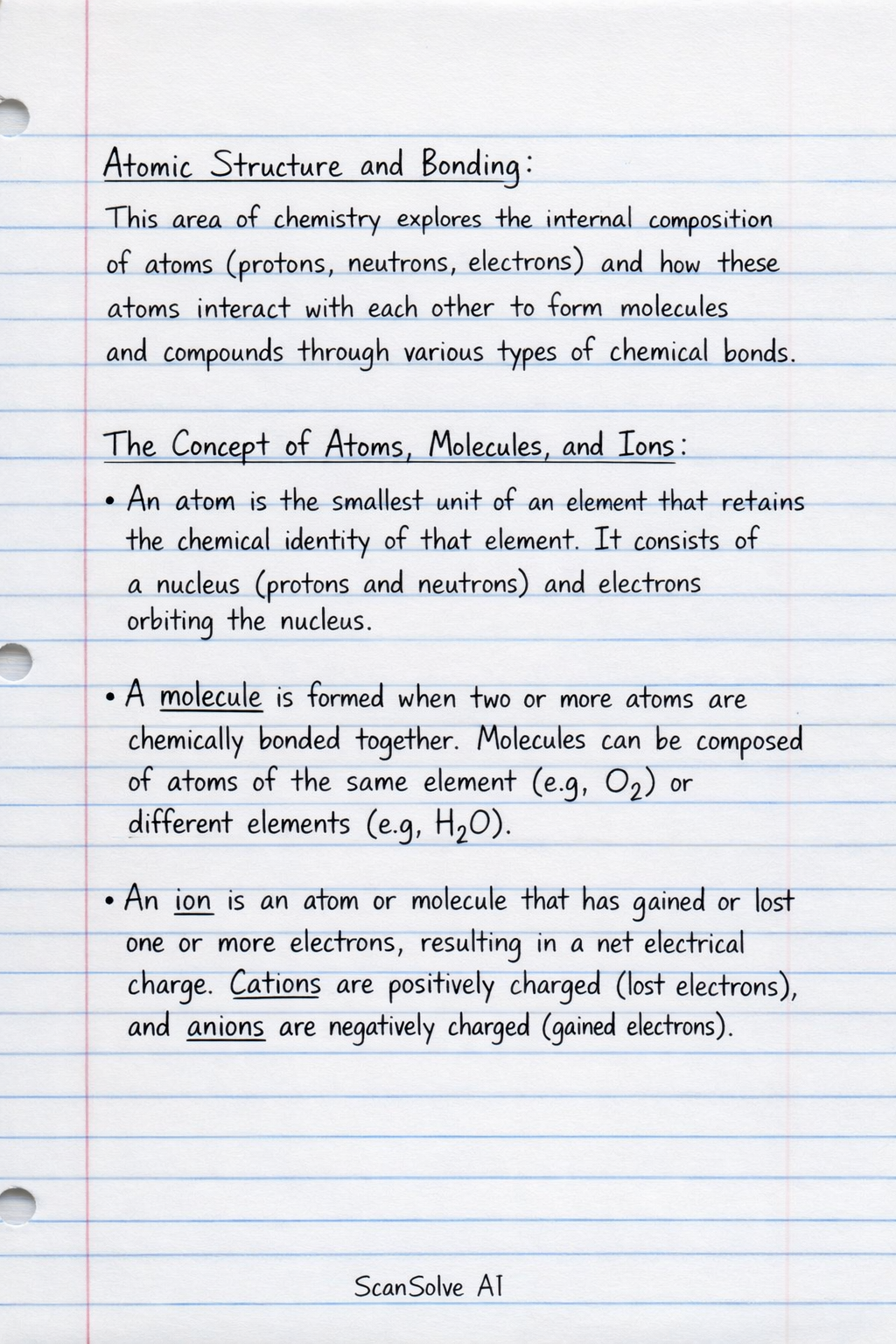
Atomic Structure and Bonding: This area of chemistry explores the internal composition of atoms (protons, neutrons, electrons) and how these atoms interact with each other to form molecules and compounds through various types of chemical bonds.
-
The Concept of Atoms, Molecules, and Ions:
- An atom is the smallest unit of an element that retains the chemical identity of that element. It consists of a nucleus (protons and neutrons) and electrons orbiting the nucleus.
- A molecule is formed when two or more atoms are chemically bonded together. Molecules can be composed of atoms of the same element (e.g., ) or different elements (e.g., ).
- An ion is an atom or molecule that has gained or lost one or more electrons, resulting in a net electrical charge. Cations are positively charged (lost electrons), and anions are negatively charged (gained electrons).
-
The Works of Key Scientists:
- Dalton: Proposed the first modern atomic theory (1808), stating that elements are made of indivisible atoms, atoms of the same element are identical, atoms combine in whole-number ratios to form compounds, and atoms are rearranged in chemical reactions.
- Thomson: Discovered the electron (1897) using cathode ray tubes and proposed the "plum pudding" model of the atom, where electrons were embedded in a sphere of positive charge.
- Millikan: Determined the charge of a single electron (1909) through his oil drop experiment.
- Rutherford: Through the gold foil experiment (1911), he discovered the atomic nucleus, proposing that atoms have a dense, positively charged nucleus with electrons orbiting around it.
- Bohr: Proposed a planetary model of the atom (1913) where electrons orbit the nucleus in specific, quantized energy levels or shells. Electrons can jump between these levels by absorbing or emitting specific amounts of energy.
- Moseley: Established the concept of atomic number (1913) as the number of protons in an atom's nucleus, showing that it is the fundamental property determining an element's identity, not atomic mass.
-
Atomic Structure:
- Electron Configuration: The arrangement of electrons in the orbitals around an atom's nucleus. Electrons fill orbitals according to the Aufbau principle, Hund's rule, and the Pauli exclusion principle.
- Examples (Atomic Number 1-20):
- or
- Examples (Atomic Number 1-20):
- Atomic Number (): The number of protons in the nucleus of an atom. It defines the element. For a neutral atom, it also equals the number of electrons.
- Mass Number (): The total number of protons and neutrons in the nucleus of an atom.
- Isotopes: Atoms of the same element (same atomic number) that have different numbers of neutrons, and thus different mass numbers.
- Example: Carbon-12 (
\text{_6}^{12}\text{C}) has 6 protons and 6 neutrons, while Carbon-14 (\text{_6}^{14}\text{C}) has 6 protons and 8 neutrons.
- Example: Carbon-12 (
- Electron Configuration: The arrangement of electrons in the orbitals around an atom's nucleus. Electrons fill orbitals according to the Aufbau principle, Hund's rule, and the Pauli exclusion principle.
-
Shapes of s and p Orbitals:
- s-orbital: Spherical in shape, with the nucleus at the center. There is one s-orbital per energy level (e.g., ).
- p-orbital: Dumbbell-shaped, consisting of two lobes on opposite sides of the nucleus. There are three p-orbitals per energy level (starting from the second energy level), oriented along the x, y, and z axes ().
-
The Periodic Table and Periodicity of Elements:
- The periodic table is an organized arrangement of elements based on their atomic number, electron configuration, and recurring chemical properties. Elements are arranged in rows called periods and columns called groups or families.
- Families of Elements:
- Alkali Metals (Group 1): Highly reactive metals with one valence electron (e.g., ).
- Halogens (Group 17): Highly reactive nonmetals with seven valence electrons (e.g., ).
- Noble Gases (Group 18): Unreactive gases with a full outer electron shell (e.g., ).
- Transition Metals (Groups 3-12): Metals known for forming colored compounds and having multiple oxidation states (e.g., ).
-
Variation of Properties (Periodicity):
- Ionization Energy: The minimum energy required to remove one electron from a gaseous atom in its ground state. Generally increases across a period (due to increasing nuclear charge) and decreases down a group (due to increasing atomic size and shielding).
- Ionic Radii: The radius of an ion. Cations are smaller than their parent atoms, and anions are larger. Generally decreases across a period for isoelectronic ions (due to increasing nuclear charge) and increases down a group (due to adding electron shells).
- Electron Affinity: The energy change that occurs when an electron is added to a gaseous atom to form a negative ion. Generally becomes more negative (more favorable) across a period (due to increasing nuclear charge) and less negative (less favorable) down a group (due to increasing atomic size).
- Electronegativity: A measure of the ability of an atom in a chemical compound to attract electrons towards itself. Generally increases across a period (due to increasing nuclear charge and decreasing atomic size) and decreases down a group (due to increasing atomic size and shielding).
-
Chemical Bonding: The forces that hold atoms together in molecules and compounds.
- Ionic bonding: Involves the complete transfer of electrons between atoms, typically between a metal and a nonmetal, forming ions that are attracted by electrostatic forces.
- Covalent bonding: Involves the sharing of electrons between atoms, typically between two nonmetals.
- Metallic bonding: Involves a "sea" of delocalized electrons shared among a lattice of metal cations.
-
Shapes of Simple Molecules: Determined by the repulsion between electron pairs (both bonding and lone pairs) in the valence shell of the central atom, as described by the Valence Shell Electron Pair Repulsion (VSEPR) theory.
- Examples:
- (methane): Tetrahedral
- (ammonia): Trigonal pyramidal
- (water): Bent or V-shaped
- (carbon dioxide): Linear
- (boron trifluoride): Trigonal planar
- Examples:
-
Nuclear Chemistry: The study of reactions involving changes in the nucleus of an atom. It deals with radioactivity, nuclear fission (splitting of heavy nuclei), and nuclear fusion (combining of light nuclei), as well as the applications of these processes.
Still stuck on this one?
Ask a follow-up, and the answer starts from this question.
More Physics Questions
Handwritten Step-by-Step Solution
Get this as a handwritten image on WhatsApp — like a tutor wrote it for you.
Try on WhatsApp