
We read your photo as:
Discuss the Periodic Table under the following: - Arrangement of elements - Periodic trends (atomic radius, ionization energy, electronegativity)
ScanSolve AI Answer
here are the answers to questions 5, 6, 7, and 8:
5)
The Periodic Table:
-
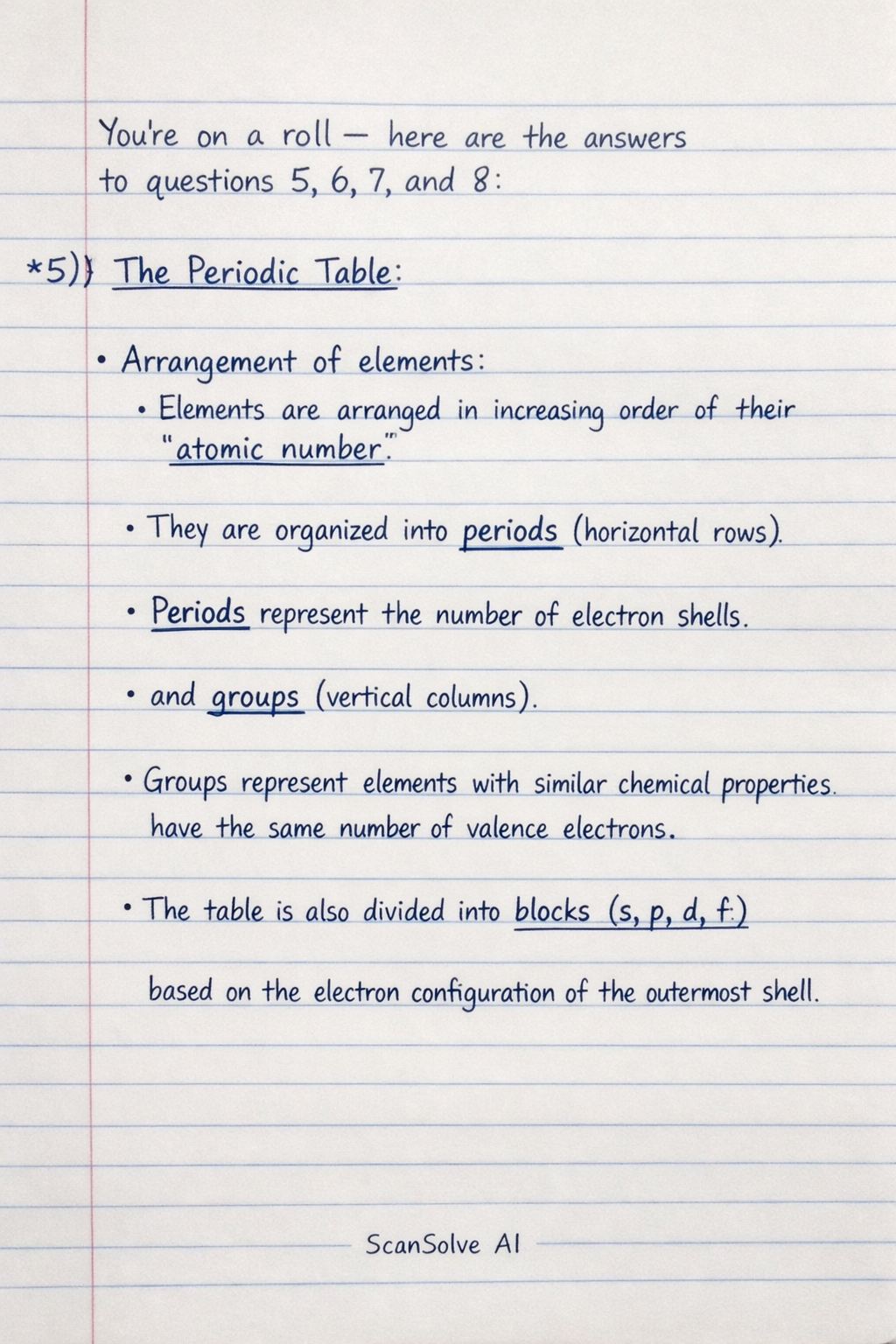
Arrangement of elements: Elements are arranged in increasing order of their atomic number. They are organized into periods (horizontal rows) which represent the number of electron shells, and groups (vertical columns) which represent elements with similar chemical properties due to having the same number of valence electrons. The table is also divided into blocks (s, p, d, f) based on the electron configuration of the outermost shell.
-
Periodic trends:
- Atomic radius: This is the distance from the nucleus to the outermost electron shell. It decreases across a period due to increasing nuclear charge pulling electrons closer, and increases down a group as new electron shells are added.
- Ionization energy: This is the energy required to remove one electron from a gaseous atom. It generally increases across a period due to stronger nuclear attraction, and decreases down a group because valence electrons are further from the nucleus and more shielded.
- Electronegativity: This is the ability of an atom to attract electrons in a chemical bond. It generally increases across a period as nuclear charge increases, and decreases down a group due to increased atomic size and shielding.
6)
Chemical equilibrium is a dynamic state in a reversible reaction where the rate of the forward reaction is equal to the rate of the reverse reaction. At equilibrium, the concentrations of reactants and products remain constant, but the reactions continue to occur.
Le Chatelier's principle states that if a change of condition (such as temperature, pressure, or concentration) is applied to a system in equilibrium, the system will shift in a direction that relieves the stress.
Factors affecting chemical equilibrium:
- Concentration: Increasing the concentration of a reactant shifts the equilibrium to the right (towards products); increasing the concentration of a product shifts it to the left (towards reactants).
- Pressure (for gaseous reactions): Increasing pressure shifts the equilibrium towards the side with fewer moles of gas; decreasing pressure shifts it towards the side with more moles of gas.
- Temperature: Increasing temperature shifts the equilibrium in the endothermic direction; decreasing temperature shifts it in the exothermic direction.
7)
Acids, Bases, and Salts:
-
Definitions:
- Arrhenius: An acid is a substance that produces ions (protons) when dissolved in water. A base is a substance that produces ions (hydroxide ions) when dissolved in water.
- Brønsted-Lowry: An acid is a proton () donor. A base is a proton () acceptor.
-
Properties:
- Acids: Taste sour, turn blue litmus red, react with metals to produce hydrogen gas, react with bases to form salt and water.
- Bases: Taste bitter, feel slippery, turn red litmus blue, react with acids to form salt and water.
- Salts: Ionic compounds formed from the reaction of an acid and a base. They typically have high melting points and conduct electricity when molten or dissolved in water.
-
Neutralization: This is a chemical reaction between an acid and a base, which typically produces a salt and water. The ions from the acid combine with the ions from the base to form water, while the remaining ions form the salt. General equation: Example:
8)
The kinetic theory of gases describes the macroscopic properties of gases, such as pressure, temperature, and volume, in terms of the motion of their constituent particles (atoms or molecules). It explains gas behavior based on a set of assumptions about the nature of gas particles and their interactions.
Assumptions of the kinetic theory of gases:
- Gases consist of a large number of tiny particles (atoms or molecules) that are in constant, random motion.
- The volume of the gas particles themselves is negligible compared to the total volume occupied by the gas.
- There are no significant attractive or repulsive forces between gas particles.
- Collisions between gas particles and with the walls of the container are perfectly elastic, meaning no kinetic energy is lost during collisions.
- The average kinetic energy of the gas particles is directly proportional to the absolute temperature of the gas.
Still stuck on this one?
Ask a follow-up, and the answer starts from this question.
More Chemistry Questions
Handwritten Step-by-Step Solution
Get this as a handwritten image on WhatsApp — like a tutor wrote it for you.
Try on WhatsApp