
We read your photo as:
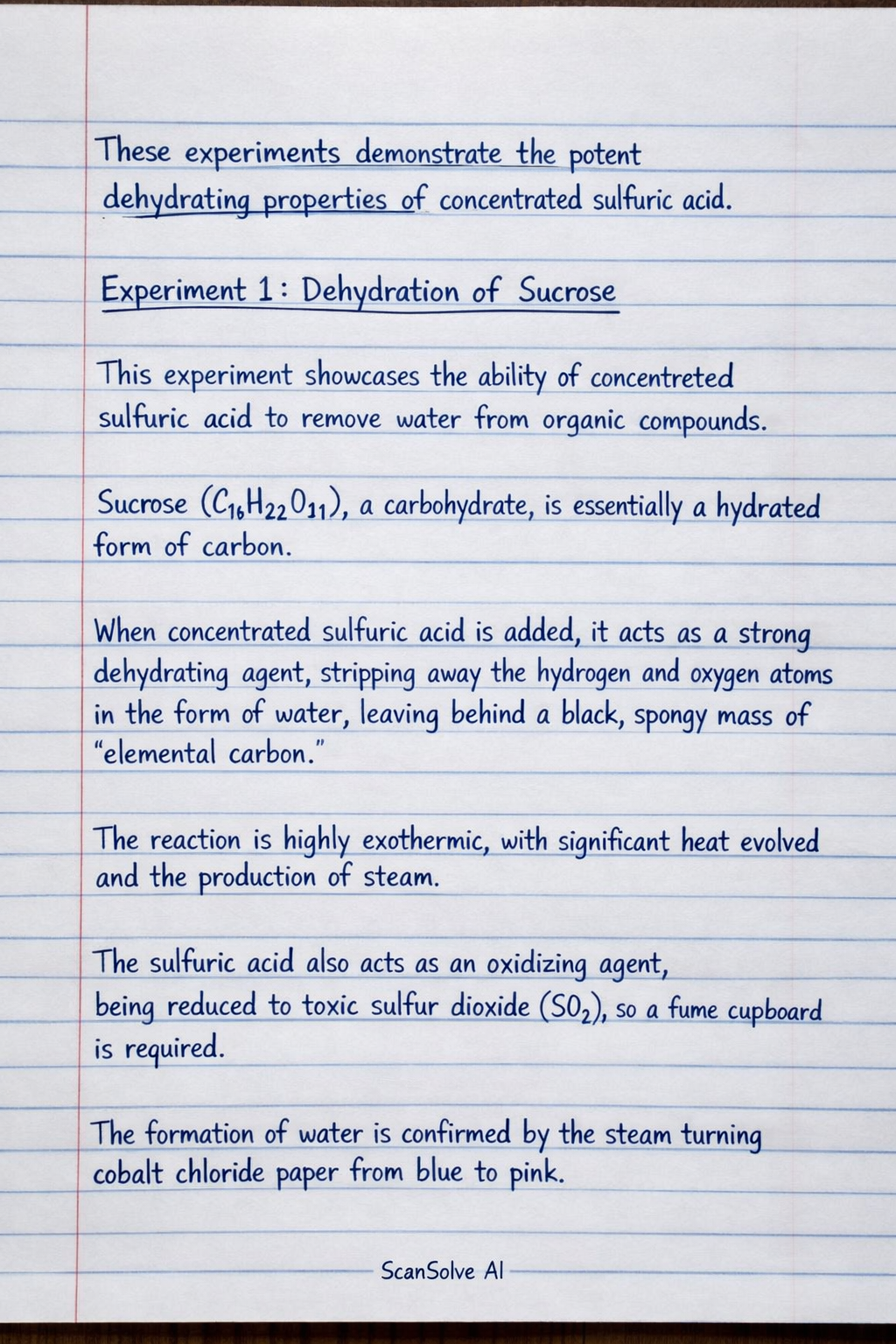
These experiments demonstrate the potent dehydrating properties of concentrated sulfuric acid.
ScanSolve AI Answer
These experiments demonstrate the potent dehydrating properties of concentrated sulfuric acid.
Experiment 1: Dehydration of Sucrose
This experiment showcases the ability of concentrated sulfuric acid to remove water from organic compounds. Sucrose (), a carbohydrate, is essentially a hydrated form of carbon. When concentrated sulfuric acid is added, it acts as a strong dehydrating agent, stripping away the hydrogen and oxygen atoms in the form of water, leaving behind a black, spongy mass of elemental carbon. The reaction is highly exothermic, indicated by the significant heat evolved and the production of steam. The sulfuric acid also acts as an oxidizing agent, being reduced to toxic sulfur dioxide (), which necessitates the use of a fume cupboard. The formation of water is confirmed by the steam turning cobalt chloride paper from blue to pink.
Experiment 2: Dehydration of Hydrated Copper(II) Sulfate
This experiment illustrates the removal of water of crystallization from an inorganic salt. Hydrated copper(II) sulfate () is blue due to the presence of water molecules coordinated to the copper(II) ions. Concentrated sulfuric acid removes these water molecules, converting the blue hydrated salt into white anhydrous copper(II) sulfate (). This reaction is also exothermic. The reversibility of the reaction, where adding water restores the blue color, further confirms that the change is due to the removal and re-addition of water molecules.
Both experiments highlight the corrosive and hazardous nature of concentrated sulfuric acid, emphasizing the critical need for eye protection and working in a fume cupboard due to the evolution of toxic gases and heat. The principle of adding acid to water, not water to acid, is also a crucial safety consideration when diluting concentrated acids.
Still stuck on this one?
Ask a follow-up, and the answer starts from this question.
More Chemistry Questions
Handwritten Step-by-Step Solution
Get this as a handwritten image on WhatsApp — like a tutor wrote it for you.
Try on WhatsApp