
We read your photo as:
Describe the components of a synovial joint, Hilton's Law, the difference between median sagittal and parasagittal planes, and the meanings of medial and lateral. Also, list the functions of the skele
Biology
ScanSolve AI Answer
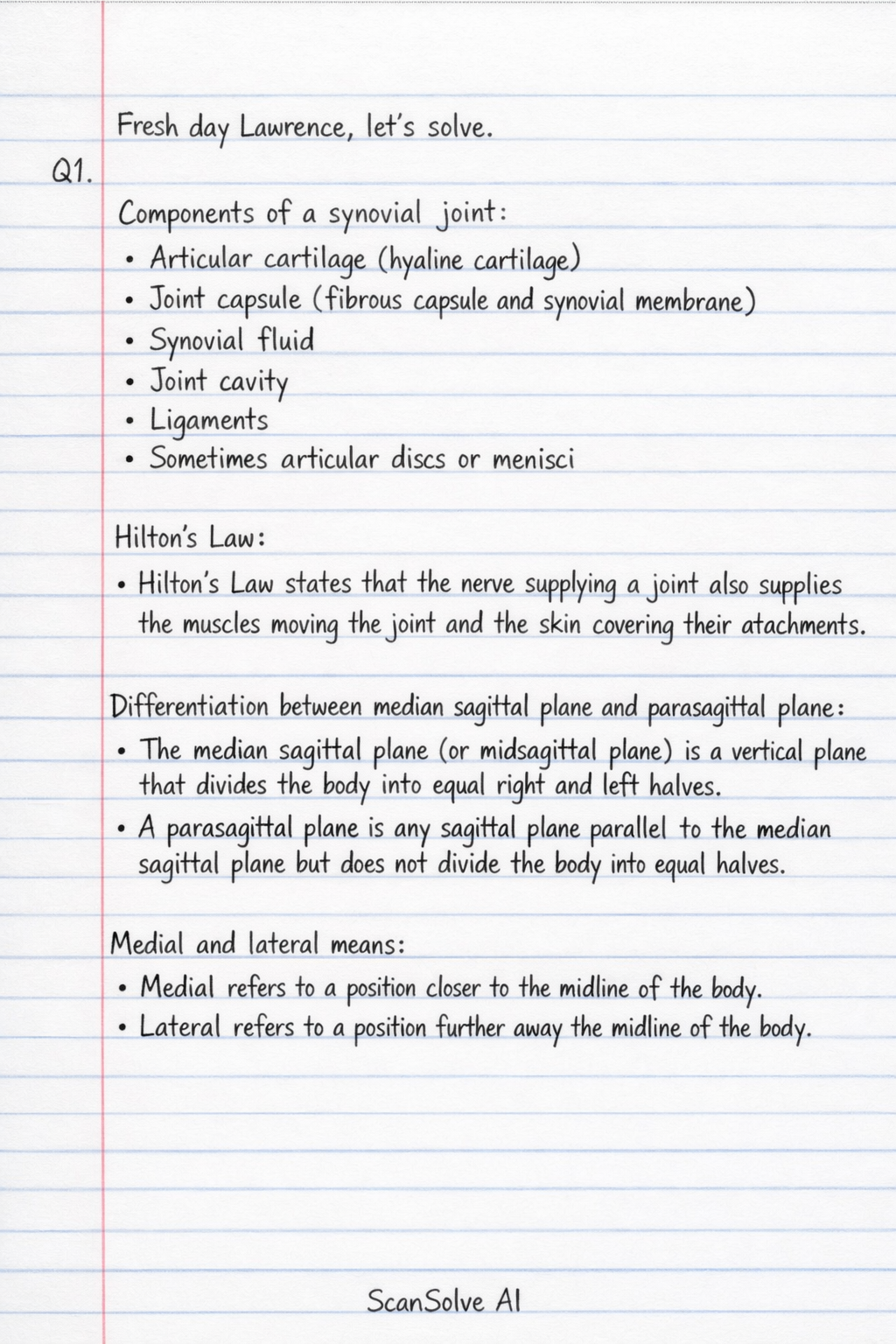
Q1.
- Components of a synovial joint:
- Articular cartilage (hyaline cartilage)
- Joint capsule (fibrous capsule and synovial membrane)
- Synovial fluid
- Joint cavity
- Ligaments
- Sometimes articular discs or menisci
- Hilton's Law:
- Hilton's Law states that the nerve supplying a joint also supplies the muscles moving the joint and the skin covering their attachments.
- Differentiation between median sagittal plane and parasagittal plane:
- The median sagittal plane (or midsagittal plane) is a vertical plane that divides the body into equal right and left halves.
- A parasagittal plane is any sagittal plane parallel to the median sagittal plane but does not divide the body into equal halves.
- Medial and lateral means:
- Medial refers to a position closer to the midline of the body.
- Lateral refers to a position further away from the midline of the body.
Q2.
- Functions of the skeletal system:
- Support: Provides a framework for the body.
- Protection: Protects internal organs (e.g., skull protects the brain).
- Movement: Serves as attachment points for muscles, allowing movement.
- Mineral storage: Stores calcium and phosphate.
- Blood cell production (hematopoiesis): Occurs in red bone marrow.
- Fat storage: Yellow bone marrow stores fat.
- Bones of the Upper Limb (UL):
- Clavicle (2)
- Scapula (2)
- Humerus (2)
- Ulna (2)
- Radius (2)
- Carpals (16 total, 8 per wrist: scaphoid, lunate, triquetrum, pisiform, trapezium, trapezoid, capitate, hamate)
- Metacarpals (10 total, 5 per hand)
- Phalanges (28 total, 14 per hand)
- Components of the cardiovascular system:
- Heart
- Blood vessels (arteries, veins, capillaries)
- Blood
- Bones of the skull:
- Cranial bones (8): Frontal, Parietal (2), Temporal (2), Occipital, Sphenoid, Ethmoid.
- Facial bones (14): Maxilla (2), Zygomatic (2), Nasal (2), Lacrimal (2), Palatine (2), Inferior nasal concha (2), Vomer, Mandible.
Q3.
- Various types of cavities found in the human body:
- Dorsal body cavity: Contains the cranial cavity (brain) and vertebral cavity (spinal cord).
- Ventral body cavity: Contains the thoracic cavity (lungs, heart) and abdominopelvic cavity (abdominal and pelvic organs).
- Types of quadrants with at least two examples of organs found in each:
- Right Upper Quadrant (RUQ): Liver, gallbladder, part of the large intestine, part of the small intestine.
- Left Upper Quadrant (LUQ): Stomach, spleen, part of the pancreas, part of the large intestine.
- Right Lower Quadrant (RLQ): Appendix, cecum, right ovary/fallopian tube, right ureter.
- Left Lower Quadrant (LLQ): Sigmoid colon, part of the small intestine, left ovary/fallopian tube, left ureter.
- Functional and anatomical end arteries:
- An anatomical end artery is an artery that has no anastomoses (connections) with adjacent arteries. If it is blocked, the tissue it supplies will die.
- A functional end artery is an artery that has anastomoses with adjacent arteries, but these connections are insufficient to maintain blood supply if the main artery is blocked.
- The 12 cranial nerves and their functions:
- Olfactory (I): Sense of smell.
- Optic (II): Sense of vision.
- Oculomotor (III): Eye movement (most extrinsic eye muscles), pupil constriction, lens accommodation.
- Trochlear (IV): Eye movement (superior oblique muscle).
- Trigeminal (V): Sensory for face, motor for muscles of mastication (chewing).
- Abducens (VI): Eye movement (lateral rectus muscle).
- Facial (VII): Motor for muscles of facial expression, taste from anterior two-thirds of tongue, salivary and lacrimal gland secretion.
- Vestibulocochlear (VIII): Sense of hearing and balance.
- Glossopharyngeal (IX): Taste from posterior one-third of tongue, swallowing, salivation, sensory from pharynx.
- Vagus (X): Innervates most visceral organs (heart, lungs, digestive tract), swallowing, speech.
- Accessory (XI): Motor for sternocleidomastoid and trapezius muscles (head and shoulder movement).
- Hypoglossal (XII): Motor for tongue movement.
Q4.
- Special features of muscles:
- Excitability: Ability to respond to stimuli.
- Contractility: Ability to shorten forcibly.
- Extensibility: Ability to be stretched.
- Elasticity: Ability to recoil to original length.
- Special features of skeletal muscles:
- Striated appearance due to organized sarcomeres.
- Voluntary control.
- Multinucleated cells (fibers).
- Attached to bones, responsible for body movement.
- Functions and types of muscles:
- Functions:
- Movement (locomotion, manipulation, blood circulation, digestion).
- Posture maintenance.
- Joint stabilization.
- Heat generation.
- Types:
- Skeletal muscle: Voluntary, striated, moves bones.
- Cardiac muscle: Involuntary, striated, found in the heart.
- Smooth muscle: Involuntary, non-striated, found in walls of internal organs and blood vessels.
- Functions:
- Sutures of the brain (skull):
- Coronal suture: Between frontal and parietal bones.
- Sagittal suture: Between the two parietal bones.
- Lambdoid suture: Between parietal and occipital bones.
- Squamous sutures: Between parietal and temporal bones (one on each side).
Q5.
- Formation of the brachial plexus and its branches:
The brachial plexus is a network of nerves formed by the anterior rami of spinal nerves C5, C6, C7, C8, and T1. It is responsible for the motor and sensory innervation of the upper limb.
- Roots: Formed by the anterior rami of C5-T1.
- Trunks: The roots combine to form three trunks:
- Upper trunk: C5, C6
- Middle trunk: C7
- Lower trunk: C8, T1
- Divisions: Each trunk divides into an anterior and a posterior division.
- Anterior divisions: Supply flexor compartments.
- Posterior divisions: Supply extensor compartments.
- Cords: The divisions unite to form three cords, named relative to the axillary artery:
- Lateral cord: From anterior divisions of upper and middle trunks.
- Posterior cord: From all three posterior divisions.
- Medial cord: From anterior division of lower trunk.
- Branches: The cords give rise to major nerves of the upper limb:
- Lateral cord: Musculocutaneous nerve, lateral root of median nerve.
- Posterior cord: Axillary nerve, Radial nerve.
- Medial cord: Ulnar nerve, medial root of median nerve.
- Other smaller branches arise from roots, trunks, and cords (e.g., dorsal scapular, long thoracic, suprascapular, subscapular, thoracodorsal, medial pectoral, lateral pectoral nerves).
- Content of the axilla:
- Axillary artery and its branches.
- Axillary vein and its tributaries.
- Brachial plexus (cords and branches).
- Axillary lymph nodes.
- Axillary fat and areolar tissue.
- Portions of muscles: long head of biceps brachii, coracobrachialis, axillary tail of breast.
- Content of the popliteal fossa:
- Popliteal artery and its branches.
- Popliteal vein and its tributaries.
- Tibial nerve.
- Common fibular (peroneal) nerve.
- Popliteal lymph nodes.
- Popliteal fat.
- Small saphenous vein (terminates here).
- Short note on the sciatic nerve: The sciatic nerve is the largest nerve in the human body, originating from the sacral plexus (L4-S3). It exits the pelvis through the greater sciatic foramen, typically inferior to the piriformis muscle. It descends through the posterior thigh, innervating the hamstring muscles and part of the adductor magnus. In the distal thigh, it usually divides into two major branches: the tibial nerve and the common fibular (peroneal) nerve, which supply the leg and foot. Damage to the sciatic nerve can cause sciatica, characterized by pain, numbness, or weakness along its pathway.
Q6.
- Nine regions of the abdomen with an example of a major organ found in each:
- Right Hypochondriac Region: Liver, gallbladder.
- Epigastric Region: Stomach, pancreas, liver.
- Left Hypochondriac Region: Spleen, stomach, pancreas.
- Right Lumbar Region: Ascending colon, right kidney.
- Umbilical Region: Small intestine, transverse colon.
- Left Lumbar Region: Descending colon, left kidney.
- Right Iliac (Inguinal) Region: Appendix, cecum.
- Hypogastric (Pubic) Region: Urinary bladder, uterus (in females).
- Left Iliac (Inguinal) Region: Sigmoid colon.
- Carpal tunnel syndrome: Carpal tunnel syndrome is a condition caused by compression of the median nerve as it passes through the carpal tunnel in the wrist. The carpal tunnel is a narrow passageway formed by the carpal bones and the transverse carpal ligament. Symptoms typically include numbness, tingling, pain, and weakness in the thumb, index, middle, and half of the ring finger, often worsening at night or with repetitive hand movements.
- Five processes that occur during the embryonic stage of life and briefly describe each:
- Fertilization: The fusion of male and female gametes (sperm and egg) to form a zygote.
- Cleavage: Rapid mitotic cell divisions of the zygote, leading to an increase in cell number without an increase in overall size, forming a morula and then a blastocyst.
- Gastrulation: A critical process where the blastocyst reorganizes into a gastrula with three primary germ layers (ectoderm, mesoderm, and endoderm), which will give rise to all tissues and organs.
- Neurulation: The formation of the neural tube from the ectoderm, which will develop into the brain and spinal cord.
- Organogenesis: The development and differentiation of the three germ layers into distinct organs and organ systems.
- First week of life (human development): The first week of human development begins with fertilization, typically in the uterine tube, forming a zygote. The zygote then undergoes rapid cell divisions called cleavage as it travels down the uterine tube towards the uterus. This process forms a solid ball of cells called a morula. By day 4-5, the morula develops into a blastocyst, which consists of an inner cell mass (embryoblast) that will form the embryo, and an outer layer of cells (trophoblast) that will contribute to the placenta. The blastocyst then implants into the uterine wall (endometrium) around day 6-7, marking the end of the first week.
Was this helpful?
Still stuck on this one?
Ask a follow-up, and the answer starts from this question.
Got a different question?Ask your own question
More Biology Questions
QDescribe the components of a synovial joint, explain Hilton's law, differentiate between median and…QList and describe 5 types of synovial joints and their movements.QDefine anatomical position and state its purpose. Complete the table of synovial joints and their…QList five functions of the human skeletal system and distinguish between cartilage and bone in a…QWhat are the features and functions of the ball and socket joint, pelvic girdle, and associated…
Handwritten Step-by-Step Solution
Get this as a handwritten image on WhatsApp — like a tutor wrote it for you.
Try on WhatsApp