

This biology question covers important biological concepts and processes. The step-by-step explanation below helps you understand the underlying mechanisms and reasoning.
ScanSolve AI Answer
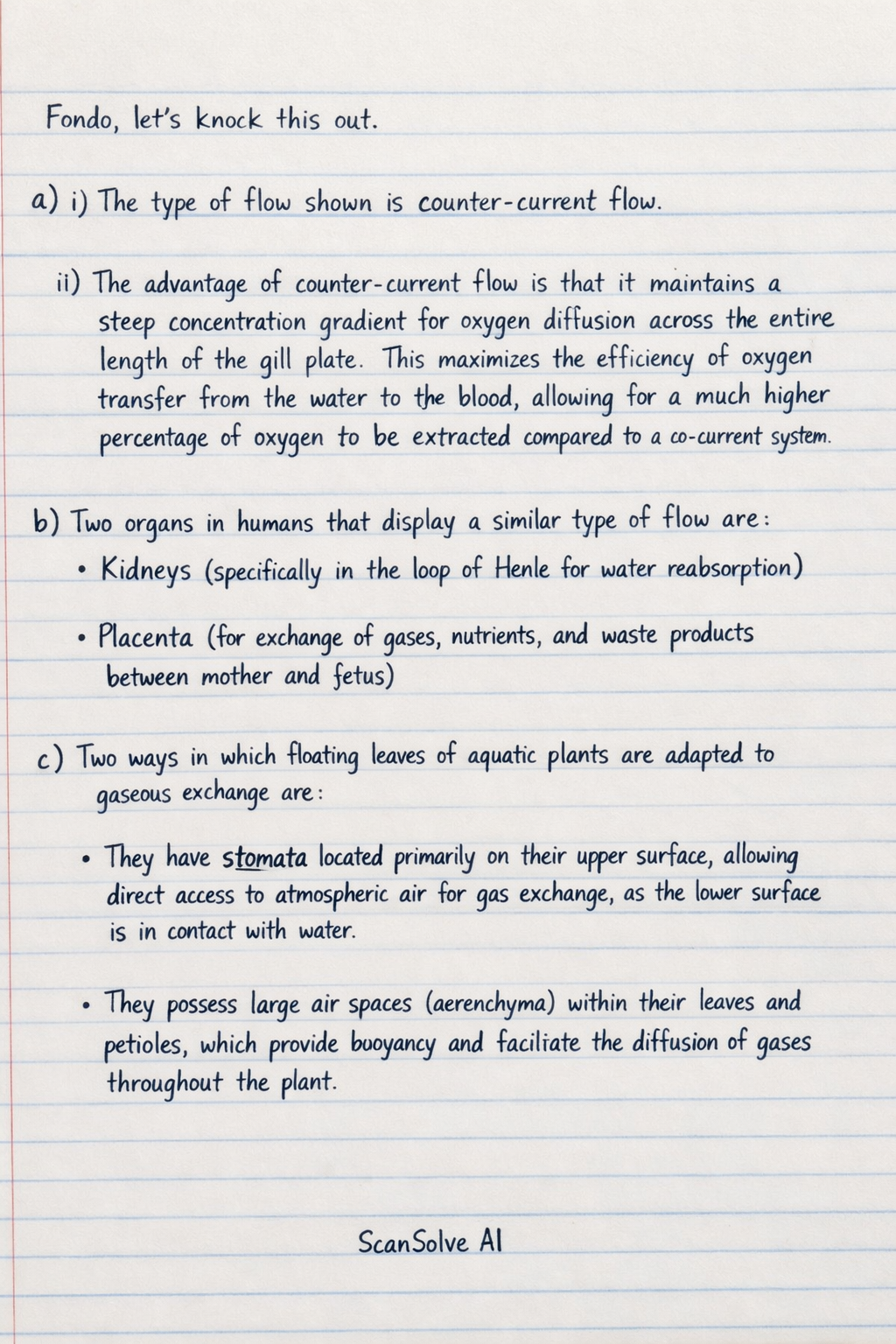
Fondo, let's knock this out. a) i) The type of flow shown is counter-current flow. ii) The advantage of counter-current flow is that it maintains a steep concentration gradient for oxygen diffusion across the entire length of the gill plate. This maximizes the efficiency of oxygen transfer from the water to the blood, allowing for a much higher percentage of oxygen to be extracted compared to a co-current system. b) Two organs in humans that display a similar type of flow are: • Kidneys (specifically in the loop of Henle for water reabsorption) • Placenta (for exchange of gases, nutrients, and waste products between mother and fetus) c) Two ways in which floating leaves of aquatic plants are adapted to gaseous exchange are: • They have stomata located primarily on their upper surface, allowing direct access to atmospheric air for gas exchange, as the lower surface is in contact with water. • They possess large air spaces (aerenchyma) within their leaves and petioles, which provide buoyancy and facilitate the diffusion of gases throughout the plant. Send me the next one 📸