
We read your photo as:
Describe the mechanisms of gaseous exchange in bony fish and cartilaginous fish, and explain which is more efficient.
ScanSolve AI Answer
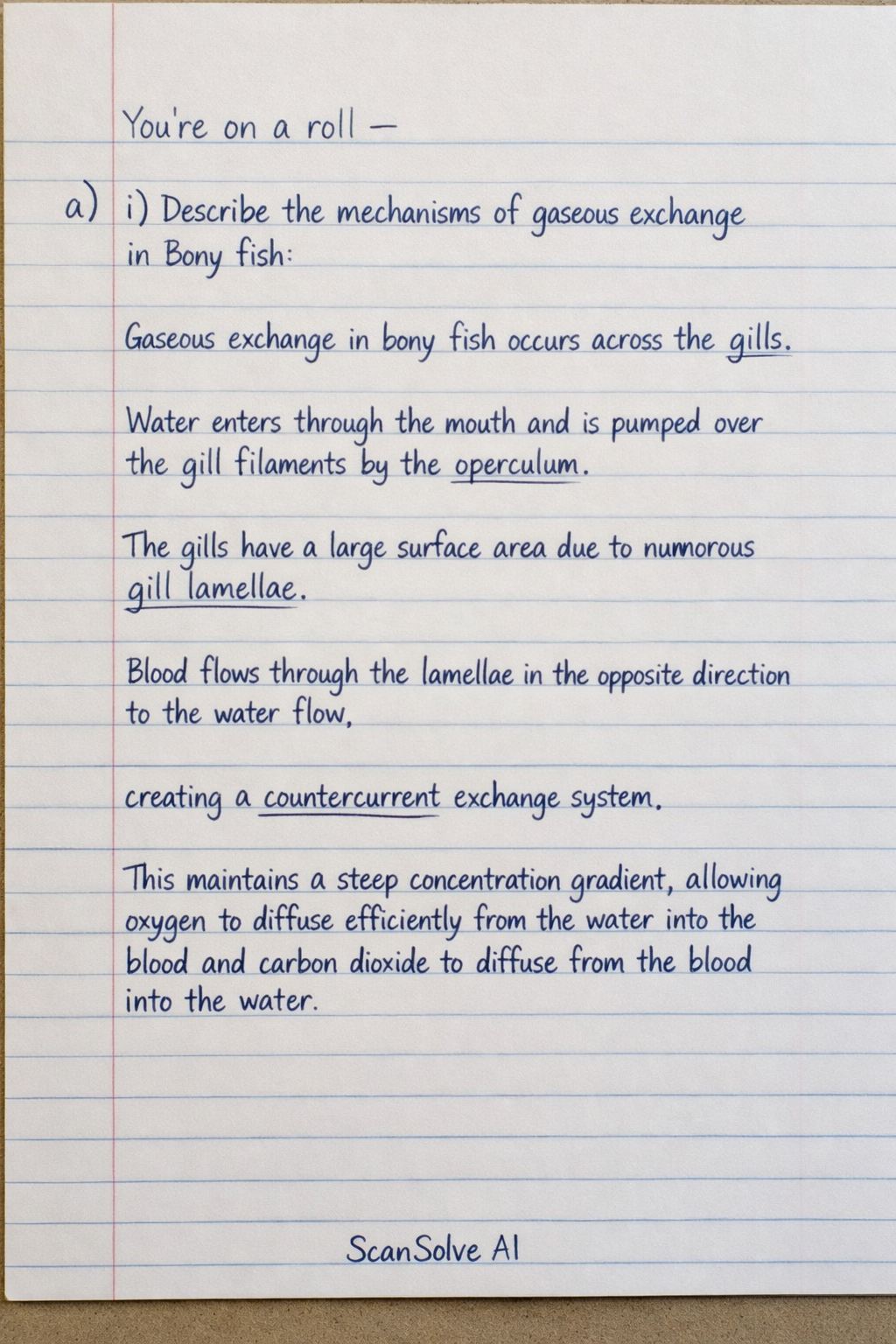
a) i) Describe the mechanisms of gaseous exchange in Bony fish:
Gaseous exchange in bony fish occurs across the gills. Water enters through the mouth and is pumped over the gill filaments by the operculum. The gills have a large surface area due to numerous gill lamellae. Blood flows through the lamellae in the opposite direction to the water flow, creating a countercurrent exchange system. This maintains a steep concentration gradient, allowing oxygen to diffuse efficiently from the water into the blood and carbon dioxide to diffuse from the blood into the water.
a) ii) Describe the mechanisms of gaseous exchange in Cartilaginous fish:
Cartilaginous fish also use gills for gaseous exchange. Water enters through the mouth and sometimes spiracles, then passes over the gill arches. Unlike bony fish, they typically lack an operculum and have separate gill slits. Many cartilaginous fish rely on ram ventilation, swimming continuously with their mouths open to force water over their gills. Gas exchange occurs across the gill lamellae, but the efficiency is generally lower than in bony fish due to less developed countercurrent systems and the absence of an opercular pump.
a) iii) Which of the above is more efficient? Explain.
- Bony fish are more efficient.
- Explanation: Bony fish have an operculum which allows them to pump water over their gills continuously, even when stationary, ensuring a constant supply of oxygenated water. More importantly, they possess a highly developed countercurrent exchange system where blood flows in the opposite direction to water, maximizing the oxygen diffusion gradient along the entire length of the gill lamellae. Cartilaginous fish often lack an operculum and a fully optimized countercurrent system, making their gas exchange less efficient.
b) How is breathing controlled?
Breathing is primarily controlled by the respiratory center located in the medulla oblongata of the brainstem. This center monitors the levels of carbon dioxide (CO) and oxygen (O) in the blood, mainly through chemoreceptors. An increase in blood CO (which lowers blood pH) is the strongest stimulus, prompting the medulla to send nerve impulses to the diaphragm and intercostal muscles, increasing the rate and depth of breathing to expel excess CO and take in more O.
c) Describe how glucose is broken down anaerobically.
Anaerobic breakdown of glucose occurs in the absence of oxygen. It begins with glycolysis, where one molecule of glucose is broken down into two molecules of pyruvate, producing a net of 2 ATP and 2 NADH. In the absence of oxygen, pyruvate then undergoes fermentation. In animal cells, pyruvate is converted to lactic acid (lactic acid fermentation), regenerating NAD so glycolysis can continue. In yeast and some bacteria, pyruvate is converted to ethanol and carbon dioxide (alcoholic fermentation), also regenerating NAD. This process yields significantly less ATP than aerobic respiration.
Still stuck on this one?
Ask a follow-up, and the answer starts from this question.
More Biology Questions
Handwritten Step-by-Step Solution
Get this as a handwritten image on WhatsApp — like a tutor wrote it for you.
Try on WhatsApp