
We read your photo as:
Describe adaptations of xerophytes to their habitat, including adaptations for reducing water loss and increasing water uptake/storage.
Biology
ScanSolve AI Answer
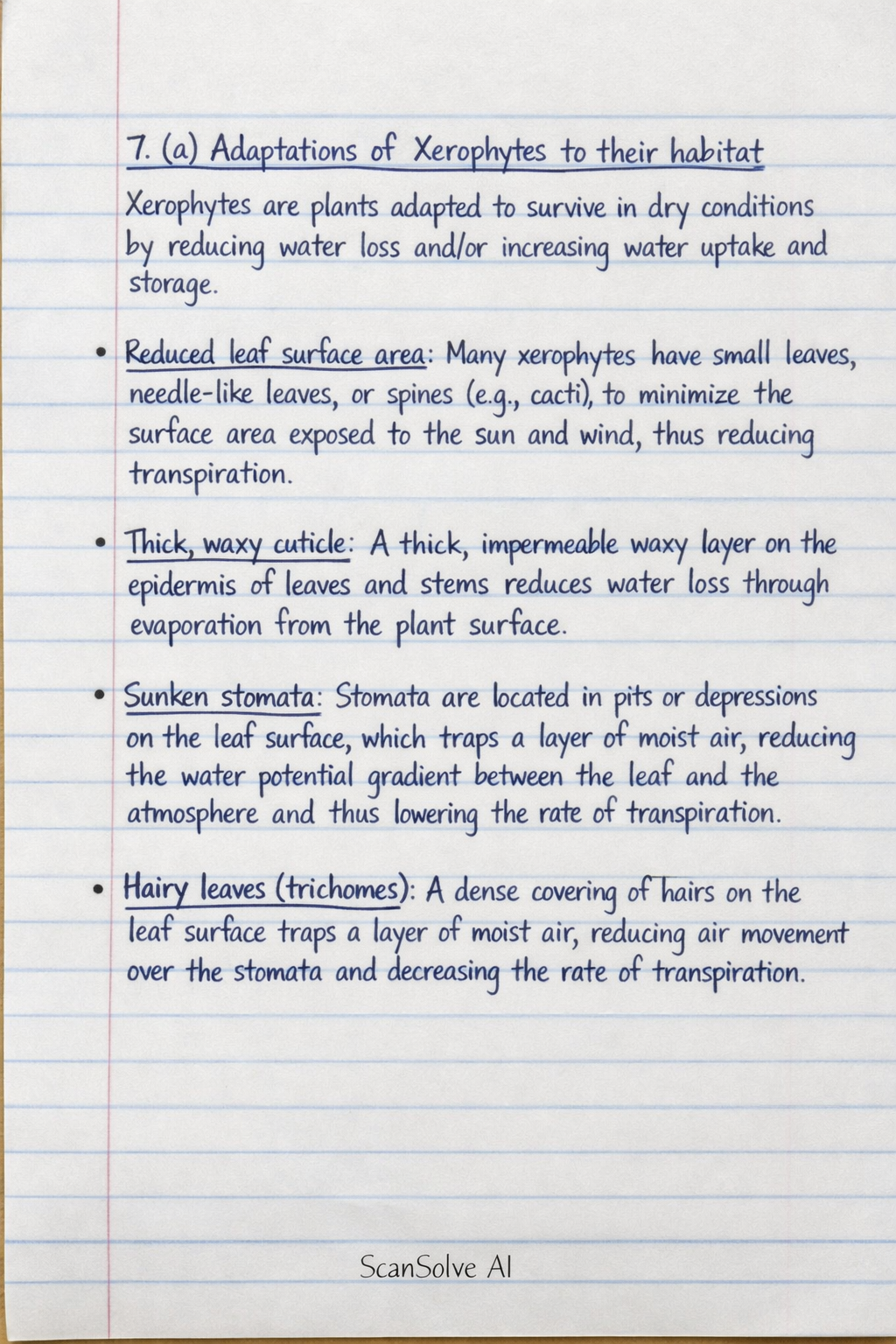
7. (a) Adaptations of Xerophytes to their habitat
Xerophytes are plants adapted to survive in dry conditions by reducing water loss and/or increasing water uptake and storage.
- Reduced leaf surface area: Many xerophytes have small leaves, needle-like leaves, or spines (e.g., cacti) to minimize the surface area exposed to the sun and wind, thus reducing transpiration.
- Thick, waxy cuticle: A thick, impermeable waxy layer on the epidermis of leaves and stems reduces water loss through evaporation from the plant surface.
- Sunken stomata: Stomata are located in pits or depressions on the leaf surface, which traps a layer of moist air, reducing the water potential gradient between the leaf and the atmosphere and thus lowering the rate of transpiration.
- Hairy leaves (trichomes): A dense covering of hairs on the leaf surface traps a layer of moist air, reducing air movement over the stomata and decreasing the rate of transpiration.
- Rolled leaves: Some xerophytes (e.g., marram grass) have leaves that roll inwards, enclosing the stomata within a humid microenvironment, which reduces water loss.
- Extensive root systems: Xerophytes often have very long taproots to reach deep groundwater or widespread shallow root systems to quickly absorb surface water after rainfall.
- Succulence: Some plants (e.g., cacti, aloes) store water in fleshy stems or leaves, allowing them to survive long periods without rainfall.
- CAM photosynthesis: Crassulacean Acid Metabolism (CAM) plants open their stomata at night to take in carbon dioxide and close them during the day, significantly reducing water loss through transpiration in hot, dry conditions.
- Shedding leaves: Some xerophytes shed their leaves during prolonged dry periods to avoid excessive water loss.
7. (b) Five environmental factors that affect the rate of transpiration
- Humidity: The rate of transpiration decreases as the humidity of the surrounding air increases. High humidity means the air already contains a lot of water vapor, reducing the water potential gradient between the leaf and the atmosphere, thus slowing down the diffusion of water vapor out of the stomata.
- Temperature: An increase in temperature generally increases the rate of transpiration. Higher temperatures increase the kinetic energy of water molecules, leading to faster evaporation from the leaf surface and a steeper water potential gradient between the leaf and the drier, warmer air.
- Wind speed: Increased wind speed increases the rate of transpiration. Wind blows away the layer of humid air that accumulates around the stomata, maintaining a steep water potential gradient between the leaf and the surrounding air, which promotes faster diffusion of water vapor.
- Light intensity: The rate of transpiration increases with increasing light intensity. Light stimulates the stomata to open to allow for carbon dioxide uptake for photosynthesis. When stomata are open, water vapor can escape, leading to higher transpiration rates.
- Soil water availability: The availability of water in the soil directly affects transpiration. If there is insufficient water in the soil, the plant cannot replace the water lost through transpiration, leading to wilting and stomatal closure, which reduces the transpiration rate.
8. Mechanism of inhalation and exhalation in humans
Inhalation (Inspiration):
Inhalation is an active process that brings air into the lungs.
- The diaphragm, a dome-shaped muscle located below the lungs, contracts and flattens, moving downwards.
- Simultaneously, the external intercostal muscles located between the ribs contract, pulling the rib cage upwards and outwards.
- These actions increase the volume of the thoracic cavity (chest cavity).
- As the volume of the thoracic cavity increases, the pressure inside the lungs (intrapulmonary pressure) decreases to a level below the atmospheric pressure.
- Due to this pressure difference, air from the higher atmospheric pressure outside the body flows into the lungs through the respiratory passages (nose/mouth, pharynx, larynx, trachea, bronchi, bronchioles) until the pressure inside the lungs equalizes with the atmospheric pressure.
Exhalation (Expiration):
Exhalation is typically a passive process during quiet breathing, expelling air from the lungs.
- The diaphragm relaxes and returns to its dome shape, moving upwards.
- The external intercostal muscles relax, allowing the rib cage to move downwards and inwards due to gravity and the elastic recoil of the lung tissue.
- These actions decrease the volume of the thoracic cavity.
- As the volume of the thoracic cavity decreases, the pressure inside the lungs (intrapulmonary pressure) increases to a level above the atmospheric pressure.
- Due to this pressure difference, air from the higher pressure inside the lungs is forced out of the body through the respiratory passages until the pressure inside the lungs equalizes with the atmospheric pressure.
- During forced exhalation (e.g., during exercise), the internal intercostal muscles contract, actively pulling the rib cage further downwards and inwards, and the abdominal muscles contract, pushing the diaphragm upwards, further decreasing thoracic volume and increasing lung pressure to expel more air.
Was this helpful?
Still stuck on this one?
Ask a follow-up, and the answer starts from this question.
Got a different question?Ask your own question
More Biology Questions
QWhat are the adaptation of xerophytesQDescribe the adaptations of various organisms like cacti, fish, and frogs to their respective…QDescribe adaptations of a leaf for photosynthesis and transpiration.QTheir adaptation to drier areasQAdaption of xerophyte to their hani
Browse by topic:Ecology
Handwritten Step-by-Step Solution
Get this as a handwritten image on WhatsApp — like a tutor wrote it for you.
Try on WhatsApp