
We read your photo as:
Design an experiment to investigate the effect of pH on catalase activity in a germinating bean seed. Include a hypothesis, identification of variables, and a data table for results.
ScanSolve AI Answer
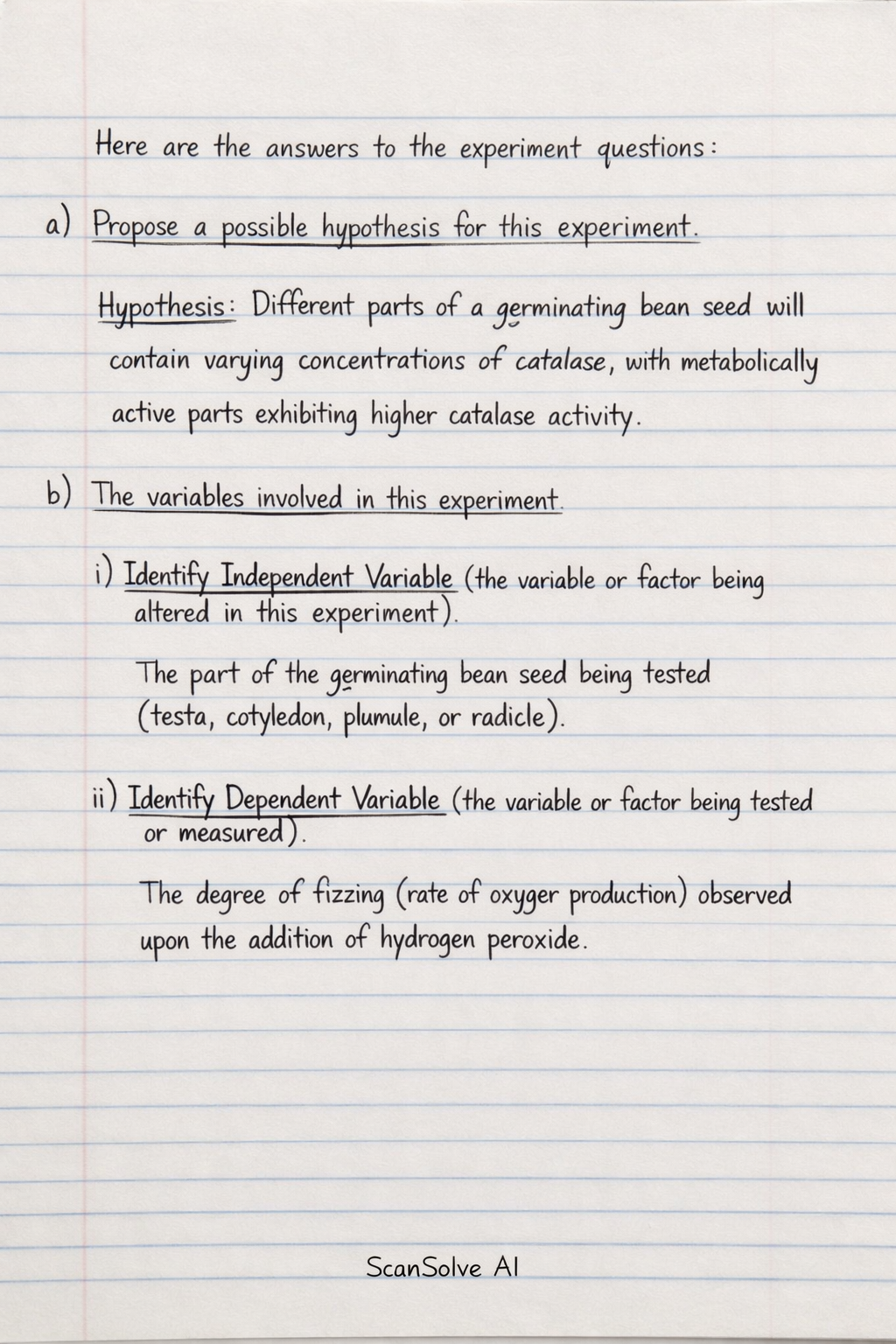
Here are the answers to the experiment questions:
a) Propose a possible hypothesis for this experiment.
Hypothesis: Different parts of a germinating bean seed will contain varying concentrations of catalase, with metabolically active parts exhibiting higher catalase activity.
b) The variables involved in this experiment
-
i) Identify Independent Variable (the variable or factor being altered in this experiment) The part of the germinating bean seed being tested (testa, cotyledon, plumule, or radicle).
-
ii) Identify Dependent Variable (the variable or factor being tested or measured) The degree of fizzing (rate of oxygen production) observed upon the addition of hydrogen peroxide.
-
iii) Identify two Controlled variables (variable or factor being kept constant during experiment)
- The volume and concentration of hydrogen peroxide added to each preparation.
- The temperature at which the reaction takes place.
- The mass or amount of tissue used from each part of the bean seed.
- The pH of the solution (if not specifically varied as an independent variable).
- The incubation time for the reaction.
c) Record your observations and results obtained using three different pH, in the table below
(Assuming the table is for recording observations at an optimal pH, e.g., pH 7, as the table structure does not allow for recording three different pH values per tissue type.)
| Catalase incubated in Solution of different pH (e.g., at optimal pH 7) | Degree of fizzing on addition of HO |
|---|---|
| Test tube A (Testa + catalase) | Very low / None |
| Test tube B (Cotyledon + catalase) | High |
| Test tube C (Plumule + catalase) | Moderate |
| Test tube C (Radicle + catalase) | Moderate |
d) Interpret the results obtained in c) above as fully as you can.
The results indicate varying levels of catalase activity in different parts of the germinating bean seed.
- The cotyledon shows the highest degree of fizzing, suggesting it has the highest concentration and activity of catalase. This is consistent with its role as a storage organ that undergoes significant metabolic activity during germination to provide energy and nutrients, producing hydrogen peroxide as a toxic byproduct that needs to be broken down.
- The plumule and radicle exhibit moderate fizzing. These are actively growing parts of the embryo, which also have high metabolic rates and thus require catalase to detoxify hydrogen peroxide.
- The testa (seed coat) shows very low or no fizzing. This is because the testa is a protective, non-metabolically active layer, and therefore has little to no need for catalase.
e) Does the result confirm or refute the hypothesis?
The results confirm the hypothesis. The hypothesis stated that catalase concentration would vary in different parts of the germinating bean seed, with metabolically active parts showing higher activity. The observations show distinct differences in fizzing (catalase activity) among the testa, cotyledon, plumule, and radicle, with the metabolically active cotyledon, plumule, and radicle showing higher activity compared to the inactive testa.
Still stuck on this one?
Ask a follow-up, and the answer starts from this question.
More Biology Questions
Handwritten Step-by-Step Solution
Get this as a handwritten image on WhatsApp — like a tutor wrote it for you.
Try on WhatsApp