
We read your photo as:
Diagram below shows two types of animals. What will these two types of animals do in cold weather?
ScanSolve AI Answer
Here are the answers to the multiple-choice questions:
-
The diagram shows a snake and a lizard, which are cold-blooded (poikilothermic) animals. In cold weather, their internal body temperature drops, causing their metabolic processes to slow down significantly. This leads to reduced activity.
- D. Movement becomes slow
-
Shafiq enters a very cold room, and his body reacts to conserve and generate heat.
- I. Less sweating occurs to reduce heat loss through evaporation. (Correct)
- II. Certain hormones (like thyroxine) are secreted to increase the body's metabolism, not decrease it, to generate heat. (Incorrect)
- III. Hair erector muscles contract, causing hairs to stand on end (piloerection), which traps a layer of insulating air to prevent heat loss. (Correct)
- IV. Skeletal muscles actively contract and relax involuntarily, causing shivering, which generates heat. (Correct) Therefore, mechanisms I, III, and IV are correct.
- D. I, III and IV
-
The diagram shows an open stoma on a leaf at 9:00 a.m., which is during the day. The primary importance of stomata being open during the day is to allow carbon dioxide to enter the leaf for photosynthesis. While water vapor also diffuses out (transpiration), the uptake of carbon dioxide is crucial for the plant's energy production.
- D. Stoma opens to allow entering of carbon dioxide
-
The question asks for the correct match of corrective mechanisms for situation M (cold environment) and N (hot environment).
- Situation M (Cold): The body conserves heat. This involves vasoconstriction (blood vessels constrict), piloerection (hairs erect), reduced sweating (sweat glands passive), and often cold diuresis (increased urine production) due to vasoconstriction and reduced sweating.
- Situation N (Hot): The body loses heat. This involves vasodilation (blood vessels dilate), hairs lying flat, increased sweating (sweat glands active), and reduced urine production to conserve water lost through sweat.
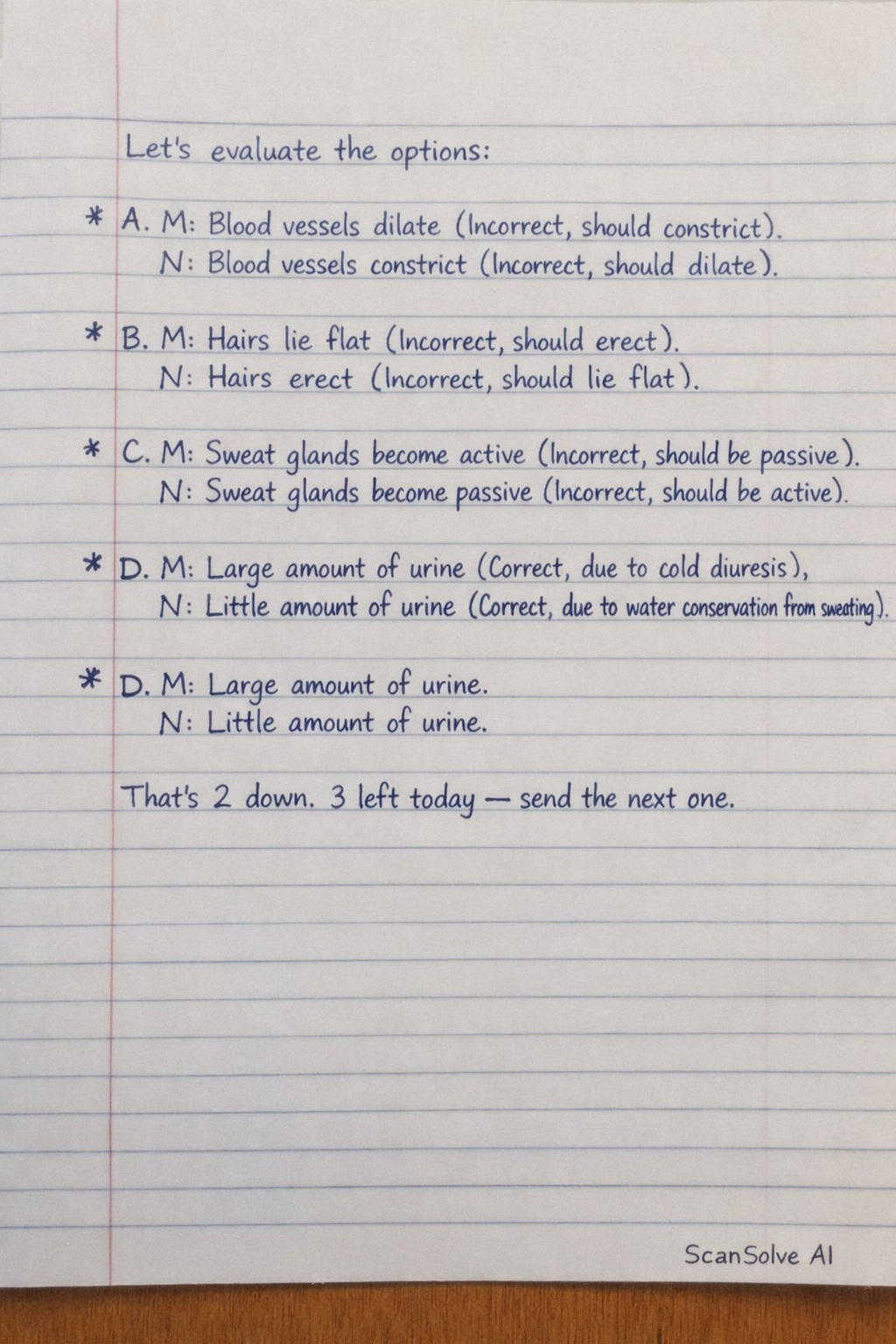
Let's evaluate the options:
- A. M: Blood vessels dilate (Incorrect, should constrict). N: Blood vessels constrict (Incorrect, should dilate).
- B. M: Hairs lie flat (Incorrect, should erect). N: Hairs erect (Incorrect, should lie flat).
- C. M: Sweat gland become active (Incorrect, should be passive). N: Sweat gland become passive (Incorrect, should be active).
- D. M: Large amount of urine (Correct, due to cold diuresis). N: Little amount of urine (Correct, due to water conservation from sweating).
- D. M: Large amount of urine. N: Little amount of urine.
Still stuck on this one?
Ask a follow-up, and the answer starts from this question.
More Biology Questions
Handwritten Step-by-Step Solution
Get this as a handwritten image on WhatsApp — like a tutor wrote it for you.
Try on WhatsApp