
We read your photo as:
Explain the differences between batch and continuous culture in microbiology. Discuss two advantages of fed-batch culture over simple batch culture.
ScanSolve AI Answer
Step-by-step solution
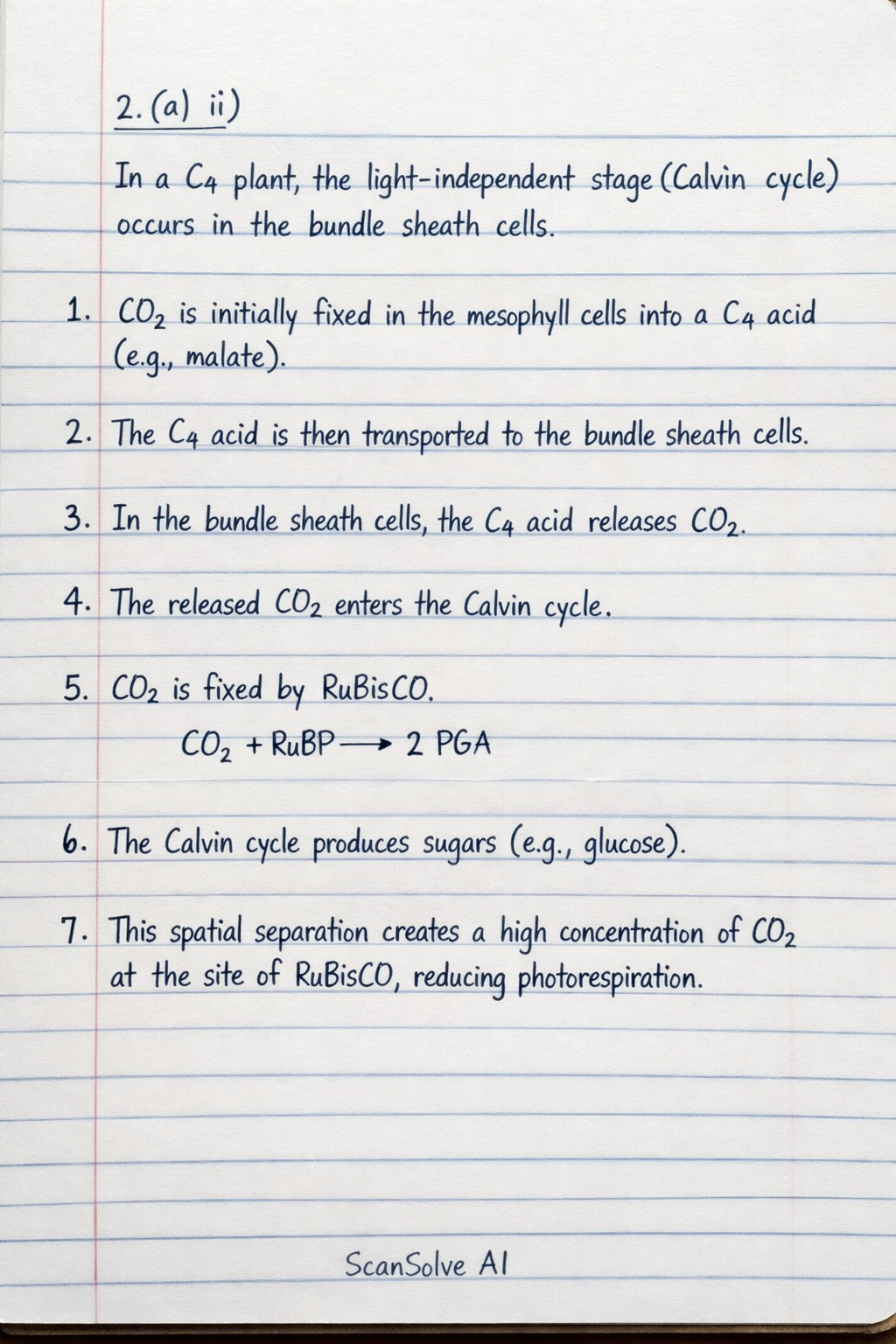
5 steps2. (a) ii) The light-independent stage (Calvin cycle) in a C4 plant occurs in the bundle sheath cells. Carbon dioxide, which was initially fixed in the mesophyll cells into a C4 acid (like malate) and then transported to the bundle sheath cells, is released from the C4 acid. This released then enters the Calvin cycle, where it is fixed by RuBisCO to produce sugars. This spatial separation ensures a high concentration of at the site of RuBisCO, minimizing photorespiration.
a) i)
Batch culture is a closed system where a fixed amount of nutrients is added at the beginning, and the microorganisms grow until nutrients are depleted or waste products become inhibitory. No fresh medium is added, and no products are removed during the fermentation. The culture typically goes through lag, exponential, stationary, and death phases.
Continuous culture is an open system where fresh medium is continuously added to the bioreactor, and an equal volume of spent medium containing cells and products is continuously removed. This maintains the culture in a steady state, often in the exponential growth phase, allowing for prolonged production.
a) ii) Two advantages of fed-batch culture over simple batch culture are:
- Higher cell density and product yield: By continuously or intermittently adding nutrients, substrate limitation is avoided, and inhibitory substrate concentrations can be prevented, leading to a longer production phase and higher biomass and product accumulation.
- Reduced accumulation of toxic by-products: The controlled addition of nutrients can prevent the rapid accumulation of metabolic by-products that might inhibit cell growth or product formation, which often occurs in simple batch cultures as nutrients are rapidly consumed.
b) i)
Restriction enzymes (also known as restriction endonucleases) are molecular scissors that recognize and cut DNA at specific nucleotide sequences called restriction sites. They are crucial for cutting both the human DNA (to isolate the insulin gene) and the bacterial plasmid DNA at specific points, often creating "sticky ends" (short single-stranded overhangs). These sticky ends are complementary, allowing the insulin gene to temporarily bind to the opened plasmid.
DNA ligase is an enzyme that acts as molecular glue. After the insulin gene has annealed to the complementary sticky ends of the plasmid, DNA ligase forms phosphodiester bonds between the sugar-phosphate backbones of the DNA fragments. This permanently joins the insulin gene into the plasmid, creating a stable recombinant plasmid.
b) ii)
The steps involved in inserting the insulin gene into a bacterial plasmid and transforming E. coli are:
Isolation of DNA**
The human gene for insulin is isolated from human cells, and a suitable plasmid (a small, circular DNA molecule) is isolated from a bacterium.
Cutting DNA**
Both the human insulin gene and the bacterial plasmid are cut with the same restriction enzyme. This enzyme recognizes a specific DNA sequence and cuts it, creating complementary "sticky ends" on both the insulin gene and the opened plasmid.
Ligation**
The isolated human insulin gene is mixed with the cut plasmid. The complementary sticky ends of the insulin gene and the plasmid anneal (base-pair). DNA ligase is then added to form phosphodiester bonds, permanently joining the insulin gene into the plasmid to create a recombinant plasmid.
Transformation**
The recombinant plasmids are introduced into E. coli bacterial cells. This process, called transformation, often involves treating the bacteria with calcium chloride and heat shock or electroporation to make their cell membranes permeable, allowing the plasmids to enter.
Selection**
The transformed E. coli cells are grown on a selective medium (e.g., containing an antibiotic if the plasmid carries an antibiotic resistance gene). Only the bacteria that have successfully taken up the plasmid will survive and multiply, forming colonies. These colonies are then screened to identify those that contain the recombinant plasmid with the insulin gene.
b) iii)
One ethical concern of using genetically engineered bacteria for insulin production is the potential for unforeseen health risks or allergic reactions in patients. Although highly purified, there could be concerns about residual bacterial components or modified proteins causing adverse effects. There are also general ethical debates about manipulating genetic material and the "naturalness" of such products.
One economic advantage for a developing country like Cameroon is the potential for local, cost-effective production of insulin. This could significantly reduce reliance on expensive imported insulin, making the life-saving drug more accessible and affordable for diabetic patients in the country. It could also stimulate local biotechnology industries and create jobs.
Still stuck on this one?
Ask a follow-up, and the answer starts from this question.
More Biology Questions
Handwritten Step-by-Step Solution
Get this as a handwritten image on WhatsApp — like a tutor wrote it for you.
Try on WhatsApp