
We read your photo as:
Explain the differences between heterochromatin and euchromatin, crossing over and gene conversion, and the effects of crossing over on gene linkage.
ScanSolve AI Answer
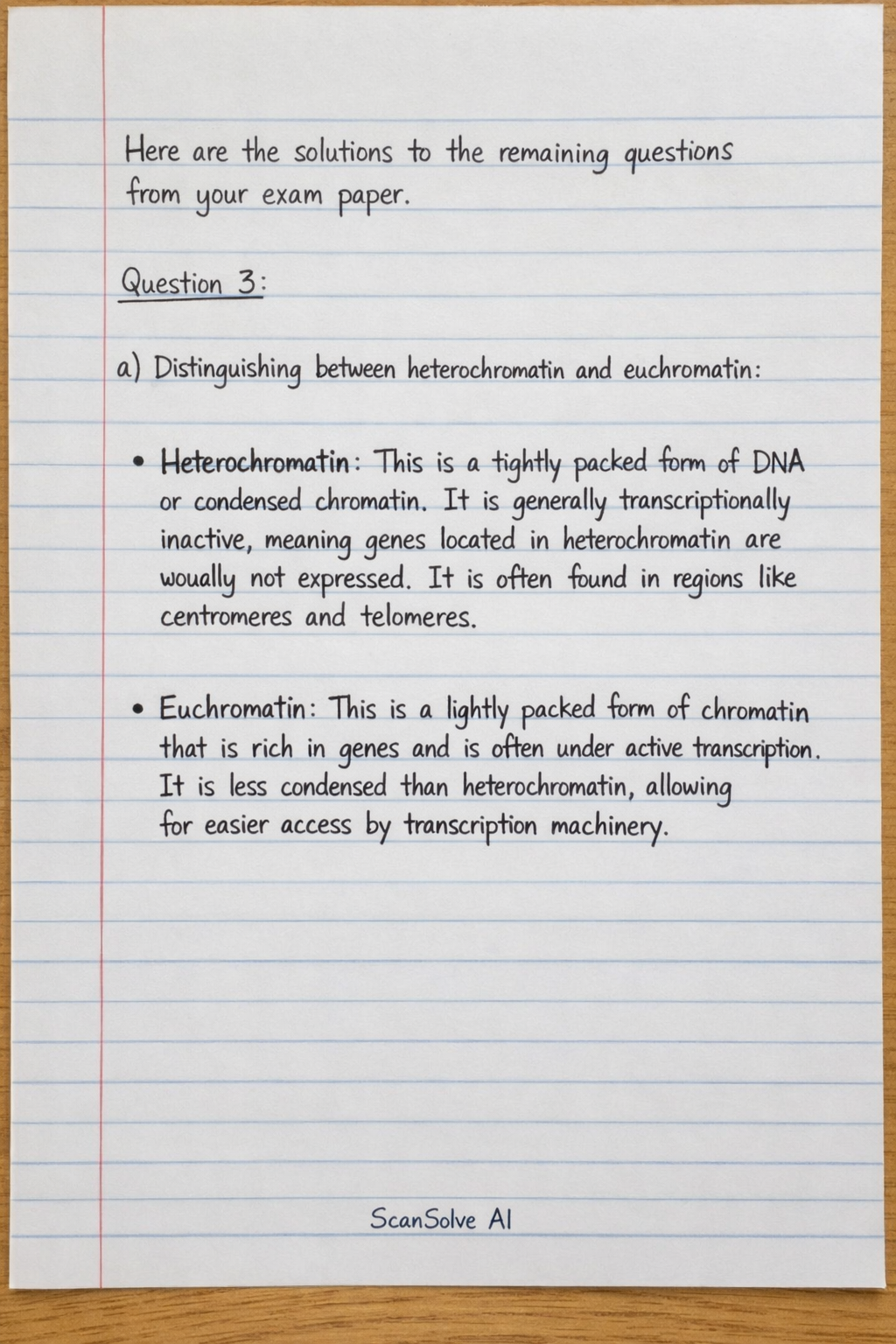
Here are the solutions to the remaining questions from your exam paper.
Question 3:
a) Distinguishing between heterochromatin and euchromatin:
- Heterochromatin: This is a tightly packed form of DNA or condensed chromatin. It is generally transcriptionally inactive, meaning genes located in heterochromatin are usually not expressed. It is often found in regions like centromeres and telomeres.
- Euchromatin: This is a lightly packed form of chromatin that is rich in genes and is often under active transcription. It is less condensed than heterochromatin, allowing for easier access by transcription machinery.
b) Distinguishing between crossing over and gene conversion:
- Crossing Over: This is the exchange of genetic material between homologous chromosomes during meiosis. It results in new combinations of alleles on the chromatids, leading to genetic recombination and increased genetic diversity.
- Gene Conversion: This is a non-reciprocal transfer of genetic information from one DNA duplex to another. It occurs when a segment of DNA from one chromosome (or chromatid) is used as a template to repair a mismatch or gap in a homologous segment on another chromosome (or chromatid), leading to one allele being converted into another. It is often associated with recombination events.
c) Discussing the effect of crossing over on proximal and distant genes/nucleotide variants:
Crossing over is a fundamental process that shuffles genetic material between homologous chromosomes.
- Proximal Genes/Variants: Genes or nucleotide variants that are located very close to each other on the same chromosome are said to be linked. Crossing over is less likely to occur between closely linked genes. Therefore, they tend to be inherited together, and their recombination frequency is low.
- Distant Genes/Variants: Genes or nucleotide variants that are located far apart on the same chromosome are more likely to be separated by a crossing over event. The further apart two genes are, the higher the probability of a crossover occurring between them, leading to a higher recombination frequency and independent assortment. This increases genetic variation in offspring.
d) A population sample has a homozygous recessive genotype (aa) proportion of 36%. Using the above information, calculate the following:
Given the proportion of homozygous recessive genotype () is 36%, which means .
We use the Hardy-Weinberg equilibrium principle, where is the frequency of the dominant allele (A) and is the frequency of the recessive allele (a).
The genotype frequencies are (AA), (Aa), and (aa).
i) The frequency of the "aa" genotype:
The frequency of the "aa" genotype is given directly.
ii) The frequency of the "a" allele:
The frequency of the "a" allele () is the square root of the frequency of the "aa" genotype ().
iii) The frequency of the "A" allele:
The sum of the frequencies of the dominant and recessive alleles must equal 1 ().
iv) The frequencies of the genotypes "AA":
The frequency of the "AA" genotype is .
Question 4:
a) Two factors that drive microevolution:
- Natural Selection: This is a process where individuals with certain heritable traits survive and reproduce at a higher rate than other individuals because of those traits. Over generations, this leads to an increase in the frequency of advantageous alleles and a decrease in the frequency of disadvantageous alleles in the population, causing evolutionary change.
- Genetic Drift: This refers to random fluctuations in allele frequencies from one generation to the next, especially pronounced in small populations. These random changes are due to chance events (e.g., random survival, reproduction, or sampling of gametes) rather than differential fitness. Genetic drift can lead to the loss of some alleles and the fixation of others, regardless of their adaptive value.
b) Ascribing a reason each to the following statements:
i) Dominant beneficial alleles are difficult to drive to fixation:
Reason: Once a dominant beneficial allele becomes common, it is mostly found in heterozygotes (e.g., Aa). In these heterozygotes, the recessive allele (a) is "hidden" from natural selection because the dominant allele (A) masks its phenotypic effect. Therefore, selection cannot completely eliminate the recessive allele, making it difficult for the dominant beneficial allele to reach 100% frequency (fixation).
ii) Dominant deleterious alleles are easily removed from the population:
Reason: Dominant deleterious alleles express their harmful phenotype even when present in a single copy (i.e., in heterozygotes). Natural selection can act strongly against individuals carrying these alleles, leading to their reduced survival or reproduction. This direct and efficient selection pressure quickly removes the allele from the population.
iii) Recessive deleterious alleles are difficult to remove from the population:
Reason: Recessive deleterious alleles only express their harmful phenotype when an individual is homozygous recessive (aa). In heterozygotes (Aa), the dominant allele masks the deleterious effect, and these individuals are often phenotypically normal. Consequently, natural selection cannot "see" and act against the allele when it is present in heterozygotes, allowing it to persist in the population at low frequencies.
c) Naming the types of centromeres found in a, b, c and d:
- a) The centromere is located at the very end of the chromosome, resulting in only one arm. This is a telocentric chromosome.
- b) The centromere is located slightly off-center, resulting in arms of unequal length, but not extremely so. This is a submetacentric chromosome.
- c) The centromere is located exactly in the middle of the chromosome, resulting in two arms of approximately equal length. This is a metacentric chromosome.
- d) The centromere is located very close to one end, resulting in one very short arm and one very long arm. This is an acrocentric chromosome.
Still stuck on this one?
Ask a follow-up, and the answer starts from this question.
More Biology Questions
Handwritten Step-by-Step Solution
Get this as a handwritten image on WhatsApp — like a tutor wrote it for you.
Try on WhatsApp