
We read your photo as:
Describe the different ways crops can be classified and the essential conditions and functions of plant parts.
Biology
ScanSolve AI Answer
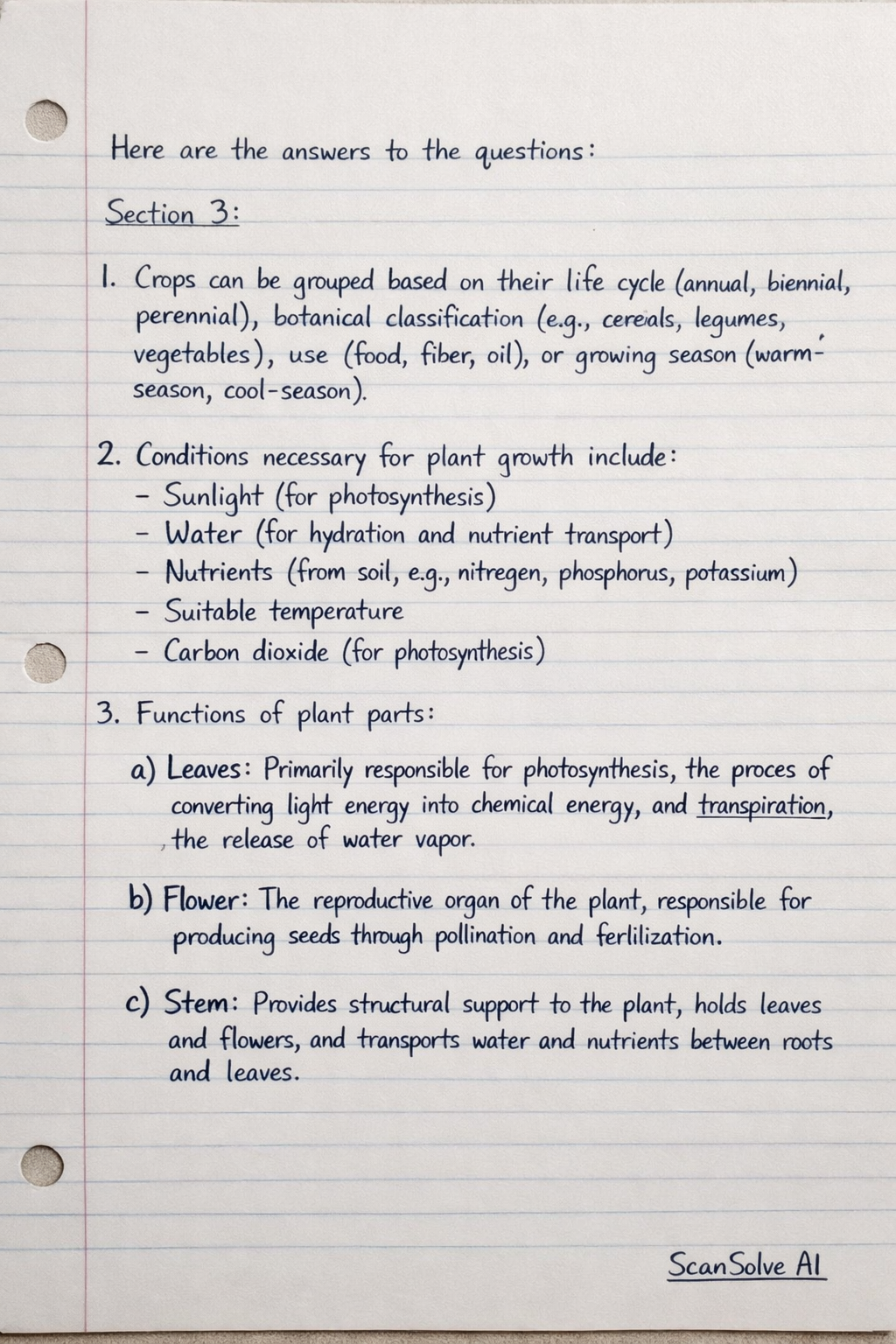
Here are the answers to the questions:
Section 3:
- Crops can be grouped based on their life cycle (annual, biennial, perennial), botanical classification (e.g., cereals, legumes, vegetables), use (food, fiber, oil), or growing season (warm-season, cool-season).
- Conditions necessary for plant growth include sunlight (for photosynthesis), water (for hydration and nutrient transport), nutrients (from soil, e.g., nitrogen, phosphorus, potassium), suitable temperature, and carbon dioxide (for photosynthesis).
- Functions of plant parts:
- a) Leaves: Primarily responsible for photosynthesis, the process of converting light energy into chemical energy, and transpiration, the release of water vapor.
- b) Flower: The reproductive organ of the plant, responsible for producing seeds through pollination and fertilization.
- c) Stem: Provides structural support to the plant, holds leaves and flowers, and transports water and nutrients between roots and leaves.
- d) Roots: Anchor the plant in the soil, absorb water and mineral nutrients, and sometimes store food.
- Plants are important because they are the primary producers in most ecosystems, providing food for nearly all life forms. They also produce oxygen, absorb carbon dioxide, prevent soil erosion, and provide materials for shelter, medicine, and fuel.
- Indigenous tree example: Oak tree (native to many temperate regions). Exotic tree example: Eucalyptus tree (native to Australia, but planted worldwide).
- Organic sources of plant nutrients include compost, manure (from livestock), green manure (cover crops tilled into soil), and bone meal.
- Two examples of small livestock are chickens and rabbits.
- Management of small livestock involves providing adequate housing (shelter from elements and predators), proper nutrition (balanced feed and water), disease prevention (vaccinations, hygiene), and breeding management.
- Small livestock are important because they provide food (meat, eggs, milk), income for small-scale farmers, and can be raised with limited space and resources. They also contribute to nutrient cycling through manure production.
- Food chain shows how plants and animal depend on each other for food.
- The components of a food chain are producers (e.g., plants), consumers (e.g., herbivores, carnivores, omnivores), and decomposers (e.g., bacteria, fungi).
- All food chains must begin with producers.
- Two examples of food chains:
- Grass Grasshopper Frog Snake Hawk
- Algae Zooplankton Small fish Large fish Seal
- Food chains are important because they illustrate the flow of energy and nutrients through an ecosystem. They show how different organisms are interconnected and dependent on each other for survival, maintaining ecological balance.
- Explanation of terms:
- a) Herbivores: Animals that feed exclusively on plants. Example: Cow.
- b) Carnivores: Animals that feed exclusively on other animals (meat). Example: Lion.
- c) Omnivores: Animals that feed on both plants and animals. Example: Human.
Section 4:
- a) Define crop rotation: Crop rotation is the practice of growing a series of different types of crops in the same area across a sequence of growing seasons.
- b) Importance of crop rotation: It helps to improve soil fertility by replenishing nutrients, reduce pest and disease outbreaks by breaking their life cycles, and control weeds.
- c) Example of crop rotation: A common rotation might involve planting corn (heavy nitrogen feeder), followed by soybeans (nitrogen-fixing legume), then wheat (a cereal crop), and finally a cover crop like clover.
- d) How pests affect crops: Pests (insects, weeds, pathogens) can damage plant tissues, reduce yields, transmit diseases, and contaminate harvests, leading to significant economic losses for farmers.
Was this helpful?
Still stuck on this one?
Ask a follow-up, and the answer starts from this question.
Got a different question?Ask your own question
More Biology Questions
QIdentify the plant part shown in the diagram and explain its features, including the function of…QWhat are the functions of different plant parts and types of plants? (Fill in the blanks, MCQs…QWhat are the characteristics of plants, seeds, and crops, and define key botanical terms related to…QWhat are crops, their importance, and examples from different plant families?QLabel the parts of a plant diagram based on the descriptions provided.
Handwritten Step-by-Step Solution
Get this as a handwritten image on WhatsApp — like a tutor wrote it for you.
Try on WhatsApp