
We read your photo as:
Differentiate between Macro-nutrients and Micro-nutrients, state two plant growth requirements and outline two uses of Sulphur in plant growth and development.
ScanSolve AI Answer
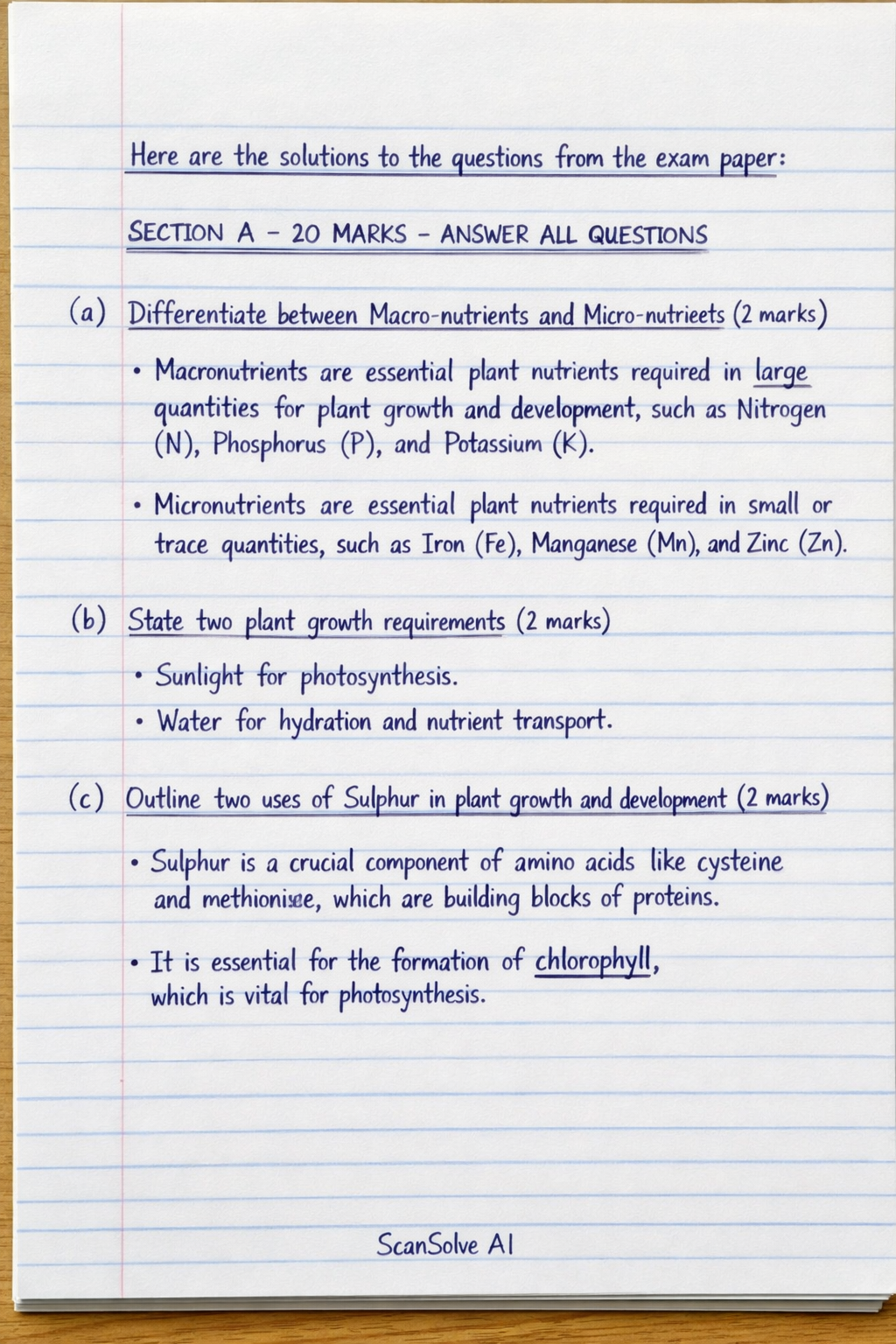
Here are the solutions to the questions from the exam paper:
SECTION A - 20 MARKS - ANSWER ALL QUESTIONS
QUESTION ONE
(a) Differentiate between Macro-nutrients and Micro-nutrients (2 marks)
- Macronutrients are essential plant nutrients required in large quantities for plant growth and development, such as Nitrogen (N), Phosphorus (P), and Potassium (K).
- Micronutrients are essential plant nutrients required in small or trace quantities, such as Iron (Fe), Manganese (Mn), and Zinc (Zn).
(b) State two plant growth requirements (2 marks)
- Sunlight for photosynthesis.
- Water for hydration and nutrient transport.
(c) Outline two uses of Sulphur in plant growth and development (2 marks)
- Sulphur is a crucial component of amino acids like cysteine and methionine, which are building blocks of proteins.
- It is essential for the formation of chlorophyll, which is vital for photosynthesis.
QUESTION TWO
(a) State three ways in which nutrients are transported in the soil (3 marks)
- Mass flow: Nutrients move with the flow of water towards plant roots as the plant transpires.
- Diffusion: Nutrients move from areas of high concentration in the soil solution to areas of lower concentration near the root surface.
- Root interception: Plant roots grow and physically encounter nutrient ions in the soil as they explore new soil volumes.
(b) Outline five factors affecting nutrient availability and uptake by plants (5 marks)
- Soil pH: Affects the solubility and chemical form of nutrients, influencing their availability.
- Soil organic matter: Provides a reservoir of nutrients and improves soil structure, enhancing nutrient retention and release.
- Soil moisture: Essential for dissolving nutrients and facilitating their transport to roots via mass flow and diffusion.
- Soil temperature: Influences root growth, microbial activity, and the rate of nutrient uptake by plants.
- Soil aeration: Adequate oxygen is necessary for root respiration and active nutrient absorption.
QUESTION THREE
(a) State four approaches of integrated soil fertility management (4 marks)
- Combining organic and inorganic nutrient sources (e.g., using both manure and synthetic fertilizers).
- Optimizing nutrient cycling through practices like returning crop residues to the soil and cover cropping.
- Managing soil acidity or alkalinity through liming or other amendments to maintain optimal pH.
- Using improved crop varieties that are more efficient in nutrient uptake and utilization.
(b) Outline two objectives of Climate Smart Agriculture (2 marks)
- To sustainably increase agricultural productivity and incomes to meet food security and development goals.
- To adapt and build resilience to climate change by reducing the vulnerability of agriculture to its impacts.
SECTION B - 30 MARKS - ANSWER ANY TWO QUESTIONS
QUESTION FOUR
(a) Discuss various methods of fertilizer application that can be used in the College farm (12 marks)
- Broadcasting: This method involves spreading fertilizer uniformly over the entire field surface, either manually or using mechanical spreaders. It is suitable for crops with high nutrient demands or when general soil fertility needs improvement. However, it can lead to nutrient losses through runoff or volatilization.
- Band Placement: Fertilizer is applied in narrow bands near the seed or plant row, either at planting (starter fertilizer) or as a side-dressing to established plants. This method concentrates nutrients in the root zone, making them more accessible to young plants and reducing fixation by soil particles.
- Foliar Application: Soluble fertilizers are dissolved in water and sprayed directly onto the leaves of plants. Nutrients are absorbed through the stomata and cuticle. This method is effective for quickly correcting micronutrient deficiencies or when soil conditions limit root uptake, but it provides only small amounts of nutrients.
- Fertigation: This involves applying soluble fertilizers through an irrigation system (e.g., drip irrigation, sprinklers). It allows for precise and timely delivery of nutrients directly to the root zone, improving nutrient use efficiency and reducing labor requirements.
- Deep Placement: Fertilizer is placed deep in the soil, below the surface, often for nutrients like phosphorus and potassium that are less mobile. This method ensures nutrients are available to deeper roots and minimizes surface runoff and volatilization losses.
(b) Explain three classes of fertilizers (3 marks)
- Straight Fertilizers: These fertilizers contain only one primary plant nutrient. Examples include Urea (for Nitrogen), Single Superphosphate (for Phosphorus), and Muriate of Potash (for Potassium).
- Compound Fertilizers: These fertilizers contain two or more primary plant nutrients (N, P, K) in a single granule or mixture, manufactured through a chemical process. An example is NPK 15-15-15, which provides equal proportions of Nitrogen, Phosphorus, and Potassium.
- Organic Fertilizers: These are derived from natural sources such as plant residues, animal manures, compost, or bone meal. They release nutrients slowly as they decompose, improving soil structure and microbial activity.
QUESTION FIVE
(a) Explain three pillars of Climate Smart Agriculture (6 marks)
- Sustainably increasing agricultural productivity and incomes: This pillar focuses on enhancing food production and improving the livelihoods of farmers, especially smallholders, by adopting practices that increase yields and efficiency without degrading natural resources.
- Adapting and building resilience to climate change: This involves implementing strategies that help agricultural systems cope with the adverse effects of climate change, such as droughts, floods, and extreme temperatures. Examples include using drought-resistant crop varieties and improved water management.
- Reducing and/or removing greenhouse gas emissions: This pillar aims to mitigate agriculture's contribution to climate change by decreasing emissions of greenhouse gases (like methane and nitrous oxide) and enhancing carbon sequestration in soils and biomass through practices like improved nutrient management and agroforestry.
(b) Discuss the conservation tillage practices carried out during Conservation Agriculture practices (8 marks)
Conservation tillage practices are fundamental to Conservation Agriculture, aiming to minimize soil disturbance and maintain crop residue cover.
- No-till (or Zero Tillage): This is the most intensive form of conservation tillage where crops are planted directly into undisturbed soil, leaving the previous crop's residues on the surface. It significantly reduces soil erosion, improves soil structure, and conserves soil moisture.
- Reduced Tillage: This encompasses any tillage system that leaves at least 30% of the soil surface covered with crop residue after planting. It involves less intensive soil disturbance compared to conventional tillage, often using implements like chisel plows or field cultivators instead of moldboard plows.
- Strip Tillage: In this practice, only narrow strips of soil where the crop will be planted are tilled, leaving the areas between rows undisturbed and covered with residue. This allows for targeted seedbed preparation while retaining the benefits of residue cover in the inter-row spaces.
- Ridge Tillage: Crops are planted on permanent ridges, with crop residues left in the furrows between the ridges. Tillage is limited to preparing the top of the ridge for planting, which helps in warming the soil and improving drainage in some areas.
(c) Outline one importance of conservation agriculture (1 mark)
- Conservation agriculture significantly reduces soil erosion by maintaining a protective cover of crop residues on the soil surface and minimizing soil disturbance.
Still stuck on this one?
Ask a follow-up, and the answer starts from this question.
More Biology Questions
Handwritten Step-by-Step Solution
Get this as a handwritten image on WhatsApp — like a tutor wrote it for you.
Try on WhatsApp