
We read your photo as:
Analyze the relationship between the conditions of the green houses and the grow and physiological traits of the tomatoes. Justify the recommendation of the agricultural officer and advise the farmers.
ScanSolve AI Answer
Step-by-step solution
6 stepsPart a· 4 steps
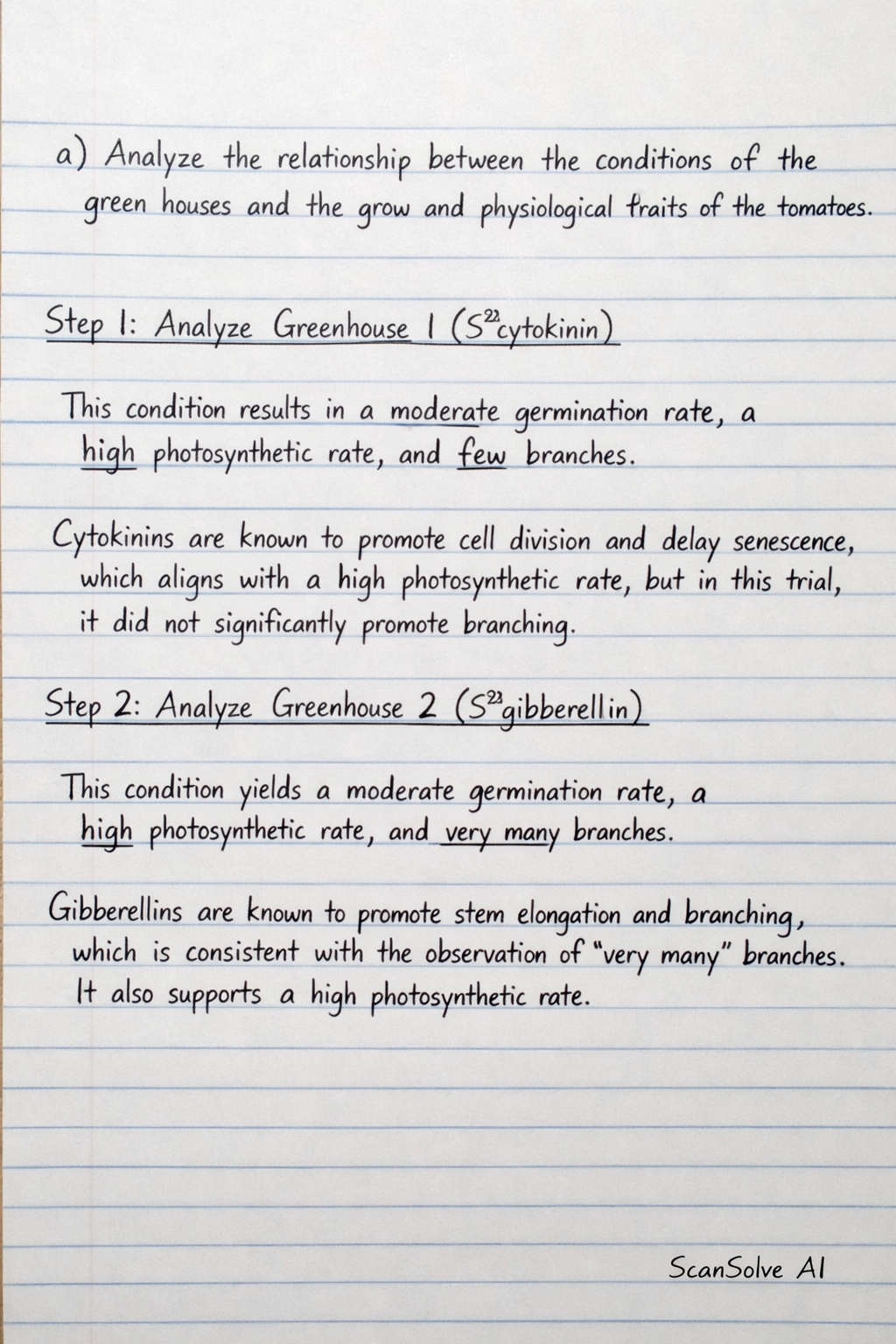
Analyze the relationship between the conditions of the green houses and the grow and physiological traits of the tomatoes.
Analyze Greenhouse 1 (S^2^cytokinin)
This condition results in a moderate germination rate, a high photosynthetic rate, and few branches. Cytokinins are known to promote cell division and delay senescence, which aligns with a high photosynthetic rate, but in this trial, it did not significantly promote branching.
Analyze Greenhouse 2 (S^2^gibbberellin)
This condition yields a moderate germination rate, a high photosynthetic rate, and very many branches. Gibberellins are known to promote stem elongation and branching, which is consistent with the observation of "very many" branches. It also supports a high photosynthetic rate.
Analyze Greenhouse 3 (25% taxine)
This condition leads to a moderate germination rate, a low photosynthetic rate, and few branches. Taxine appears to be detrimental to both photosynthetic activity and branching, indicating it is not suitable for optimal tomato growth.
Analyze Greenhouse 4 (25% gibbberellin)
This condition results in a high germination rate, a low photosynthetic rate, and many branches. While it promotes high germination and branching, the photosynthetic rate is significantly reduced compared to Greenhouse 1 and 2, suggesting that this specific concentration or formulation of gibberellin might have a trade-off effect on photosynthesis.
Summary of relationships:
- Cytokinin (S^2^): Promotes high photosynthetic rate but limits branching.
- Gibberellin (S^2^): Promotes high photosynthetic rate and extensive branching.
- Gibberellin (25%): Promotes high germination and many branches, but leads to a low photosynthetic rate.
- Taxine (25%): Detrimental to photosynthetic rate and branching.
Part b· 2 steps
Justify the recommendation of the agricultural officer and advise the farmers.
Justify the recommendation.
The agricultural officer's recommendation that "the conditions for greenhouse should not be kept constant throughout" is justified because no single set of conditions in the trial optimized all desirable growth traits simultaneously. For example, Greenhouse 4 provides the best germination rate but a low photosynthetic rate, while Greenhouse 2 offers the best branching and high photosynthesis but only a moderate germination rate. To achieve the best overall yield, different conditions are needed at different stages of the plant's life cycle.
Advise the farmers on implementation.
Farmers should implement a phased approach to greenhouse conditions:
- For germination: Start with conditions similar to Greenhouse 4 (25% gibberellin) to ensure a high germination rate.
- For vegetative growth and branching: Once seedlings have emerged, switch to conditions similar to Greenhouse 2 (S^2^gibbberellin) to promote very many branches and maintain a high photosynthetic rate, which are crucial for fruit production.
- Avoid taxine: Conditions like Greenhouse 3 (25% taxine) should be avoided entirely as they negatively impact photosynthesis and branching.
- Consider cytokinin: Conditions like Greenhouse 1 (S^2^cytokinin) could be used to maintain a high photosynthetic rate, especially if excessive branching is not desired or needs to be controlled.
This dynamic management of conditions will allow farmers to optimize each stage of tomato growth, leading to better overall yields.
Still stuck on this one?
Ask a follow-up, and the answer starts from this question.
More Biology Questions
Handwritten Step-by-Step Solution
Get this as a handwritten image on WhatsApp — like a tutor wrote it for you.
Try on WhatsApp